The Body and the Court
Digital edition
Ships in 2 to 5 working days. Delivery quoted from your address at checkout.
4,186 words · no email, no account
No. 013 · Sport · Tennis
a biography of Arthur Robert Ashe Jr.
He was born on July 10, 1943, in Richmond, Virginia, into a country in which a Black tennis prodigy was not allowed to enter the city's main public courts. He won the U.S. Open at twenty-five, Wimbledon at thirty-one, and an honorary doctorate from Yale at thirty-six. He received a contaminated blood transfusion during double bypass surgery in 1983. He died of AIDS-related pneumonia on February 6, 1993, at forty-nine.
Roland Mercer's biography opens with the Brook Field segregation and the Lynchburg coaching of Dr. Robert Walter Johnson, follows the arc through UCLA on a full scholarship, the 1968 U.S. Open (open era's first), the 1970 South African visa denial and the long anti-apartheid campaign, the 1975 Wimbledon five-set defeat of Jimmy Connors, the 1979 first heart attack and 1983 second bypass, the 1988 brain-infection diagnosis and HIV-positive serology, the 1992 USA Today outing that forced him to disclose his status, the 1992 founding of the Arthur Ashe Institute for Urban Health, the September 1992 White House arrest for protesting U.S. Haitian-refugee policy, and the death five months later.
What emerges is a portrait of an African-American tennis champion whose career the country let him play in white tournaments and whose death the country let him be the most prominent HIV-positive man of his generation.
The opening chapter is published in full — read it here.
The printed edition has no ISBN registered yet. It affects library and retail listing, not your order.
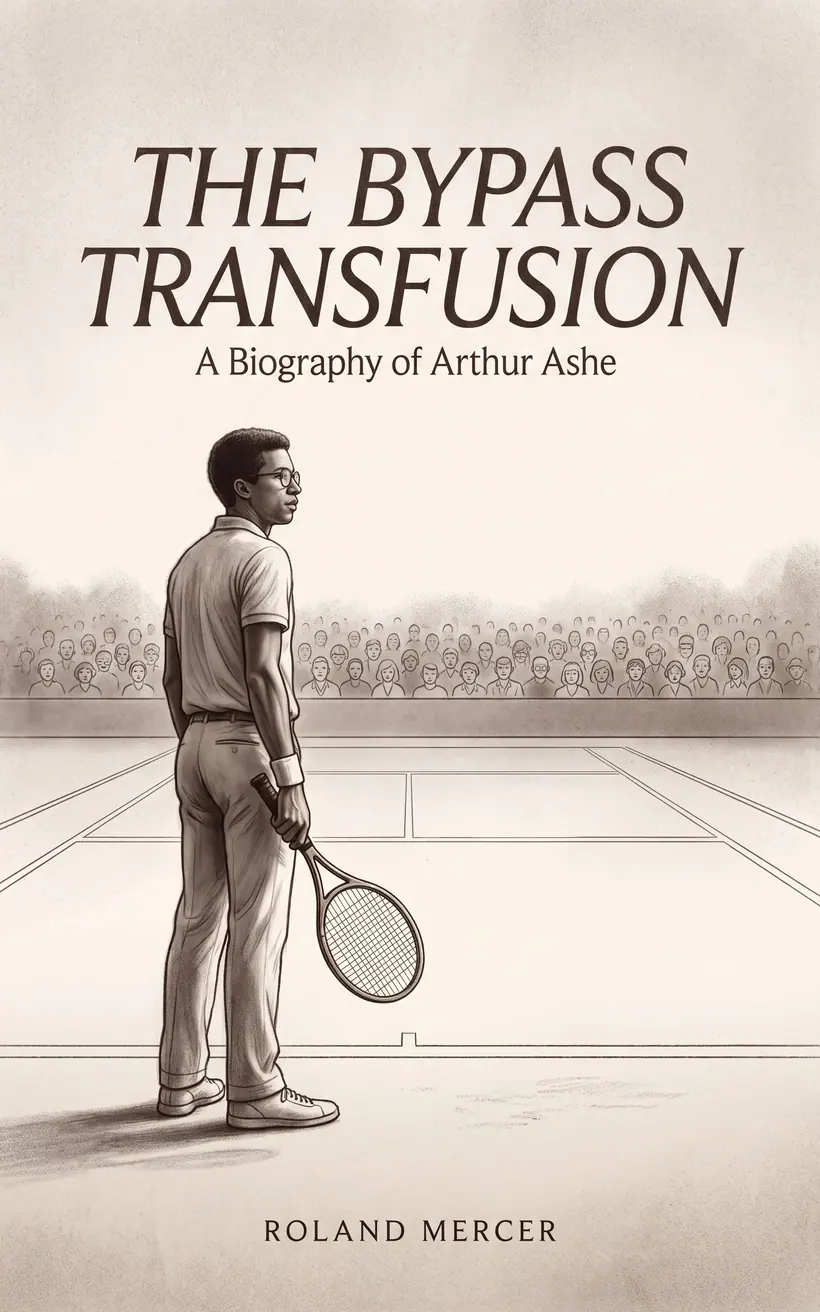
Arthur Robert Ashe Jr.. The title never carries the subject's name: it names one concrete thing out of the life — in this case The Bypass Transfusion — and the name goes on the line underneath.
No. No subject, estate, label or foundation had approval over the text, and none paid for a word of it. The cost of that independence is that no new interviews were conducted for the book; it is built from the public record, and it says on the page where a scene is reconstructed rather than documented.
Yes — the whole opening chapter and the writer's foreword, free and in full, with no email address and no account. That is 4,186 words of the book.
About 61,500 words, 18 chapters, 185 pages in the paperback.
6 × 9 in, 60# uncoated cream, black ink, perfect-bound paperback, matte laminate. Every title in the series uses the same specification, so they line up on a shelf.
Digital edition