The Honduran Crash
Paperback · Hardcover
Ships in 2 to 5 working days. Delivery quoted from your address at checkout.
3,336 words · no email, no account
No. 055 · Music · Hip-Hop
a biography of Ermias Joseph Asghedom
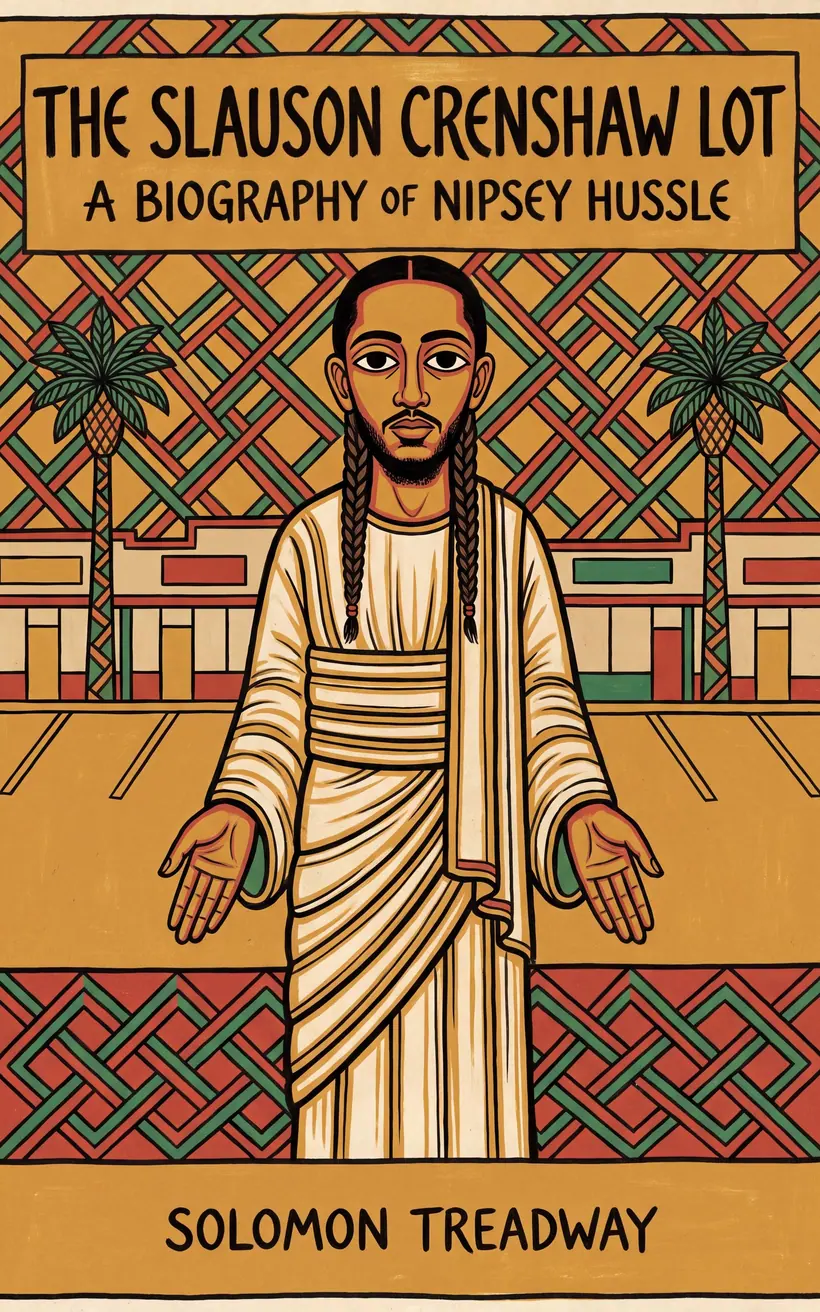
On a Sunday afternoon in March 2019, a man stood outside his own clothing store on Slauson Avenue, in the Crenshaw neighborhood where he had spent his whole life. He was thirty-three. He had just been nominated for a Grammy. Within minutes he would be dead on the pavement of the corner he had refused to leave.
Ermias Asghedom — known to the world as Nipsey Hussle — spent more than a decade building something the music industry could neither categorize nor contain. The son of an Eritrean refugee and a Black American mother, he came up through the Rollin' 60s, sold his debut mixtape out of the trunk of a car for a hundred dollars a copy, and turned a strip-mall storefront into a blueprint for neighborhood ownership. He called it the marathon. The pace was the point.
Solomon Treadway traces that long run from its first mile: the South Central of the eighties and nineties, the cousins lost and the cousins still here, the Eritrea trip that rearranged a young man's idea of what a Black man could inherit, the slow construction of Marathon Clothing and the Vector90 co-working space, the deals signed and the deals walked away from.
What emerges is a portrait of a particular kind of American ambition — patient, communal, rooted to a single intersection — and an accounting of what was built, and what was taken, in the space of one short life.
The opening chapter is published in full — read it here.
The printed edition has no ISBN registered yet. It affects library and retail listing, not your order.
Ermias Joseph Asghedom. The title never carries the subject's name: it names one concrete thing out of the life — in this case The Slauson Crenshaw Lot — and the name goes on the line underneath.
No. No subject, estate, label or foundation had approval over the text, and none paid for a word of it. The cost of that independence is that no new interviews were conducted for the book; it is built from the public record, and it says on the page where a scene is reconstructed rather than documented.
Yes — the whole opening chapter and the writer's foreword, free and in full, with no email address and no account. That is 3,336 words of the book.
About 64,000 words, 19 chapters, 184 pages in the paperback.
6 × 9 in, 60# uncoated cream, black ink, perfect-bound paperback, matte laminate. Every title in the series uses the same specification, so they line up on a shelf.
Yes: gun violence; homicide. They are listed before you buy rather than discovered afterwards. The material is handled as evidence, not as spectacle.
Listed before you buy, not after.
Paperback · Hardcover
Paperback
Paperback · Hardcover