Download link emailed the moment payment clears.
4,334 words · no email, no account
No. 098 · Letters & Ideas · Philosophy
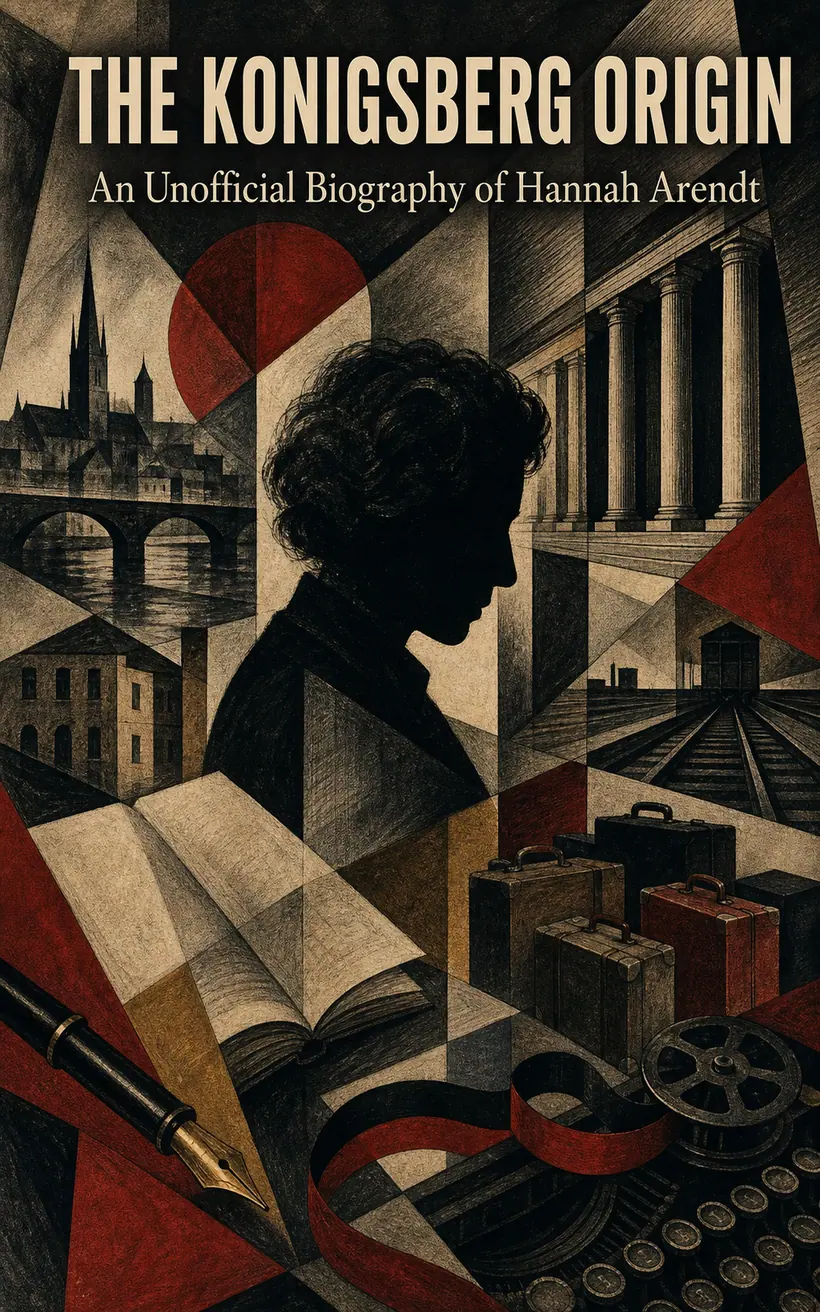
The Konigsberg Origin
a biography of Johanna 'Hannah' Arendt
What the book is
She reported on the Eichmann trial and lost most of her surviving German-Jewish friends. The reportage ran in the New Yorker and became Eichmann in Jerusalem in 1963. The phrase it produced — "the banality of evil" — outlived the argument that followed it, and the argument is still going: sixty years on, the field has not finished having it. Eleanor Whitlock's biography sets that quarrel back inside the whole life it came out of.
Johanna Arendt was the only child of secular Jewish parents, born on October 14, 1906, in Linden, near Hanover, and raised in Königsberg. She read philosophy at Marburg under Martin Heidegger, with whom she began a four-year affair at eighteen; at Freiburg under Edmund Husserl; and at Heidelberg under Karl Jaspers, who supervised her 1929 doctoral thesis on the concept of love in Augustine. In 1933, after a brief Gestapo detention for documenting anti-Semitic propaganda, she left Germany. Seven years in Paris followed, working with the Youth Aliyah. In 1940 the Vichy government interned her in the camp at Gurs. She escaped, and reached New York by way of Lisbon in May 1941.
The American decades produced the work. Whitlock follows the long years of journalism for Aufbau and the Jewish Cultural Reconstruction project with Salo Baron, the publication of The Origins of Totalitarianism in 1951 and The Human Condition in 1958, the 1961 trial and the 1963 controversy that estranged her from most of her surviving German-Jewish friends, and the long second marriage to Heinrich Blücher. On December 4, 1975, at sixty-nine, she died of a heart attack at her Riverside Drive apartment, mid-conversation with friends.
What emerges is a portrait of the most consequential political philosopher of the second half of the twentieth century — and of the argument her Eichmann book opened, which her own field has yet to close.
At a glance
- Subject
- Johanna 'Hannah' Arendt
- Shelf
- Letters & Ideas · Philosophy
- Written by
- Eleanor Whitlock
- Chapters
- 18 across 198 pages
- Narrated by
- Edmund Hartley
- Editions
- EPUB · Audiobook
- Authorisation
- Unauthorised — no subject, estate or label had approval over the text.
Contents · 18 chapters
- 01The Girl from HanoverRead free
- 02The Magician of Marburg3,014 words
- 03The Shadow Falls4,130 words
- 04The Trap3,599 words
- 05New York, New World3,019 words
- 06The Origins3,067 words
- 07Becoming American3,030 words
- 08The Human Condition3,576 words
- 09Between Past and Future3,423 words
- 10Jerusalem3,085 words
- 11The Banality of Evil3,586 words
- 12The Cost of Thinking3,109 words
- 13Crises of the Republic2,720 words
- 14The Life of the Mind2,936 words
- 15Amor Mundi3,001 words
- 16The Last Year3,151 words
- 17The Afterlife3,207 words
- 18Thinking Without a Banister3,622 words
The opening chapter is published in full — read it here.
Editions
- EPUB · $3.99
- EPUB 3 · DRM-free · reads on Kindle, Kobo and Apple Books
ISBN 979-8-90623-496-4 - Audiobook · $5.99
- Unabridged · measured from the masters · read by Edmund Hartley
ISBN 979-8-90623-583-1
Questions
01Who is The Konigsberg Origin about?
Johanna 'Hannah' Arendt. The title never carries the subject's name: it names one concrete thing out of the life — in this case The Konigsberg Origin — and the name goes on the line underneath.
02Is this an authorised biography?
No. No subject, estate, label or foundation had approval over the text, and none paid for a word of it. The cost of that independence is that no new interviews were conducted for the book; it is built from the public record, and it says on the page where a scene is reconstructed rather than documented.
03Can I read some of it before buying?
Yes — the whole opening chapter and the writer's foreword, free and in full, with no email address and no account. That is 4,334 words of the book.
04How long is it?
About 60,000 words, 18 chapters, 198 pages in the paperback.