The Lanai Purchase
Paperback
Download link emailed the moment payment clears.
5,322 words · no email, no account
No. 101 · Technology & Money · Technology
a biography of Samuel Harris Altman
November 17, 2023, 11:53 a.m. Pacific Time. The OpenAI board of directors fires Sam Altman as chief executive officer. The text of their statement says he has "not been consistently candid in his communications." Five days later — after a near-total employee revolt (743 of 770 OpenAI employees sign a letter threatening to follow Altman to Microsoft) and a long weekend of mediation — Altman is reinstated, the board is reconstituted with new outside directors, and an internal investigation conducted by WilmerHale concludes in March 2024 that the board's decision-making process was "unreasonable." Altman has since launched GPT-5 (March 2025) and raised an additional $40 billion at a $300 billion post-money valuation.
Sterling Aldridge's biography opens earlier — in Clayton, Missouri, where Samuel Harris Altman was born in 1985, the eldest of four children of a real-estate developer and a dermatologist — and follows the arc through the Burroughs School, the Stanford computer-science dropout, the 2005 Loopt founding through Y Combinator's second batch, the seven-year Loopt run and the Green Dot acquisition, the YC presidency (2014-2019), the Helion Energy and Worldcoin founding, the OpenAI 2015 founding with Elon Musk and Greg Brockman and Ilya Sutskever, the 2019 Musk departure, the Microsoft $1 billion investment, the November 2022 launch of ChatGPT, and the November 2023 five-day firing.
What emerges is a portrait of the Stanford-dropout founder whose twenty-year ascent through the Silicon Valley founder track has made him the de facto public face of contemporary artificial intelligence — and the November 2023 board crisis that the company and the industry have spent the years since trying to absorb.
The opening chapter is published in full — read it here.
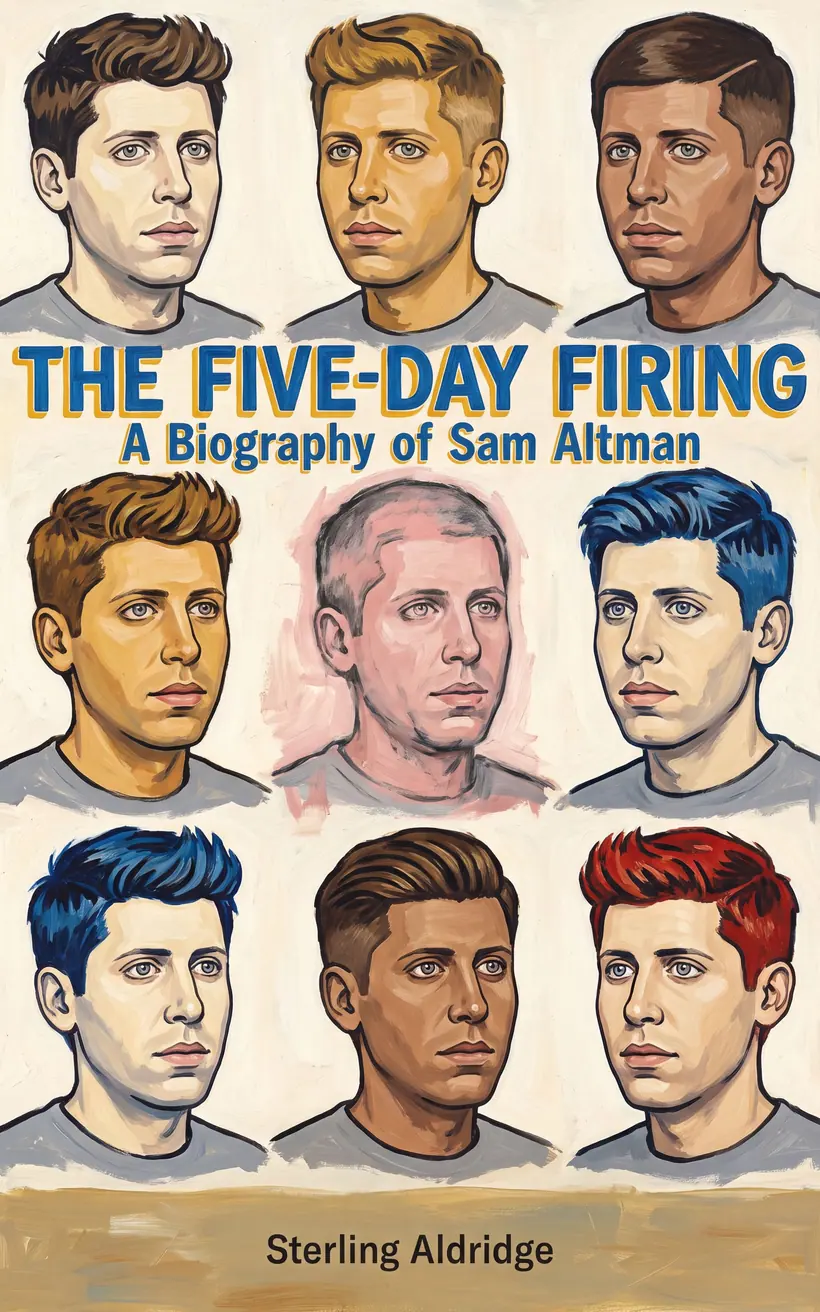
Samuel Harris Altman. The title never carries the subject's name: it names one concrete thing out of the life — in this case The Five-Day Firing — and the name goes on the line underneath.
No. No subject, estate, label or foundation had approval over the text, and none paid for a word of it. The cost of that independence is that no new interviews were conducted for the book; it is built from the public record, and it says on the page where a scene is reconstructed rather than documented.
Yes — the whole opening chapter and the writer's foreword, free and in full, with no email address and no account. That is 5,322 words of the book.
About 65,500 words, 19 chapters, 214 pages in the paperback.