The Honduran Crash
Paperback · Hardcover
Ships in 2 to 5 working days. Delivery quoted from your address at checkout.
4,201 words · no email, no account
No. 115 · Music · Hip-Hop
a biography of Christopher George Latore Wallace
March 9, 1997. A green GMC Suburban idles at a red light on Wilshire Boulevard. A dark Chevy Impala pulls alongside. Four shots, and Christopher Wallace — twenty-four years old, three weeks from the release of the album he had titled Life After Death — is gone. The case is still open.
Jamal Whitestone's biography begins long before the intersection: in the Brevoort houses of Brooklyn, where a single mother raised a watchful, asthmatic boy with an ear for the cadences around him; on the Bedford-Stuyvesant corners where that boy learned to count money and weigh product before he learned to write a verse; in the basement studios where Sean Combs heard something nobody else had quite heard yet.
Whitestone follows the arc through Ready to Die, the ascent, the rivalry with Tupac Shakur that hardened from competition into something neither man could call back, the lobby of Quad Studios, the after-party at the Petersen. He draws on court filings from Voletta Wallace's civil suit, on LAPD case material accumulated across nearly three decades, and on the testimony of those who were in the rooms.
What emerges is a portrait of a young writer at the edge of his own myth, and of the city, the industry, and the institutions that have spent twenty-nine years declining to answer for him.
The opening chapter is published in full — read it here.
The printed edition has no ISBN registered yet. It affects library and retail listing, not your order.
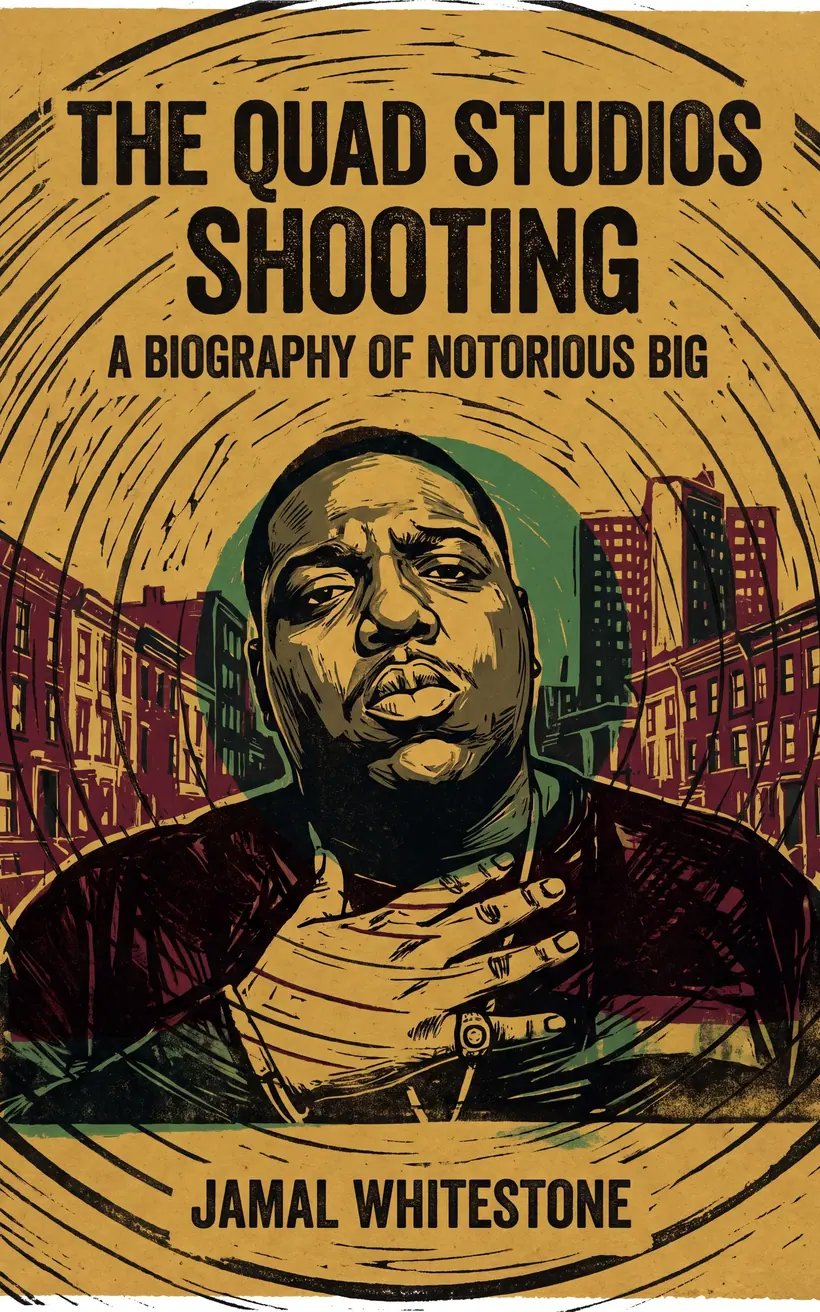
Christopher George Latore Wallace. The title never carries the subject's name: it names one concrete thing out of the life — in this case The Quad Studios Shooting — and the name goes on the line underneath.
No. No subject, estate, label or foundation had approval over the text, and none paid for a word of it. The cost of that independence is that no new interviews were conducted for the book; it is built from the public record, and it says on the page where a scene is reconstructed rather than documented.
Yes — the whole opening chapter and the writer's foreword, free and in full, with no email address and no account. That is 4,201 words of the book.
About 61,500 words, 18 chapters, 197 pages in the paperback.
6 × 9 in, 60# uncoated cream, black ink, perfect-bound paperback, matte laminate. Every title in the series uses the same specification, so they line up on a shelf.
Yes: gun violence; homicide. They are listed before you buy rather than discovered afterwards. The material is handled as evidence, not as spectacle.
Listed before you buy, not after.
Paperback · Hardcover
Paperback
Paperback · Hardcover