
The Honduran Crash
Paperback · Hardcover
Download link emailed the moment payment clears.
3,917 words · no email, no account
No. 125 · Music · Hip-Hop
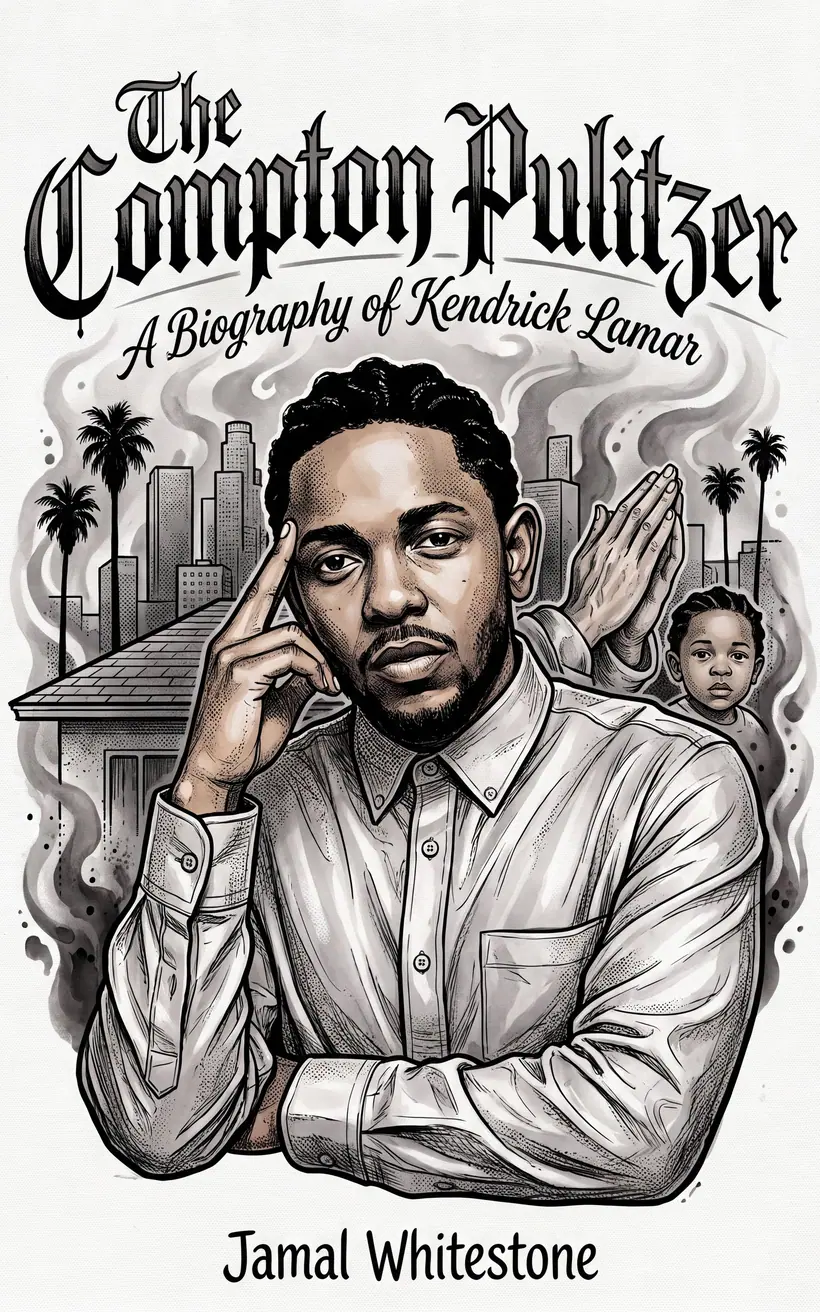
a biography of Kendrick Lamar Duckworth
The last thing on the record is the Super Bowl. On February 9, 2025 he performed the halftime show at Super Bowl LIX. The spring before, the feud with Drake had run to five diss tracks across three weeks and produced Not Like Us, the most-streamed song of the year. In 2018 DAMN. had won the Pulitzer Prize for Music, the first non-classical, non-jazz album to do so.
Go back far enough and there is an eight-year-old in the parking lot of the Compton Swap Meet, watching Tupac Shakur and Dr. Dre film the video for California Love. Kendrick Lamar Duckworth was born in Compton on June 17, 1987, the eldest son of a Job Corps cook and a homemaker from the Park Compton housing projects. He recorded his first mixtape, Y.H.N.I.C., at fifteen, as K-Dot. Top Dawg Entertainment signed him in 2005. Section.80 came on Independence Day 2011. Interscope and Aftermath signed him in 2012, and good kid, m.A.A.d city arrived that October. To Pimp a Butterfly followed in March 2015, DAMN. in April 2017, Mr. Morale & the Big Steppers in May 2022.
Jamal Whitestone's biography traces the arc through the Compton childhood and the early Top Dawg Studios years, the Overly Dedicated and Section.80 breakthroughs, the Control verse of August 2013 that called out every other rapper of his generation, the long studio sessions for To Pimp a Butterfly with Thundercat and Kamasi Washington, the Pulitzer, the co-founding of pgLang with Dave Free in 2020, the family-therapy record of 2022, the Drake battle of 2024 and the Not Like Us video, and the 2025 halftime show.
What emerges is a portrait of the most decorated American rapper of his generation: the Compton son whose Pulitzer the literature of hip-hop had been waiting for, and whose halftime show made the case, in a single act, for the centrality of Black American music to the country's official cultural life.
The opening chapter is published in full — read it here.
Kendrick Lamar Duckworth. The title never carries the subject's name: it names one concrete thing out of the life — in this case The Compton Pulitzer — and the name goes on the line underneath.
No. No subject, estate, label or foundation had approval over the text, and none paid for a word of it. The cost of that independence is that no new interviews were conducted for the book; it is built from the public record, and it says on the page where a scene is reconstructed rather than documented.
Yes — the whole opening chapter and the writer's foreword, free and in full, with no email address and no account. That is 3,917 words of the book.
About 57,500 words, 19 chapters, 190 pages in the paperback.
Paperback · Hardcover
Paperback

Paperback · Hardcover