The Counting Video
Digital edition
Download link emailed the moment payment clears.
3,657 words · no email, no account
No. 129 · Technology & Money · Internet Culture
a biography of Joseph James Rogan
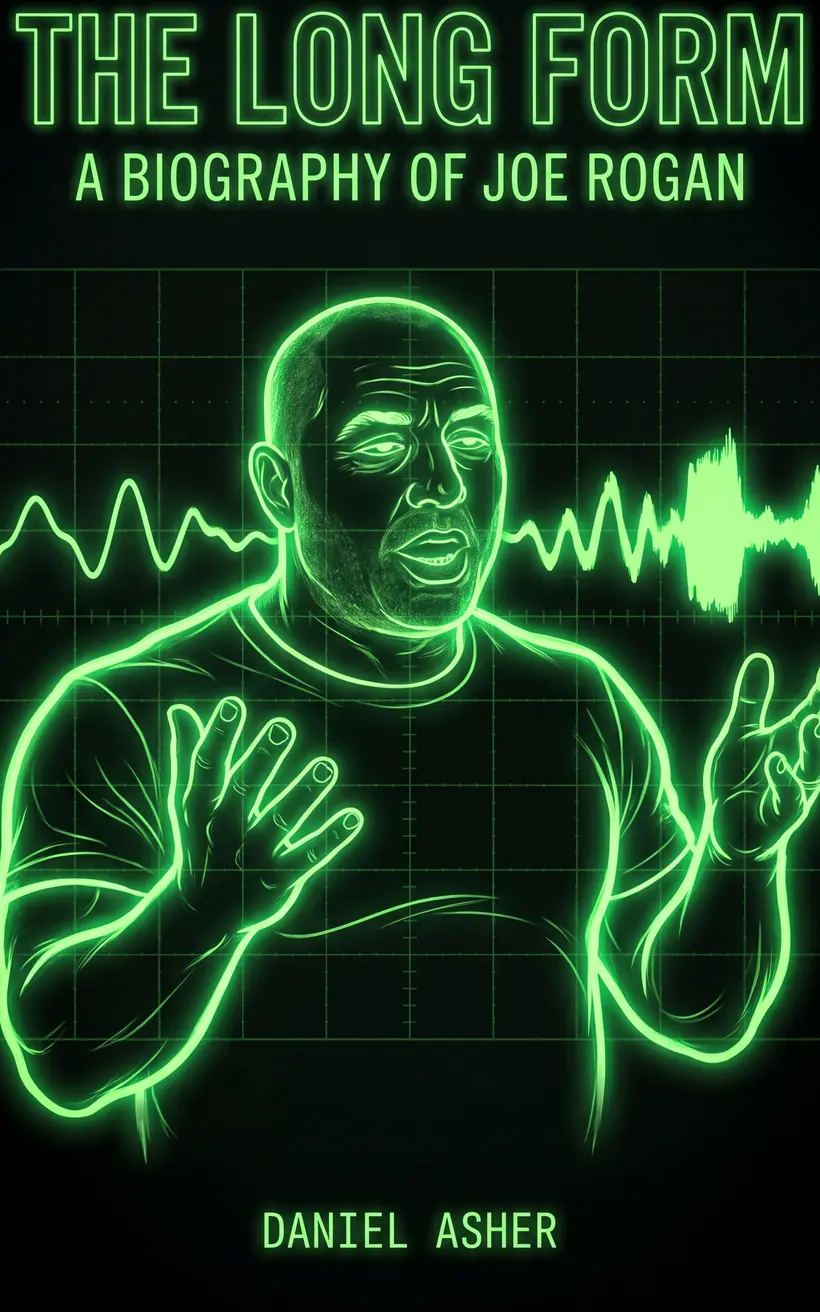
The question that trails Joe Rogan is one of responsibility, and Daniel Asher's biography answers it by first settling a question of fact: where the audience came from. Not from the California garage where The Joe Rogan Experience launched on December 24, 2009. It came from the job before it, colour commentator for the UFC, taken in 1997, and from Fear Factor, which he hosted for NBC from 2001 to 2006. By 2026 the podcast has 14 million subscribers and is the most-listened-to in the world.
The book opens earlier still, in Newark, New Jersey, where Joseph James Rogan was born on August 11, 1967 to an Irish-American cop and an Italian-American homemaker. His parents divorced when he was five. He moved with his mother to Gainesville, Florida, then to Newton Upper Falls, Massachusetts, took up Taekwondo at fourteen, and had won the U.S. Open and a Pan American lightweight championship by twenty. Stand-up came at twenty-one, in the Boston clubs. Los Angeles came at twenty-seven. NewsRadio cast him in 1995.
Asher then follows the second act with the procedural rigour fifteen years of it demand: the long roster of cultural and political guests, the $200 million Spotify exclusivity deal of May 2020, the Robert Malone interview of December 2021 and the Neil Young exodus it produced, the n-word compilation of 2022, the three-hour Donald Trump interview of 2024 that the polls credited as the single largest factor in his Pennsylvania vote, and the move back to Austin and Vulcan Sound Studios.
What emerges is a portrait of a Newark stand-up and Taekwondo champion who reshaped what long-form audio can be, and of the conversation his show has become, in the second Trump administration, the most consequential venue for.
The opening chapter is published in full — read it here.
Joseph James Rogan. The title never carries the subject's name: it names one concrete thing out of the life — in this case The Long Form — and the name goes on the line underneath.
No. No subject, estate, label or foundation had approval over the text, and none paid for a word of it. The cost of that independence is that no new interviews were conducted for the book; it is built from the public record, and it says on the page where a scene is reconstructed rather than documented.
Yes — the whole opening chapter and the writer's foreword, free and in full, with no email address and no account. That is 3,657 words of the book.
About 59,500 words, 19 chapters, 196 pages in the paperback.
Digital edition
Digital edition
Digital edition