The Honduran Crash
Paperback · Hardcover
Download link emailed the moment payment clears.
4,298 words · no email, no account
No. 135 · Music · Hip-Hop
a biography of Aubrey Drake Graham
Jamal Whitestone's biography declines to award the fight. The exchange with Kendrick Lamar in the spring of 2024 produced the most-streamed diss record in history and a loss, Not Like Us, that Drake has not yet conceded. The book leaves that where it belongs, with a hip-hop press that will be litigating it for the next decade, rather than settling it in a paragraph.
What can be established, it establishes. Aubrey Drake Graham was born in Toronto on October 24, 1986, the only son of Dennis Graham, an African-American musician from Memphis, and Sandi Sher, a Jewish-Canadian educator. His parents divorced when he was five, and he grew up in Forest Hill with his mother. From 2001 to 2008 he played the teenager Jimmy Brooks on the Canadian high-school drama Degrassi: The Next Generation. Room for Improvement, his first mixtape, came out in 2006. Lil Wayne signed him to Young Money Entertainment in 2009, having heard So Far Gone.
Then the records: Thank Me Later in 2010, Take Care in 2011, Nothing Was the Same in 2013, If You're Reading This It's Too Late in 2015, Views in 2016, Scorpion in 2018, Certified Lover Boy in 2021, Honestly, Nevermind and Her Loss in 2022, For All the Dogs in 2023, and $ome $exy $ongs 4 U, with PartyNextDoor, in 2025. Around them Whitestone sets the OVO Sound label and the Toronto music infrastructure, the Meek Mill and Joe Budden feuds of the 2010s, the Pusha T battle of 2018 that disclosed the existence of his son Adonis, the Aubrey & the Three Amigos tours, and the defamation suit filed against UMG in January 2025.
What emerges is a portrait of the most commercially successful rapper of the post-2010 streaming era, built only from what the record will carry.
The opening chapter is published in full — read it here.
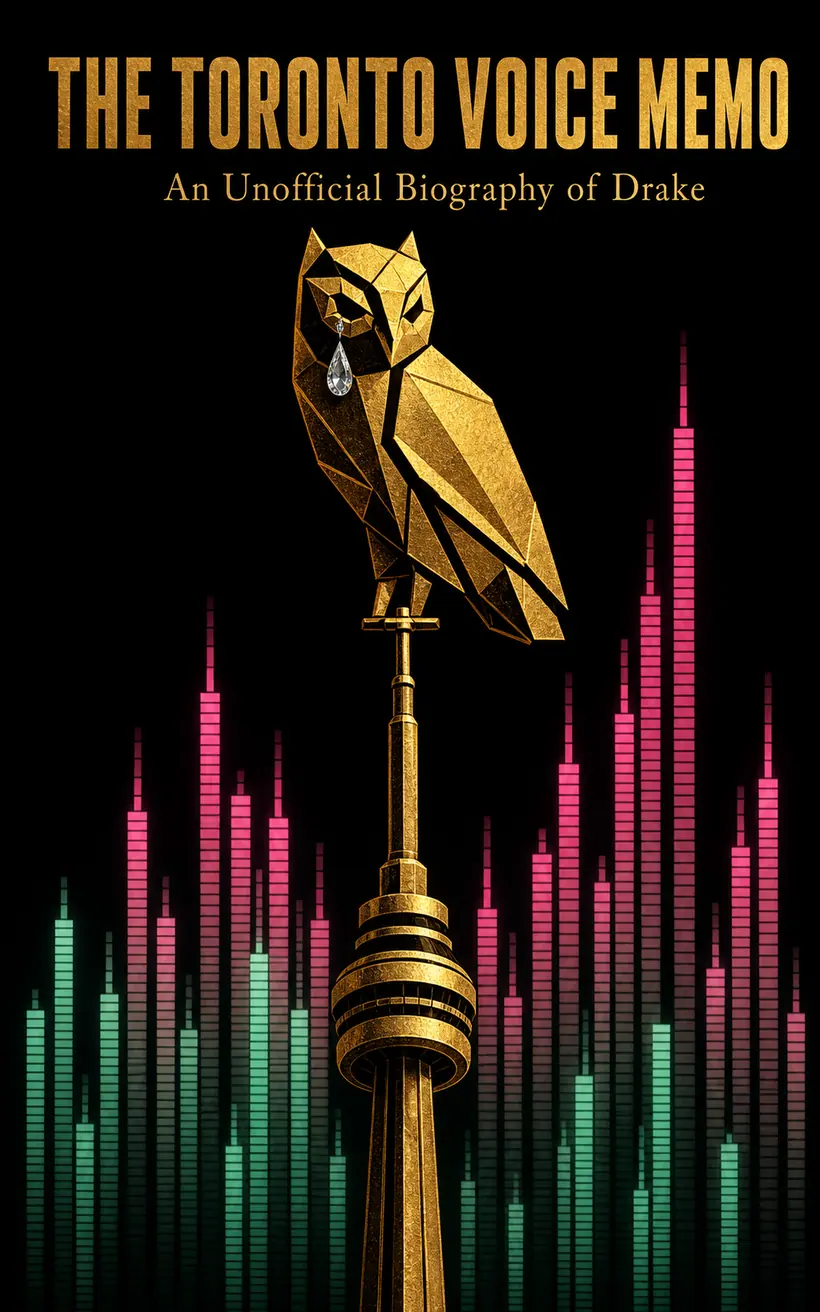
Aubrey Drake Graham. The title never carries the subject's name: it names one concrete thing out of the life — in this case The Toronto Voice Memo — and the name goes on the line underneath.
No. No subject, estate, label or foundation had approval over the text, and none paid for a word of it. The cost of that independence is that no new interviews were conducted for the book; it is built from the public record, and it says on the page where a scene is reconstructed rather than documented.
Yes — the whole opening chapter and the writer's foreword, free and in full, with no email address and no account. That is 4,298 words of the book.
About 57,000 words, 18 chapters, 188 pages in the paperback.
Paperback · Hardcover
Paperback
Paperback · Hardcover