The Azteca Quarterfinal
Paperback · Hardcover
Ships in 2 to 5 working days. Delivery quoted from your address at checkout.
4,107 words · no email, no account
No. 140 · Sport · Football
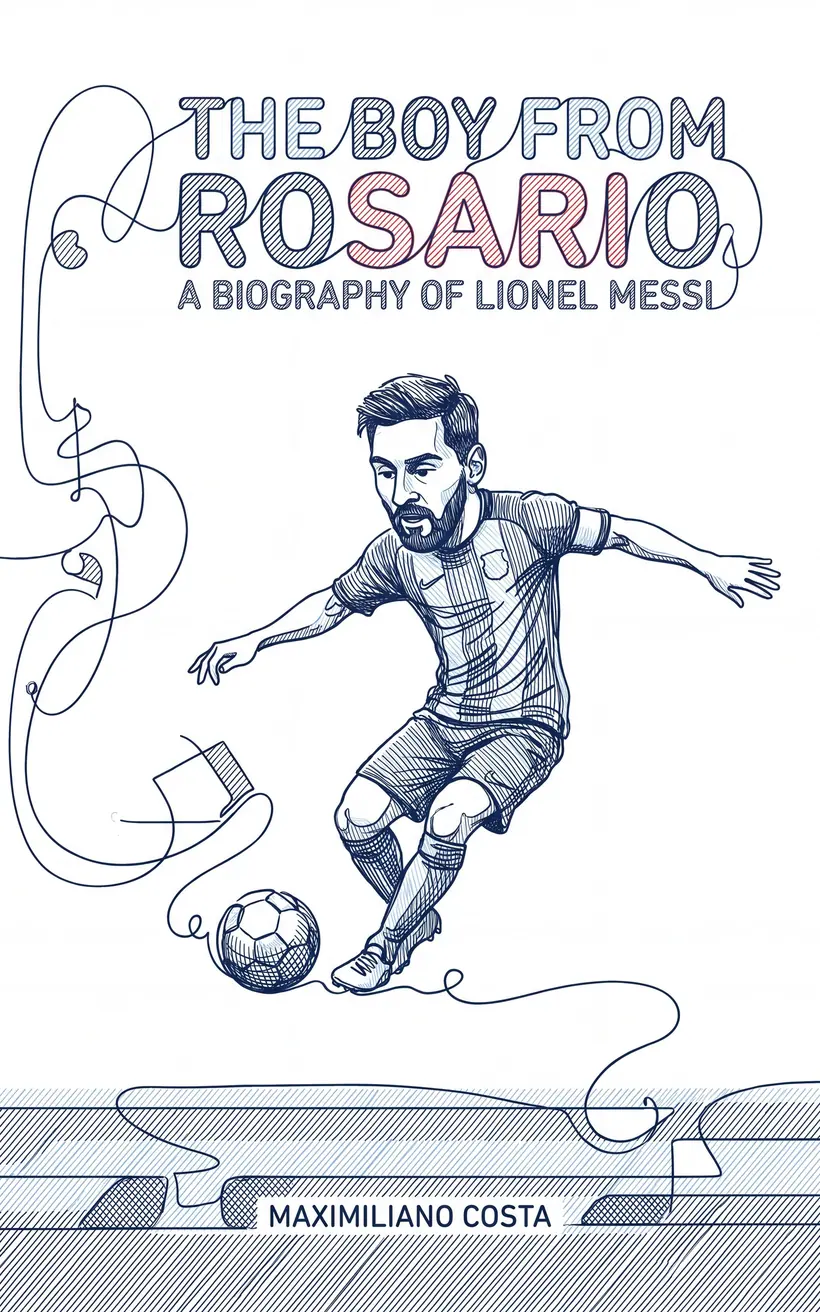
a biography of Lionel Andrés Messi Cuccittini
He was born on June 24, 1987, in Rosario, Argentina, the third of four children of a steelworker named Jorge Messi and a cleaner named Celia Cuccittini. He was diagnosed with a growth-hormone deficiency at ten. His Argentine clubs could not afford the $1,000-a-month treatment. FC Barcelona, after a Carles Rexach private trial, offered to pay it on the back of a Buenos Aires-restaurant napkin in December 2000. He moved to Barcelona with his family at thirteen and made his La Liga debut at seventeen on October 16, 2004. Across the next twenty-one professional years he has won, as of 2026, eight Ballons d'Or, ten La Liga titles, four UEFA Champions League titles, the 2022 World Cup (his first), the 2024 Copa América (his second), and the 2024 MLS Cup with Inter Miami.
Maximiliano Costa's biography traces the arc through the Rosario childhood and La Maquina del 87 youth team, the Barcelona arrival and La Masia academy years, the long Pep Guardiola era of 2008-2012 and the tiki-taka Champions League years, the long Argentina-team disappointment and the 2014 World Cup final loss to Germany, the long Spanish tax-fraud trial of 2016 and the August 2021 departure from Barcelona for Paris Saint-Germain, the two-year PSG run, the July 2023 signing with Inter Miami, and the long Mascherano coaching era from November 2024 onward.
What emerges is a portrait of the Rosario boy whose growth hormone the Barcelona scouting director chose to pay for — and the most decorated footballer in the history of the sport.
The opening chapter is published in full — read it here.
The printed edition has no ISBN registered yet. It affects library and retail listing, not your order.
Lionel Andrés Messi Cuccittini. The title never carries the subject's name: it names one concrete thing out of the life — in this case The Boy from Rosario — and the name goes on the line underneath.
No. No subject, estate, label or foundation had approval over the text, and none paid for a word of it. The cost of that independence is that no new interviews were conducted for the book; it is built from the public record, and it says on the page where a scene is reconstructed rather than documented.
Yes — the whole opening chapter and the writer's foreword, free and in full, with no email address and no account. That is 4,107 words of the book.
About 63,000 words, 19 chapters, 197 pages in the paperback.
6 × 9 in, 60# uncoated cream, black ink, perfect-bound paperback, matte laminate. Every title in the series uses the same specification, so they line up on a shelf.
Paperback · Hardcover
Digital edition