Friendly Fire
Paperback
Download link emailed the moment payment clears.
4,297 words · no email, no account
No. 142 · Sport · American Football
a biography of Aaron Josef Hernandez
April 19, 2017, the Souza-Baranowski Correctional Center in Shirley, Massachusetts. Aaron Josef Hernandez, twenty-seven, the former New England Patriots tight end who had signed a $40 million contract extension in August 2012 and was convicted of murdering the semi-professional football player Odin Lloyd in April 2015, is found hanging in his cell. He has been acquitted five days earlier in the 2012 double-murder trial of Daniel de Abreu and Safiro Furtado at a Boston nightclub. His post-mortem brain examination at the Boston University CTE Center will produce the most severe diagnosis of chronic traumatic encephalopathy ever found in someone of his age — a stage-three diagnosis the lead investigator Ann McKee said she had only previously seen in NFL players in their sixties.
Roland Mercer's biography opens earlier — in Bristol, Connecticut, where Aaron was born in 1989, the second son of a Mexican-American Hernandez family — and follows the arc through the Bristol Central High School years, the death of his father Dennis Hernandez of complications from hernia surgery in January 2006, the long University of Florida years on Urban Meyer's Gators and the 2008 national championship, the 2010 NFL draft fall to the fourth round, the three Patriots seasons and the Super Bowl XLVI appearance, the June 17, 2013 Industrial Park murder of Lloyd, the long Bristol County trial of 2015, the April 2015 conviction and the move to MCI-Cedar Junction, the transfer to Souza-Baranowski, and the morning of April 19.
What emerges is a portrait of the Bristol-born NFL tight end whose career the league had not finished writing — and the CTE diagnosis that the sport has spent the years since his death trying to absorb.
The opening chapter is published in full — read it here.
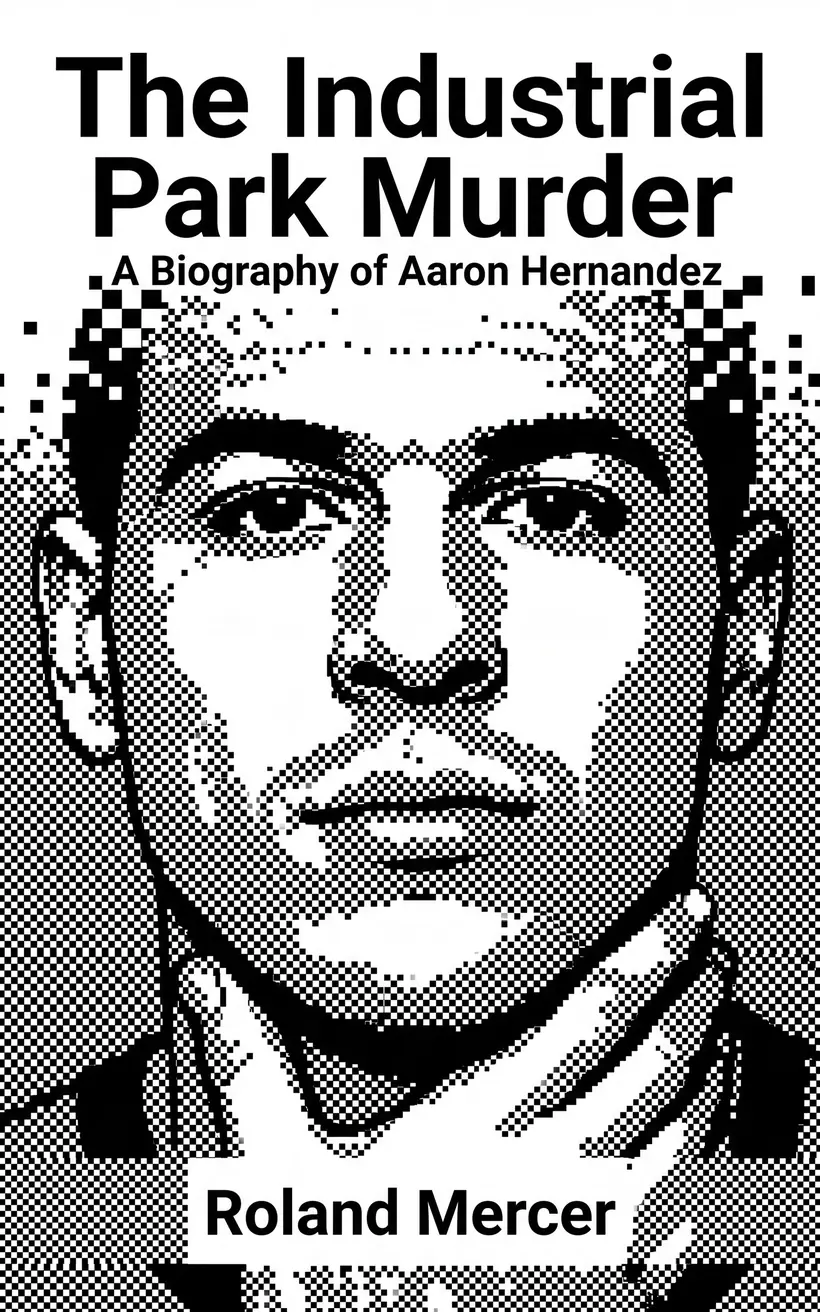
Aaron Josef Hernandez. The title never carries the subject's name: it names one concrete thing out of the life — in this case The Industrial Park Murder — and the name goes on the line underneath.
No. No subject, estate, label or foundation had approval over the text, and none paid for a word of it. The cost of that independence is that no new interviews were conducted for the book; it is built from the public record, and it says on the page where a scene is reconstructed rather than documented.
Yes — the whole opening chapter and the writer's foreword, free and in full, with no email address and no account. That is 4,297 words of the book.
About 64,000 words, 19 chapters, 208 pages in the paperback.
Yes: homicide; suicide; CTE. They are listed before you buy rather than discovered afterwards. The material is handled as evidence, not as spectacle.
Listed before you buy, not after.
Paperback