The Mount Baldy Monastery
Digital edition
Download link emailed the moment payment clears.
4,759 words · no email, no account
No. 250 · Music · Folk & Songwriting
a biography of John R. Cash
The version this book refuses hardest is the redemption arc, and the reason is Glen Sherley — the Folsom inmate whose song closed the 1968 album, whom Cash got paroled, employed, housed and taken to the United States Senate, and who killed himself in California in 1978, two days after a man was shot. Cash paid for the funeral. Whether the intervention extended that life or ended it is not resolved here.
He never shot anybody, and he never served a day of a sentence. The most famous prison song in America was written in a barracks at Landsberg am Lech in Bavaria in 1953, by a twenty-one-year-old Air Force staff sergeant who had never been inside a prison and had never been to Reno, out of a film screened at the base theatre and a melody belonging to the arranger Gordon Jenkins. Fifteen years later he sang it inside Folsom State Prison to men who had done what its narrator describes, and a country decided the song was a report. The rest is thinner: seven arrests or so, depending on who is counting, and one night in an El Paso jail in October 1965, after he came back over the bridge from Ciudad Juárez with pills in the lining of his guitar case.
The outlaw was a costume, and it was so persuasive it swallowed a stranger and better man. It was stitched out of real material: a brother pulled into a table-saw blade in a school shop in 1944, and a father who let it be known that the wrong son had lived; amphetamines that arrived in 1957 as a labour tool, the thing that made three hundred nights a year possible; a gospel guilt contracted at twelve; and a marketing department that found a profitable line and stocked it. Underneath was a federal-relief child, housed at three on twenty acres in a New Deal resettlement colony called Colony No. 1. He never lied about that part. He invented a murder and told the truth about the mule.
The opening chapter is published in full — read it here.
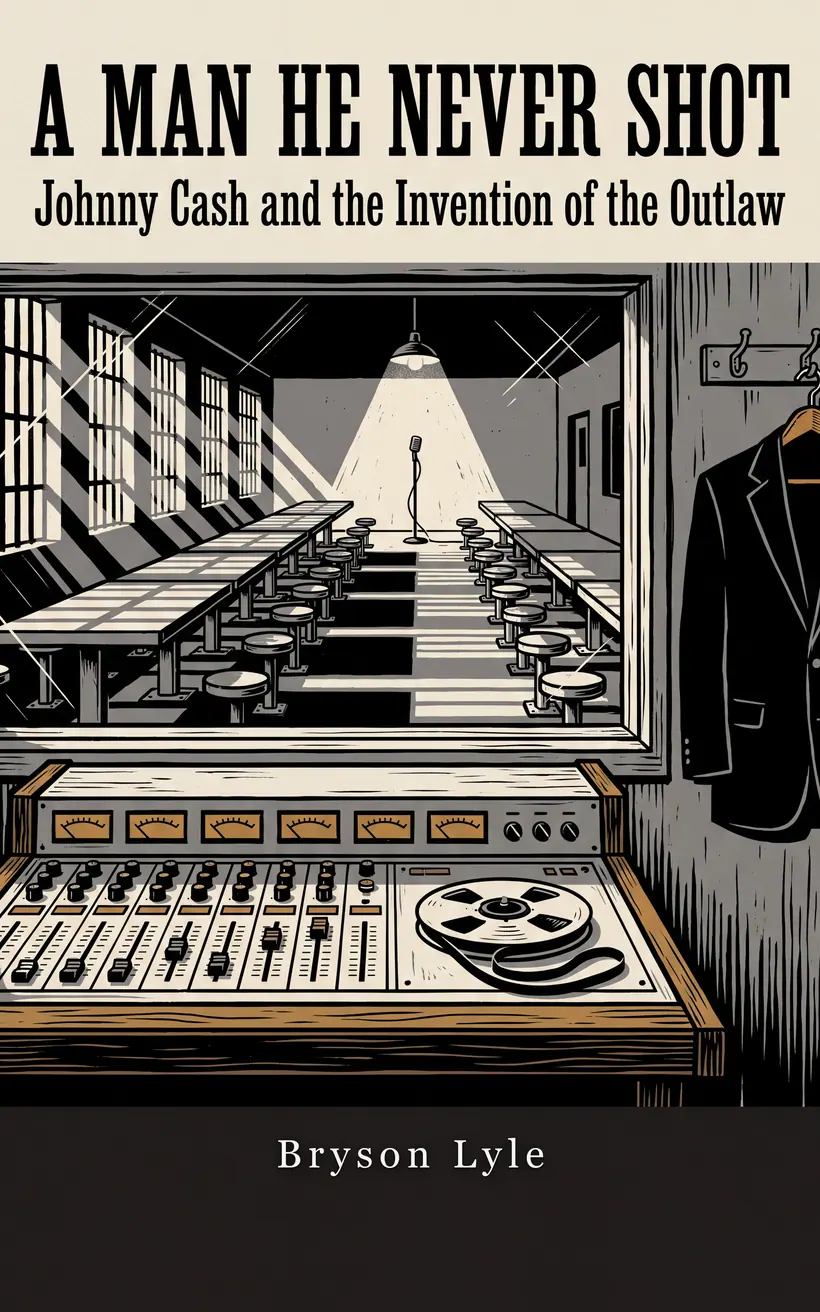
John R. Cash. The title never carries the subject's name: it names one concrete thing out of the life — in this case A Man He Never Shot — and the name goes on the line underneath.
No. No subject, estate, label or foundation had approval over the text, and none paid for a word of it. The cost of that independence is that no new interviews were conducted for the book; it is built from the public record, and it says on the page where a scene is reconstructed rather than documented.
Yes — the whole opening chapter and the writer's foreword, free and in full, with no email address and no account. That is 4,759 words of the book.
About 77,000 words, 22 chapters, 248 pages in the paperback.
Digital edition