Buttons
Paperback
Download link emailed the moment payment clears.
4,020 words · no email, no account
No. 015 · Art & Design · Fashion
a biography of Willi Donnell Smith
The back of the Philadelphia Tribune was Willi Smith's first sketchbook: newsprint, in the house of an ironworker and a domestic worker. At seventeen he had a Parsons scholarship. At nineteen he left it. He worked at Bobbie Brooks, at Digits, at Mademoiselle, and in 1976 he founded WilliWear Limited with his sister Toukie and the businessman Laurie Mallet. By the time he died of AIDS complications on April 17, 1987, at thirty-nine, WilliWear was a $25-million company and Willi Donnell Smith was the most commercially successful Black fashion designer in American history.
The line was called street couture, and what that meant commercially was the department store, the mass market rather than the runway. Vivien Beauchamp follows the whole of it. The Philadelphia childhood, the February 29, 1948 birthday, the Parsons years. The SoHo years and the New York loft of 1978, then the retail rollout of 1982. The School Daze costumes made with Spike Lee in 1986 and, that same year, the Cooper Hewitt Lifetime Achievement Award. The Toukie and De Niro relationship that ran from 1988 to 1996. And the slow ten-year decline of WilliWear after Smith was gone.
What the book is finally about is that bridge. Smith's street-couture line was the $25-million connection between Black design and the American department-store mass market, the place where the two met at scale. That is the measure Beauchamp keeps returning to: not the awards, but the shelf space. His death at thirty-nine left the bridge unfinished, and left the next generation to keep rebuilding it.
The opening chapter is published in full — read it here.
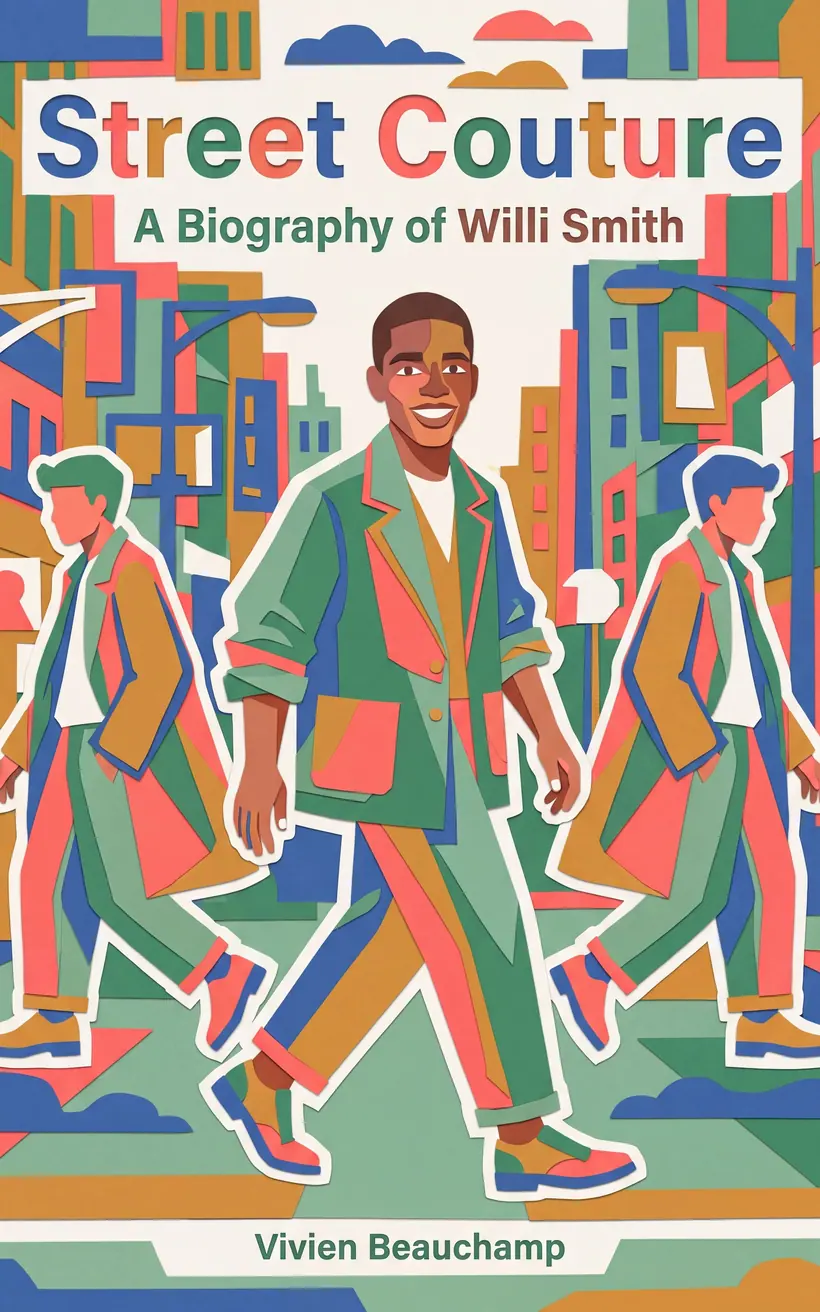
Willi Donnell Smith. The title never carries the subject's name: it names one concrete thing out of the life — in this case Street Couture — and the name goes on the line underneath.
No. No subject, estate, label or foundation had approval over the text, and none paid for a word of it. The cost of that independence is that no new interviews were conducted for the book; it is built from the public record, and it says on the page where a scene is reconstructed rather than documented.
Yes — the whole opening chapter and the writer's foreword, free and in full, with no email address and no account. That is 4,020 words of the book.
About 59,500 words, 18 chapters, 196 pages in the paperback.
Paperback
Paperback