Buttons
Paperback
Ships in 2 to 5 working days. Delivery quoted from your address at checkout.
4,108 words · no email, no account
No. 083 · Art & Design · Fashion
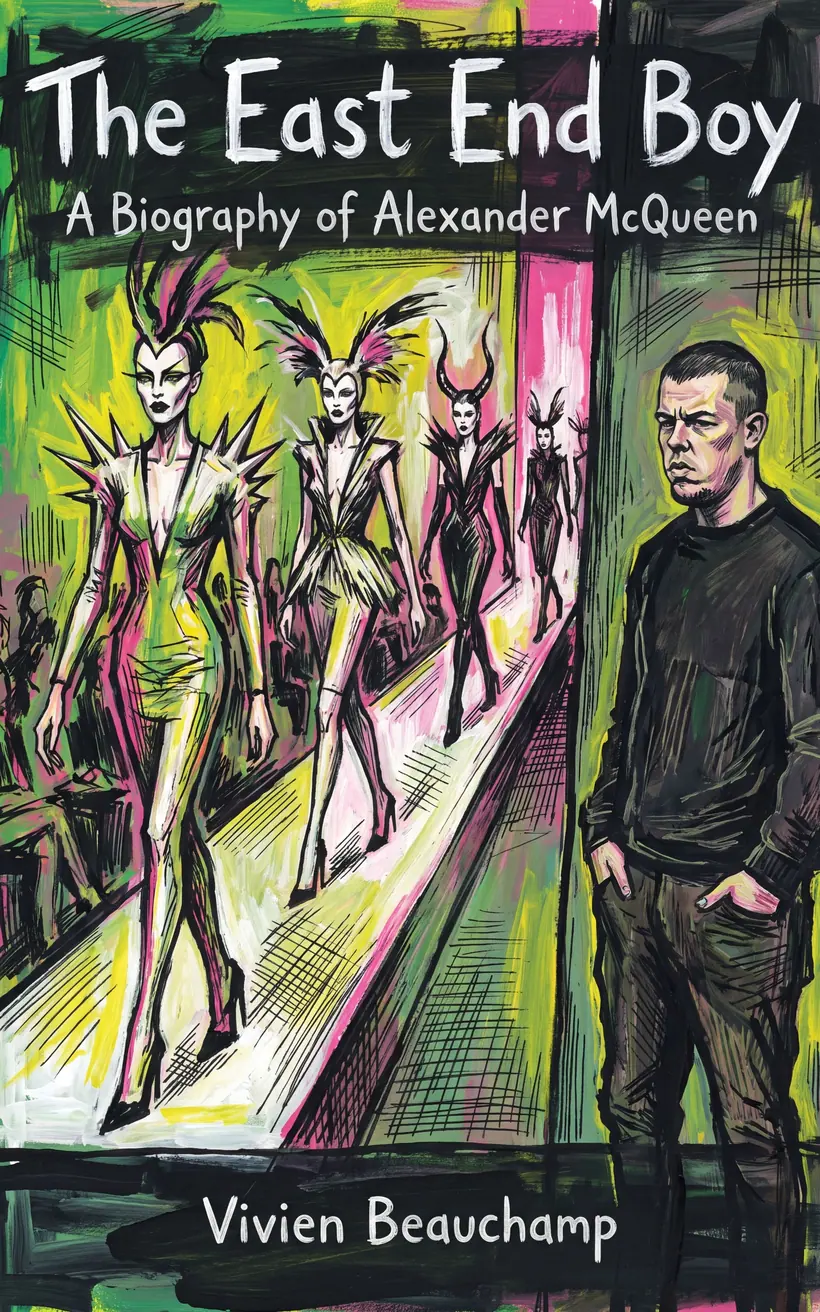
a biography of Lee Alexander McQueen
February 11, 2010, the McQueen Mayfair flat above the Costa coffee shop on Green Street. Lee Alexander McQueen, forty, the East End tailor's son who had reached the front rank of European fashion in fifteen years, hangs himself in his closet. His mother Joyce has died of cancer nine days earlier. His autumn-winter ready-to-wear show is scheduled for the following week. He has been on antidepressants and cocaine and ketamine for the better part of a decade. He is forty-five days short of his forty-first birthday.
Vivien Beauchamp's biography opens earlier — in Stratford, East London, where Lee Alexander was born in 1969, the youngest of six children of a London taxi driver — and follows the arc through the Rokeby Comprehensive School and the sixteen-year-old apprenticeship at the Savile Row tailors Anderson & Sheppard, the Central Saint Martins MA Fashion class of 1992 and the Jack the Ripper Stalks His Victims graduation collection that Isabella Blow bought entire, the long collaboration with Blow and the 1996 appointment as head designer at Givenchy, the Spring 1995 highland-rape collection and the 1999 No. 13 show with the Shalom Harlow paint-spraying robots, the 2007 Blow suicide that the book treats as the wound under everything, the 2010 Mayfair closet, and the long Sarah Burton-led posthumous house that has continued the work in his name.
What emerges is a portrait of the East End tailor's son whose fifteen-year ascent through European fashion remade what a runway could look like, and whose body the work — and the death of the two women who had loved him most — finally took.
The opening chapter is published in full — read it here.
The printed edition has no ISBN registered yet. It affects library and retail listing, not your order.
Lee Alexander McQueen. The title never carries the subject's name: it names one concrete thing out of the life — in this case The East End Boy — and the name goes on the line underneath.
No. No subject, estate, label or foundation had approval over the text, and none paid for a word of it. The cost of that independence is that no new interviews were conducted for the book; it is built from the public record, and it says on the page where a scene is reconstructed rather than documented.
Yes — the whole opening chapter and the writer's foreword, free and in full, with no email address and no account. That is 4,108 words of the book.
About 60,500 words, 18 chapters, 197 pages in the paperback.
6 × 9 in, 60# uncoated cream, black ink, perfect-bound paperback, matte laminate. Every title in the series uses the same specification, so they line up on a shelf.
Paperback
Digital edition