The Hudson River Body
Paperback
Ships in 2 to 5 working days. Delivery quoted from your address at checkout.
4,951 words · no email, no account
No. 021 · Movements · Civil Rights
a biography of Bayard Taylor Rustin
He was born on March 17, 1912, in West Chester, Pennsylvania, the eleventh child of a single mother who raised him as her younger brother and let her parents raise him as their son. He was the openly gay Quaker socialist who taught Martin Luther King Jr. how to read Gandhi, who organised the August 28, 1963, March on Washington in eight weeks, and whose name the FBI, the U.S. Senate, and the leadership of the Civil Rights Movement spent two decades trying to keep off the public record.
Solomon Treadway's biography opens earlier — in the Cheyney State Teachers College years, the City College of New York Communist Party years, the 1948 Pasadena conscientious-objector imprisonment under the Selective Service Act, the 1953 Pasadena public-restroom morals arrest that the Movement's leadership used against him for decades — and follows the arc through the 1956 Montgomery Bus Boycott tactical advisor role, the 1963 March on Washington's eight-week logistical miracle, the long late-life campaign for Soviet Jewry and Haitian refugees, the 1986 New York Times editorial that finally named him as gay, and the death at New York Hospital in 1987 at seventy-five.
What emerges is a portrait of a Black Quaker socialist whose tactical mind built the modern civil-rights movement and whose homosexuality the movement spent twenty years trying to keep behind the curtain.
The opening chapter is published in full — read it here.
The printed edition has no ISBN registered yet. It affects library and retail listing, not your order.
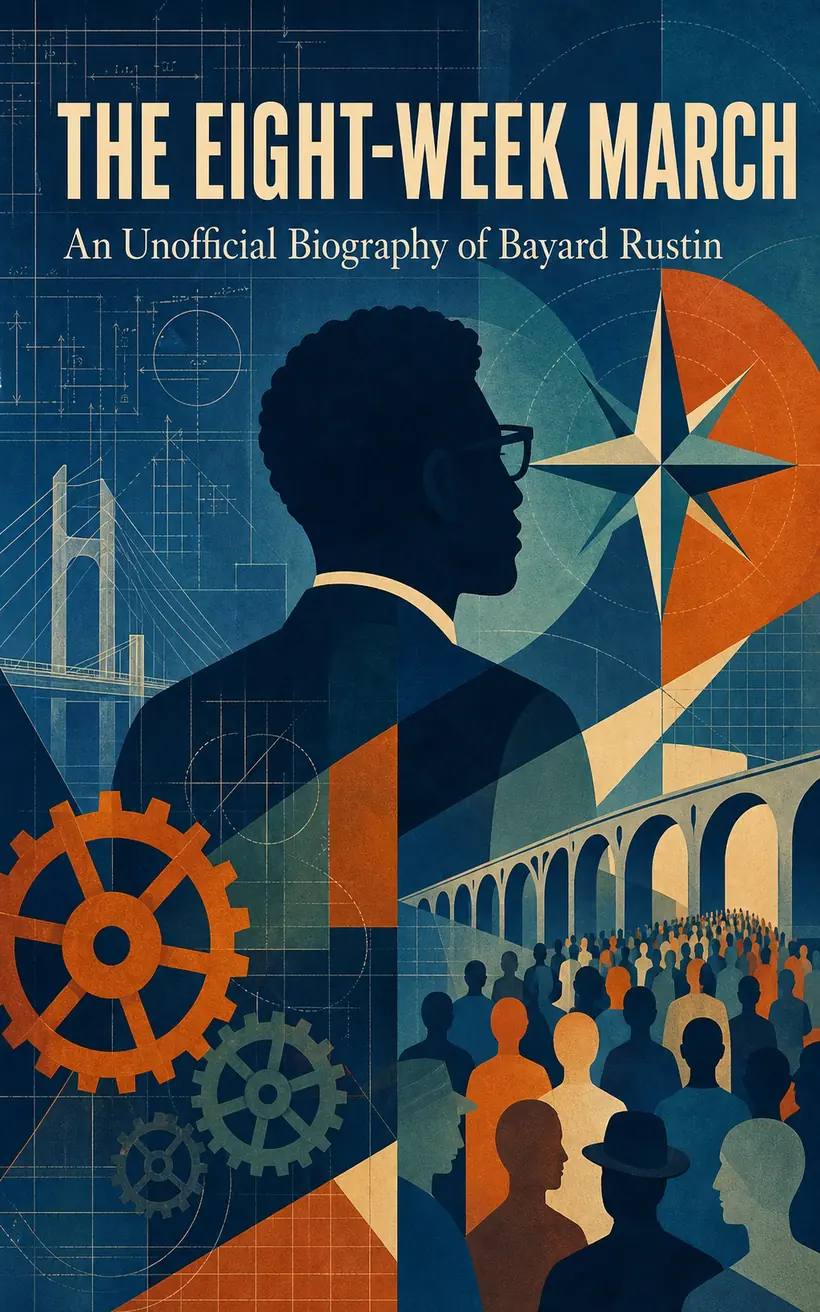
Bayard Taylor Rustin. The title never carries the subject's name: it names one concrete thing out of the life — in this case The Eight-Week March — and the name goes on the line underneath.
No. No subject, estate, label or foundation had approval over the text, and none paid for a word of it. The cost of that independence is that no new interviews were conducted for the book; it is built from the public record, and it says on the page where a scene is reconstructed rather than documented.
Yes — the whole opening chapter and the writer's foreword, free and in full, with no email address and no account. That is 4,951 words of the book.
About 64,000 words, 19 chapters, 207 pages in the paperback.
6 × 9 in, 60# uncoated cream, black ink, perfect-bound paperback, matte laminate. Every title in the series uses the same specification, so they line up on a shelf.