The Vertical
Paperback · Hardcover
Ships in 2 to 5 working days. Delivery quoted from your address at checkout.
4,564 words · no email, no account
No. 038 · Power & Politics · World Politics
a biography of Augusto José Ramón Pinochet Ugarte
On the morning of September 11, 1973, Hawker Hunter jets banked over Santiago and put their rockets through the windows of La Moneda. By nightfall, a soft-spoken career officer few Chileans could have picked out of a lineup had taken the country. He would hold it for seventeen years.
Mateo Salazar traces the long, unlikely ascent of Augusto Pinochet Ugarte: the provincial cadet from Valparaíso, the dutiful instructor of military geography, the late-blooming general whose quiet Catholicism and bureaucratic patience masked a politics he disclosed to almost no one. Drawing on declassified cables, junta minutes, and interviews with surviving aides, exiles, and prosecutors, she follows him from the parade ground to the presidential sash, and from the Caravan of Death to the Villa Grimaldi cells, to the Chicago-trained economists who remade the country in his name, and finally to a London arrest that broke open the question of what international law could ask of a former head of state.
Salazar is interested less in the monster of caricature than in the man his subordinates obeyed: how authority hardens into cult, how a constitution is written to outlive its author, how a society learns, slowly, to name what was done to it.
The result is a portrait of power in its most patient and procedural form, and of the country that is still, decades on, deciding what to do with his inheritance.
The opening chapter is published in full — read it here.
The printed edition has no ISBN registered yet. It affects library and retail listing, not your order.
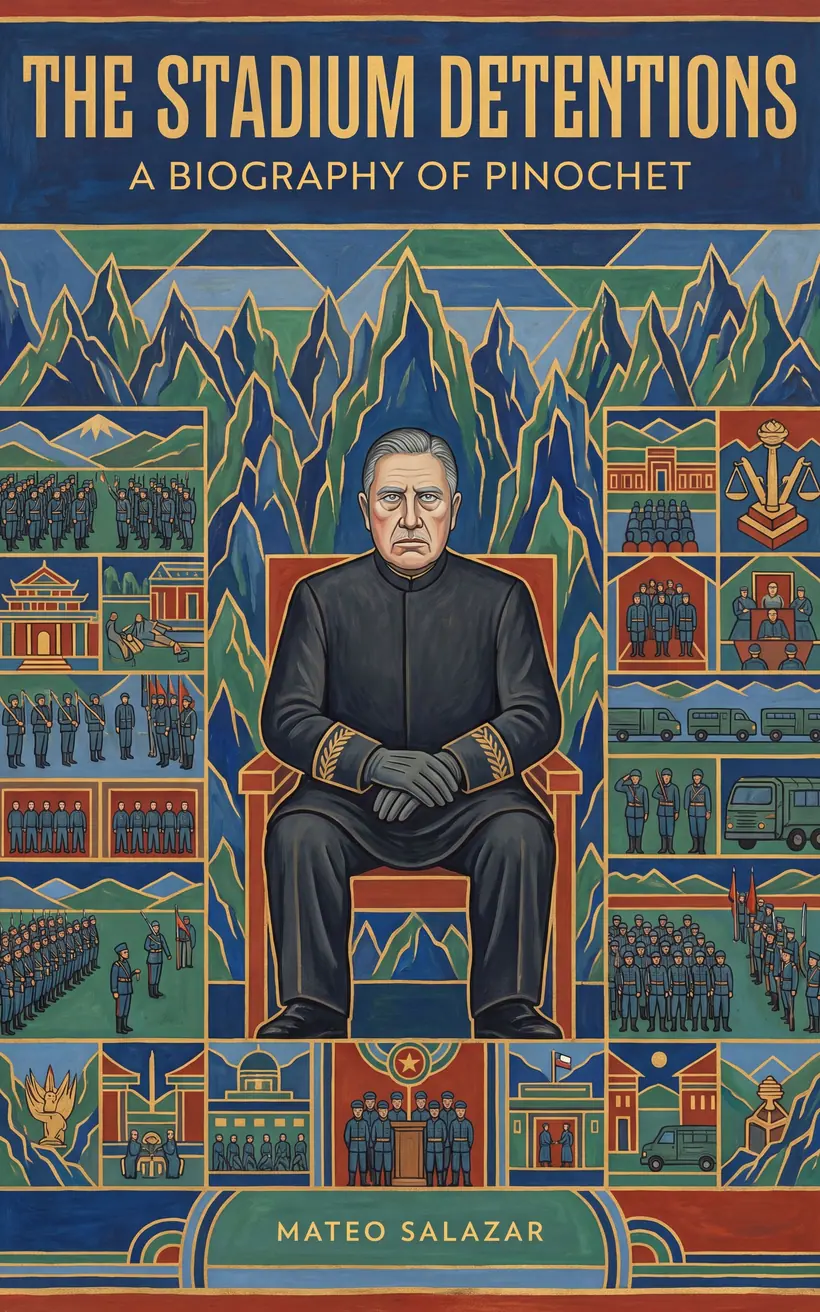
Augusto José Ramón Pinochet Ugarte. The title never carries the subject's name: it names one concrete thing out of the life — in this case The Stadium Detentions — and the name goes on the line underneath.
No. No subject, estate, label or foundation had approval over the text, and none paid for a word of it. The cost of that independence is that no new interviews were conducted for the book; it is built from the public record, and it says on the page where a scene is reconstructed rather than documented.
Yes — the whole opening chapter and the writer's foreword, free and in full, with no email address and no account. That is 4,564 words of the book.
About 63,000 words, 19 chapters, 226 pages in the paperback.
6 × 9 in, 60# uncoated cream, black ink, perfect-bound paperback, matte laminate. Every title in the series uses the same specification, so they line up on a shelf.