The Eight-Week March
Paperback
Download link emailed the moment payment clears.
4,112 words · no email, no account
No. 060 · Movements · Civil Rights
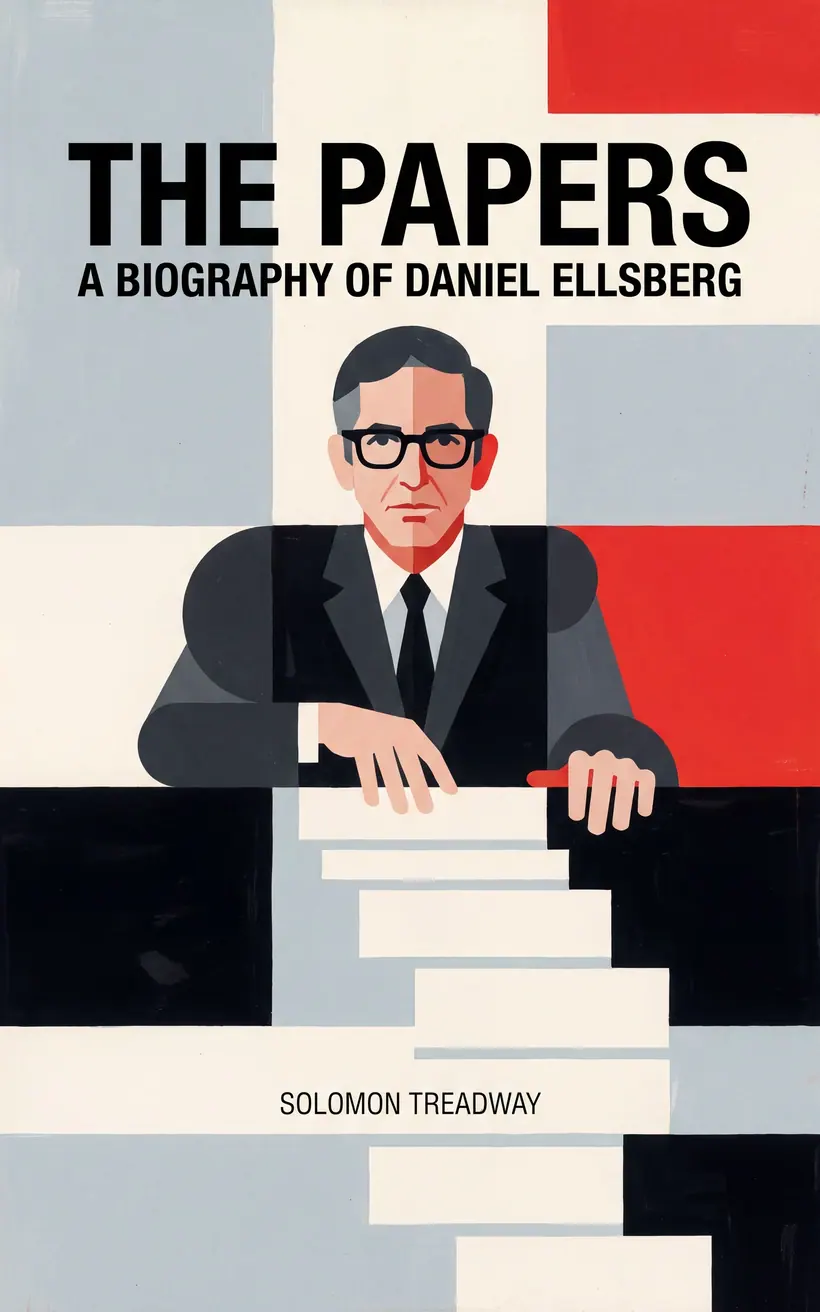
a biography of Daniel Ellsberg
March 1971, a Cambridge apartment. Daniel Ellsberg, a Marine veteran and RAND Corporation analyst who had helped author the McNamara study now known as the Pentagon Papers, copies seven thousand pages of classified Vietnam War history at his Xerox machine. On June 13, The New York Times publishes the first installment. The Nixon administration sues to block publication. The Supreme Court rules 6-3 in New York Times Co. v. United States on June 30. Ellsberg is indicted under the Espionage Act and faces 115 years in prison. His case is dismissed in May 1973 after revelations about a White House Plumbers break-in at his psychiatrist's office.
Solomon Treadway's biography opens earlier — in Chicago, where Ellsberg was born in 1931 to Christian-Scientist Jewish parents — and follows the arc through Harvard, the Marine Corps, RAND, Vietnam, McNamara, Nixon, the trial, the Pentagon Papers Project, the Sam Adams Associates Award of 2018, the Right Livelihood Award of 2006 in Stockholm, and the pancreatic-cancer death of June 16, 2023.
What emerges is a portrait of a defense intellectual whose entire career, until his forty-first year, was inside the system; and whose decision, after long anguish, to release the documents he had helped write established the modern legal architecture of the American whistleblower.
The opening chapter is published in full — read it here.
Daniel Ellsberg. The title never carries the subject's name: it names one concrete thing out of the life — in this case The Papers — and the name goes on the line underneath.
No. No subject, estate, label or foundation had approval over the text, and none paid for a word of it. The cost of that independence is that no new interviews were conducted for the book; it is built from the public record, and it says on the page where a scene is reconstructed rather than documented.
Yes — the whole opening chapter and the writer's foreword, free and in full, with no email address and no account. That is 4,112 words of the book.
About 63,500 words, 19 chapters, 206 pages in the paperback.