The Lake Forest Park Sidewalk
Paperback
Download link emailed the moment payment clears.
3,631 words · no email, no account
No. 068 · Letters & Ideas · Literature
a biography of Kenule Beeson Saro-Wiwa
November 10, 1995, the Port Harcourt Prison in southeastern Nigeria. Ken Saro-Wiwa, fifty-four, the writer and founder of the Movement for the Survival of the Ogoni People, is hanged. The Sani Abacha military government has tried him before a special tribunal whose verdict the Commonwealth, the European Union, and Nelson Mandela have all denounced. Eight of his MOSOP colleagues are hanged the same day. Their bodies are dumped into unmarked Port Harcourt cemetery graves and dissolved in sulfuric acid. They are now known as the Ogoni Nine.
Khari Ousmane's biography opens earlier — in Bori, Ogoniland, Rivers State, where Kenule Beeson Saro-Wiwa was born in 1941, the son of a Khana chief — and follows the arc through the University of Ibadan, the 1967-1970 Biafran War on the federalist side, the Khana Memoir of Sozaboy (1985) and On a Darkling Plain (1989), the 1990 founding of MOSOP, the 1993 Ogoni Bill of Rights, the long Shell Petroleum Development Company campaign and the 1994 oil-pipeline vandalism trial, the May 1994 Giokoo meeting and the killing of four Ogoni chiefs that the government used to prosecute Saro-Wiwa, and the November 10 execution.
What emerges is a portrait of the Nigerian writer and Ogoni environmentalist whose campaign against Shell's Niger Delta oil production the Abacha government hanged him for, and whose long afterlife the 2009 Wiwa v. Royal Dutch Petroleum $15.5 million settlement and the 2020 Nigerian presidential pardon have only begun to account for.
The opening chapter is published in full — read it here.
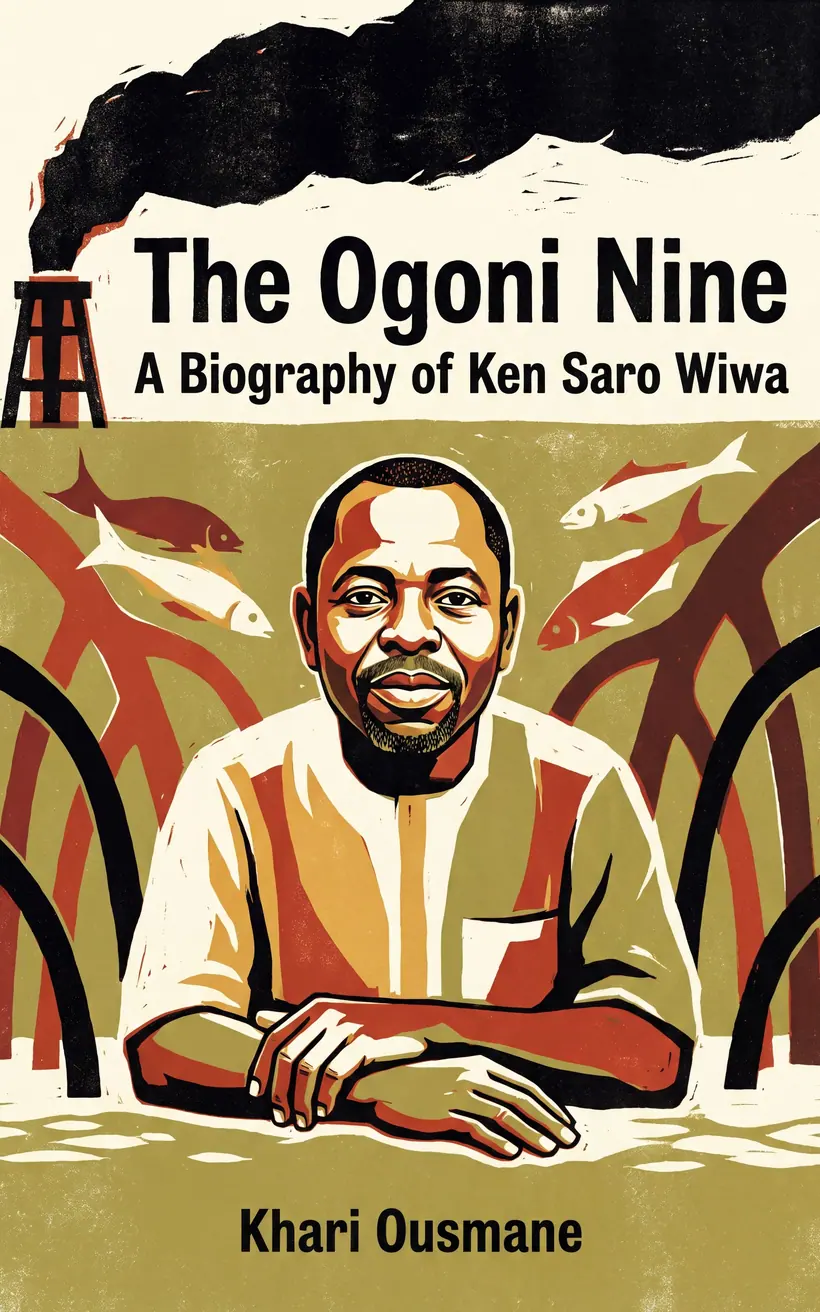
Kenule Beeson Saro-Wiwa. The title never carries the subject's name: it names one concrete thing out of the life — in this case The Ogoni Nine — and the name goes on the line underneath.
No. No subject, estate, label or foundation had approval over the text, and none paid for a word of it. The cost of that independence is that no new interviews were conducted for the book; it is built from the public record, and it says on the page where a scene is reconstructed rather than documented.
Yes — the whole opening chapter and the writer's foreword, free and in full, with no email address and no account. That is 3,631 words of the book.
About 38,500 words, 19 chapters, 132 pages in the paperback.
Paperback
Paperback · Hardcover
Paperback · Hardcover