The Thirty-Year Exile
Paperback
Ships in 2 to 5 working days. Delivery quoted from your address at checkout.
5,449 words · no email, no account
No. 073 · Music · World
a biography of Víctor Lidio Jara Martínez
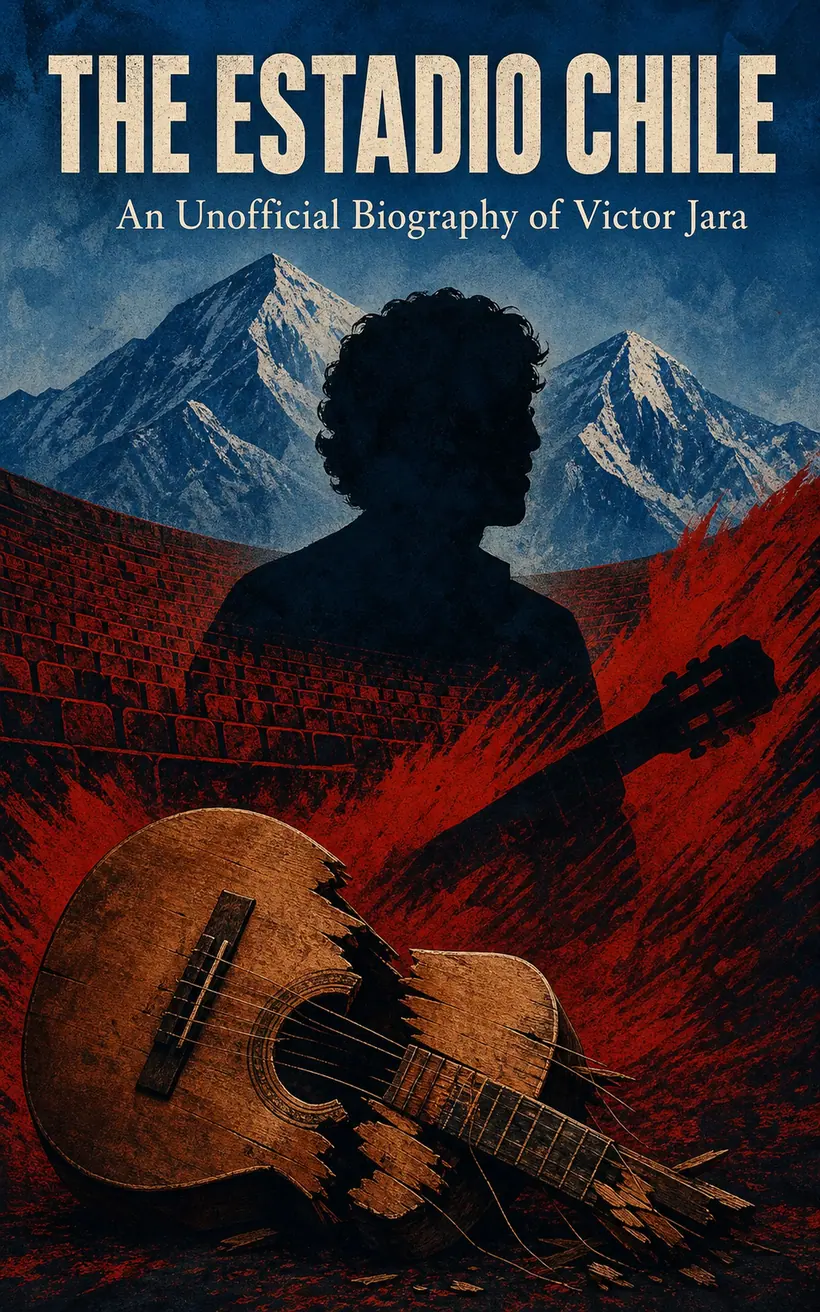
September 12, 1973, the Estadio Chile in Santiago. Víctor Lidio Jara Martínez, forty, the Chilean folk musician whose songs had soundtracked the Salvador Allende presidency, has been arrested by the soldiers of the Augusto Pinochet coup that overthrew the government the previous morning. He is held in the stadium with five thousand other detainees. Witnesses later testify that his captors broke his hands with rifle butts and mocked him to play guitar. On the morning of September 16, 1973, he is shot forty-four times. His body is dumped on a Santiago street. His widow Joan Jara, the British dancer, identifies him at the morgue.
Sandile Mokoena's biography opens earlier — in the Lonquén farming community south of Santiago, where Jara was born in 1932 — and follows the arc through the seminary years he abandoned, the University of Chile theatre school where he met Joan Turner, the long Nueva Canción Chilena movement, the Chile Stadium and El Derecho de Vivir en Paz recordings, the Manifiesto posthumous album, the September 1973 coup and the four days at the Estadio Chile, the long Joan Jara campaign for justice that lasted forty-five years, the 2018 conviction of eight retired Chilean army officers at the Santiago Court of Appeals, and the November 30, 2023 deportation of Pedro Pablo Barrientos Núñez from the United States to face Chilean prosecution.
What emerges is a portrait of the Chilean folk musician whose songs the Pinochet coup killed him for, and whose justice the four-decade campaign of his widow Joan secured — through Chilean criminal courts, U.S. federal civil courts, and finally an ICE deportation flight in November 2023.
The opening chapter is published in full — read it here.
The printed edition has no ISBN registered yet. It affects library and retail listing, not your order.
Víctor Lidio Jara Martínez. The title never carries the subject's name: it names one concrete thing out of the life — in this case The Estadio Chile — and the name goes on the line underneath.
No. No subject, estate, label or foundation had approval over the text, and none paid for a word of it. The cost of that independence is that no new interviews were conducted for the book; it is built from the public record, and it says on the page where a scene is reconstructed rather than documented.
Yes — the whole opening chapter and the writer's foreword, free and in full, with no email address and no account. That is 5,449 words of the book.
About 64,500 words, 19 chapters, 197 pages in the paperback.
6 × 9 in, 60# uncoated cream, black ink, perfect-bound paperback, matte laminate. Every title in the series uses the same specification, so they line up on a shelf.
Yes: torture; state-sponsored murder. They are listed before you buy rather than discovered afterwards. The material is handled as evidence, not as spectacle.
Listed before you buy, not after.
Paperback

Paperback