The Eight-Week March
Paperback
Ships in 2 to 5 working days. Delivery quoted from your address at checkout.
4,544 words · no email, no account
No. 080 · Movements · Civil Rights
a biography of Marie Louise Cruz (Sacheen Littlefeather)
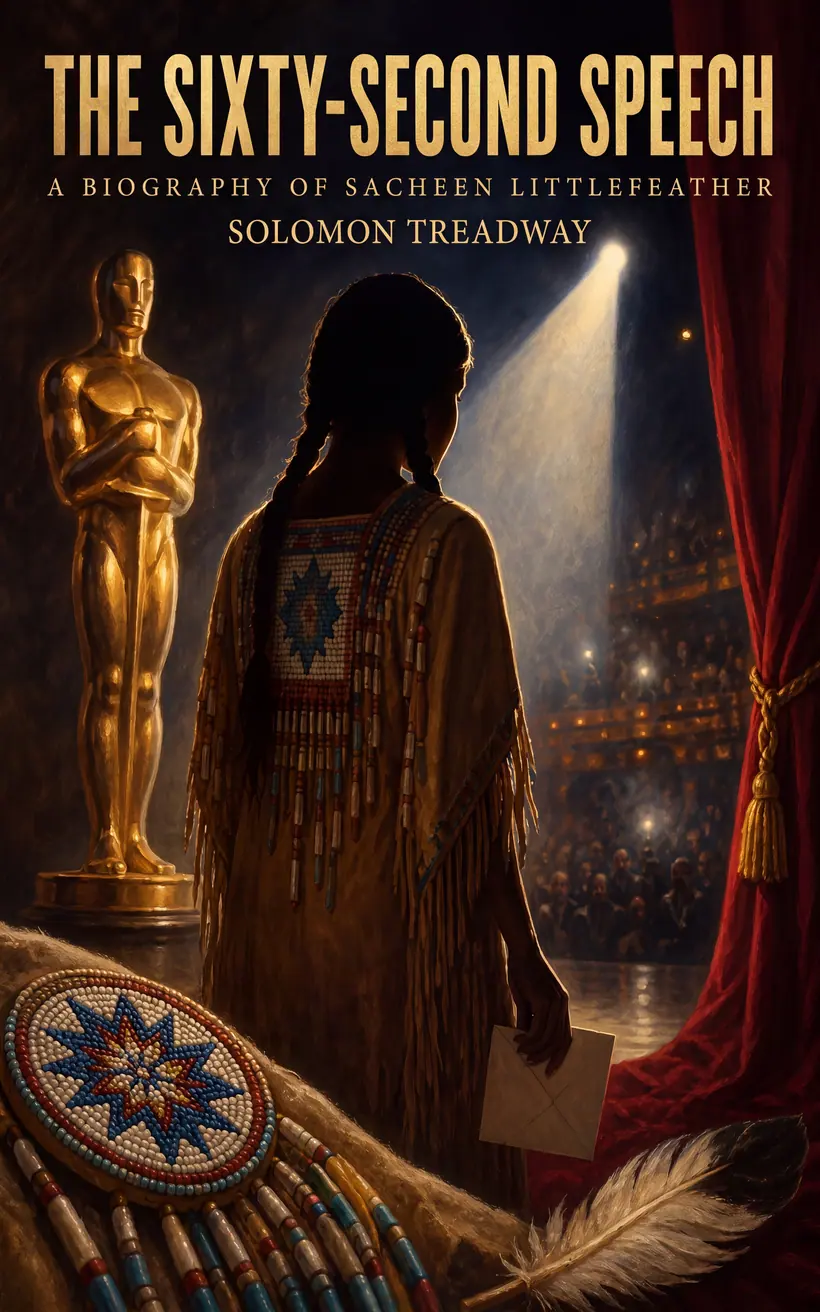
March 27, 1973, the 45th Academy Awards. Marlon Brando wins Best Actor for The Godfather. A twenty-six-year-old Apache and Yaqui woman in a beaded buckskin dress walks to the stage instead. Sacheen Littlefeather — born Marie Louise Cruz in Salinas, California, in 1946 — refuses the Oscar on Brando's behalf in protest of Hollywood's treatment of American Indians and the federal government's response to the Wounded Knee occupation then in its twenty-fifth day. She is given sixty seconds. The crowd, including John Wayne, jeers. She is blacklisted from Hollywood for the rest of her life.
Solomon Treadway's biography opens earlier — in the Salinas Valley, where Marie Louise was born in 1946 to a White Mountain Apache father and a European-American mother — and follows the arc through the tubercular childhood and the long custody fight, the 1960s San Francisco activist years and the 1971 founding of the National Native American Affirmative Image Committee, the Brando friendship and the Wounded Knee speech, the 1975 acting career that the academy boycott foreclosed, the long Daly City retirement, the 1991 long Reel Injun documentary appearance, the September 2022 Academy Award formal apology issued forty-nine years late, and the death of breast cancer at seventy-five on October 2, 2022, two weeks after the apology.
What emerges is a portrait of the Apache and Yaqui woman whose sixty seconds at the 1973 Academy Awards rewrote what Hollywood would have to answer for — and whose career the same town spent fifty years not giving her back.
The opening chapter is published in full — read it here.
The printed edition has no ISBN registered yet. It affects library and retail listing, not your order.
Marie Louise Cruz (Sacheen Littlefeather). The title never carries the subject's name: it names one concrete thing out of the life — in this case The Sixty-Second Speech — and the name goes on the line underneath.
No. No subject, estate, label or foundation had approval over the text, and none paid for a word of it. The cost of that independence is that no new interviews were conducted for the book; it is built from the public record, and it says on the page where a scene is reconstructed rather than documented.
Yes — the whole opening chapter and the writer's foreword, free and in full, with no email address and no account. That is 4,544 words of the book.
About 64,000 words, 19 chapters, 210 pages in the paperback.
6 × 9 in, 60# uncoated cream, black ink, perfect-bound paperback, matte laminate. Every title in the series uses the same specification, so they line up on a shelf.