The Eight-Week March
Paperback
Ships in 2 to 5 working days. Delivery quoted from your address at checkout.
6,750 words · no email, no account
No. 085 · Movements · Civil Rights
a biography of Araminta Ross (Harriet Tubman)
She was born Araminta Ross around 1822 on the Dorchester County, Maryland plantation of Anthony Thompson, the third or fourth child of an enslaved couple named Harriet Green and Ben Ross. She suffered a near-fatal head injury at twelve when an overseer threw a two-pound weight at another field hand that struck her instead. She escaped north to Philadelphia in September 1849 alone, returned south thirteen times between 1850 and 1860 to lead approximately seventy enslaved people to freedom through the Underground Railroad — she preferred a Saturday-night winter departure with a pistol — served as a U.S. Army scout and spy in the Combahee River Raid of June 1863, was the first woman to lead an armed military expedition in the Civil War, and lived to ninety-one in her Auburn, New York home. She died on March 10, 1913, at ninety-one.
Solomon Treadway's biography opens earlier and follows the arc with the documentary care a subject of this stature requires. The book traces the Dorchester County childhood, the head injury and the lifelong narcolepsy and visionary trances, the 1844 marriage to John Tubman, the 1849 escape, the Underground Railroad rescues, the Combahee River Raid, the long postwar fight for veterans' pensions, the 1869 marriage to Nelson Davis, the Auburn home and the AME Zion Church Home for the Aged, and the long final years that brought her to the centenary of her Maryland escape.
What emerges is a portrait of the Maryland-born Underground Railroad conductor and U.S. Army scout whose forty years of postwar organising the country has only in the twenty-first century begun to write into the official record.
The opening chapter is published in full — read it here.
The printed edition has no ISBN registered yet. It affects library and retail listing, not your order.
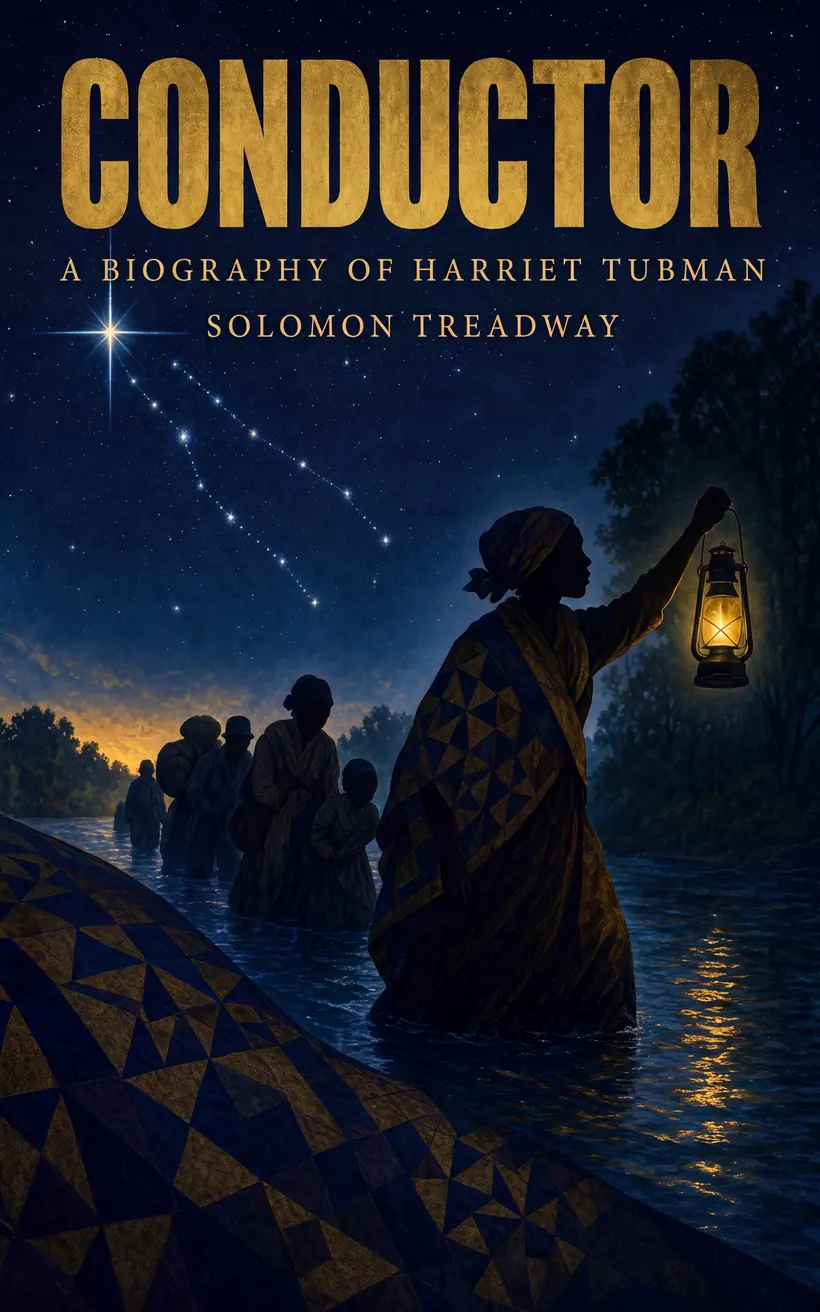
Araminta Ross (Harriet Tubman). The title never carries the subject's name: it names one concrete thing out of the life — in this case Conductor — and the name goes on the line underneath.
No. No subject, estate, label or foundation had approval over the text, and none paid for a word of it. The cost of that independence is that no new interviews were conducted for the book; it is built from the public record, and it says on the page where a scene is reconstructed rather than documented.
Yes — the whole opening chapter and the writer's foreword, free and in full, with no email address and no account. That is 6,750 words of the book.
About 60,500 words, 18 chapters, 188 pages in the paperback.
6 × 9 in, 60# uncoated cream, black ink, perfect-bound paperback, matte laminate. Every title in the series uses the same specification, so they line up on a shelf.