The Eight-Week March
Paperback
Ships in 2 to 5 working days. Delivery quoted from your address at checkout.
3,980 words · no email, no account
No. 095 · Movements · Civil Rights
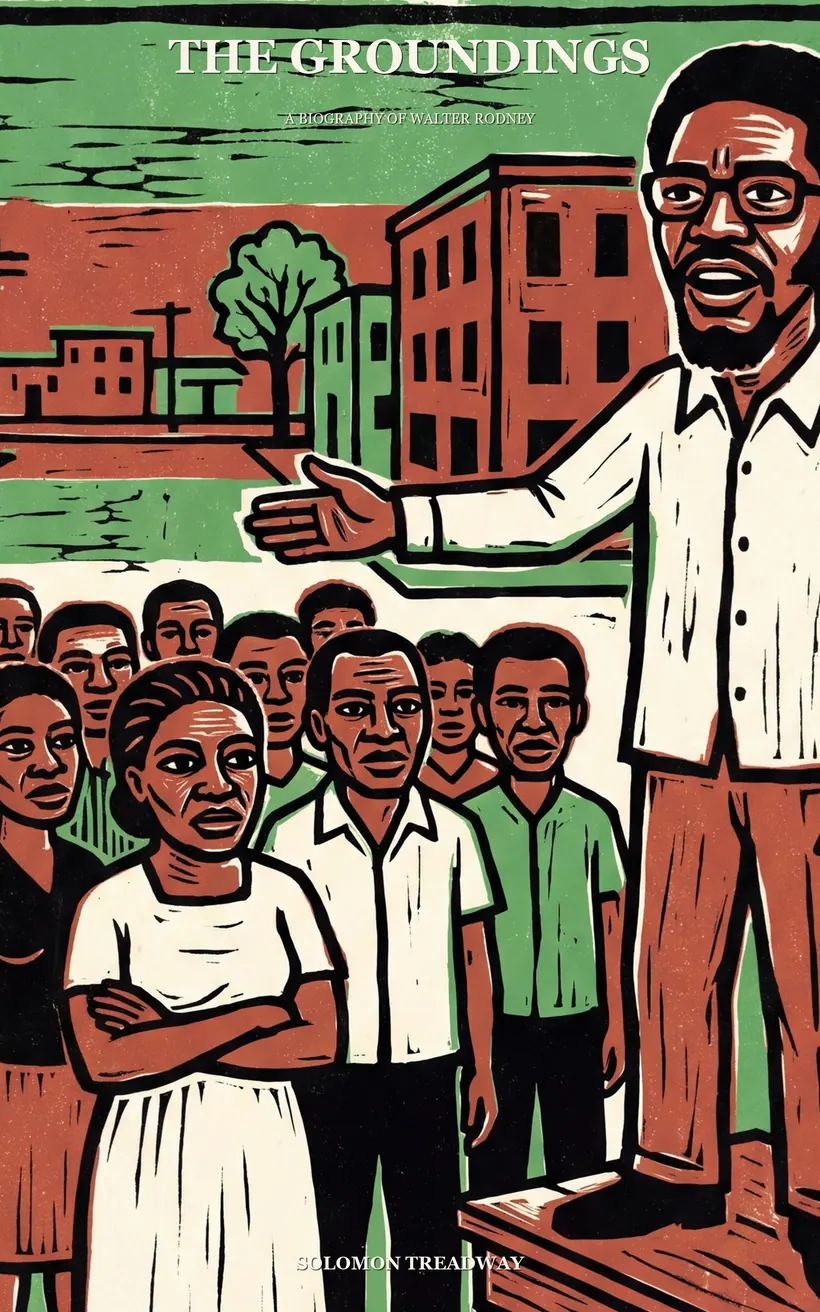
a biography of Walter Anthony Rodney
June 13, 1980, Camp Street, Georgetown, Guyana. Walter Rodney, thirty-eight, the Pan-Africanist historian and author of How Europe Underdeveloped Africa, is killed when a walkie-talkie his brother Donald is holding in the passenger seat of his car explodes. It has been given to them by Sergeant Gregory Smith of the Guyana Defence Force. Smith flees to French Guiana. The Forbes Burnham government denies involvement. A Guyana Commission of Inquiry in 2016 finds that the assassination was orchestrated by the Burnham regime.
Solomon Treadway's biography opens earlier — in Georgetown, where Walter Anthony Rodney was born in 1942, the son of a People's Progressive Party tailor — and follows the arc through Queen's College Georgetown, the University of the West Indies at Mona, the doctoral work at the School of Oriental and African Studies in London, the Dar es Salaam years at the University of Dar es Salaam, the 1968 declaration as a prohibited immigrant from Jamaica after his black-power lectures sparked the Rodney Riots, the publication of How Europe Underdeveloped Africa in 1972, the founding of the Working People's Alliance in Guyana in 1974, the long Burnham campaign of arrests and surveillance, and the morning on Camp Street.
What emerges is a portrait of the Pan-Africanist historian whose How Europe Underdeveloped Africa remade the historiography of the continent and the Caribbean, and whose Guyanese assassination the country's own commission of inquiry took thirty-six years to formally attribute to the state.
The opening chapter is published in full — read it here.
The printed edition has no ISBN registered yet. It affects library and retail listing, not your order.
Walter Anthony Rodney. The title never carries the subject's name: it names one concrete thing out of the life — in this case The Groundings — and the name goes on the line underneath.
No. No subject, estate, label or foundation had approval over the text, and none paid for a word of it. The cost of that independence is that no new interviews were conducted for the book; it is built from the public record, and it says on the page where a scene is reconstructed rather than documented.
Yes — the whole opening chapter and the writer's foreword, free and in full, with no email address and no account. That is 3,980 words of the book.
About 60,500 words, 18 chapters, 196 pages in the paperback.
6 × 9 in, 60# uncoated cream, black ink, perfect-bound paperback, matte laminate. Every title in the series uses the same specification, so they line up on a shelf.