The Bargain
Paperback · Hardcover
Ships in 2 to 5 working days. Delivery quoted from your address at checkout.
4,472 words · no email, no account
No. 106 · Crime · Crime
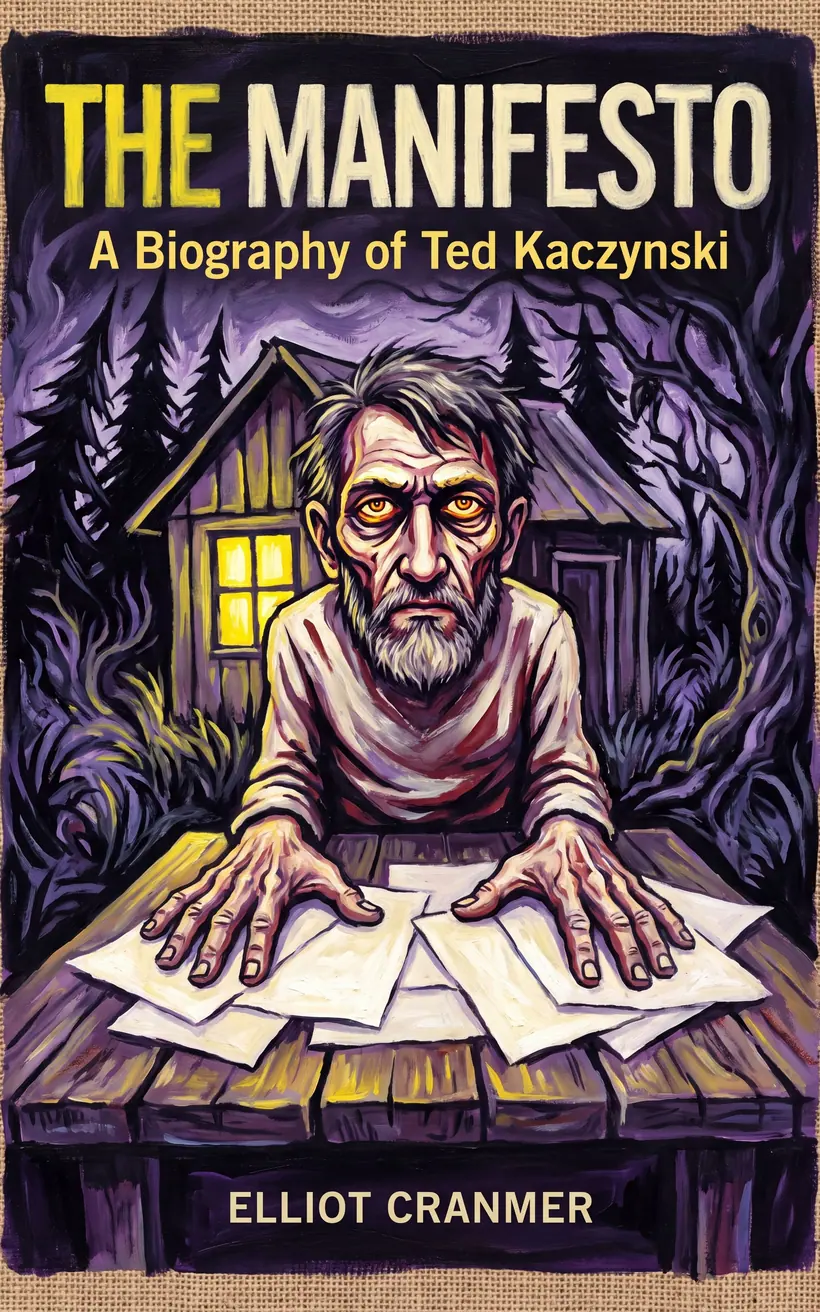
a biography of Theodore John Kaczynski
April 3, 1996, a one-room cabin at 1.4 mile post on Stemple Pass Road outside Lincoln, Montana. FBI agents arrest a fifty-three-year-old hermit named Theodore John Kaczynski. They find inside the cabin a typewriter, an unmailed mail bomb, a journal documenting the construction of sixteen bombs that, over seventeen years (1978-1995), have killed three people and injured twenty-three. He has been the FBI's longest-running fugitive case. The case was broken when his brother David recognised the prose style of the New York Times/Washington Post manifesto Industrial Society and Its Future — published under FBI sanction on September 19, 1995 in the hope of identification — and contacted the bureau in February 1996.
Elliot Cranmer's biography opens earlier — in the Evergreen Park, Illinois childhood — and follows the arc through the Harvard freshman year at sixteen, the long Henry Murray psychological-stress experiment Kaczynski participated in as an undergraduate, the University of Michigan mathematics doctorate, the assistant professorship at UC Berkeley that he resigned in 1969 at twenty-six, the 1971 move to the Stemple Pass cabin, the 1978 first bomb at Northwestern, the Industrial Society manifesto, the David Kaczynski letter to the FBI in February 1996, the Sacramento federal trial of 1997-98, the life sentence without parole at the Florence ADX, and the suicide at the FMC Butner federal medical center on June 10, 2023.
What emerges is a portrait of the Harvard mathematician turned domestic terrorist whose seventeen-year mail-bomb campaign and anti-technological manifesto the FBI required his own brother to solve — and whose June 2023 prison-cell suicide closed the case but not the literature.
The opening chapter is published in full — read it here.
The printed edition has no ISBN registered yet. It affects library and retail listing, not your order.
Theodore John Kaczynski. The title never carries the subject's name: it names one concrete thing out of the life — in this case The Manifesto — and the name goes on the line underneath.
No. No subject, estate, label or foundation had approval over the text, and none paid for a word of it. The cost of that independence is that no new interviews were conducted for the book; it is built from the public record, and it says on the page where a scene is reconstructed rather than documented.
Yes — the whole opening chapter and the writer's foreword, free and in full, with no email address and no account. That is 4,472 words of the book.
About 63,000 words, 19 chapters, 205 pages in the paperback.
6 × 9 in, 60# uncoated cream, black ink, perfect-bound paperback, matte laminate. Every title in the series uses the same specification, so they line up on a shelf.
Yes: domestic terrorism; homicide; suicide. They are listed before you buy rather than discovered afterwards. The material is handled as evidence, not as spectacle.
Listed before you buy, not after.
Paperback · Hardcover
Digital edition
Paperback · Hardcover