The Lanai Purchase
Paperback
Download link emailed the moment payment clears.
4,589 words · no email, no account
No. 107 · Technology & Money · Technology
a biography of Palmer Freeman Luckey
Why did Facebook fire the man whose prototype it had bought for $2 billion? In March 2017 the Daily Beast disclosed a $10,000 donation Palmer Luckey had made to a pro-Trump meme-shop. Five months later he founded Anduril Industries. By 2026 the defense-technology company he built in the wake of that firing is valued at $14 billion.
The prototype came first. Luckey, born in Long Beach, California, on September 19, 1992, was the eldest of four children of a car salesman and a homemaker, and his mother homeschooled him. He bought his first virtual-reality headset on eBay at fifteen and taught himself to solder optical lenses. At nineteen he built the Oculus Rift prototype in his parents' garage. He founded Oculus VR in 2012 with Brendan Iribe, Michael Antonov, Nate Mitchell, Andrew Reisse and Jack McCauley, raised $2.4 million on Kickstarter, and sold the company to Facebook in March 2014.
Sterling Aldridge's biography traces the whole line: the homeschooled Long Beach years and the modOculus VR forum, the journalism semester at California State University Long Beach, the Kickstarter and the Facebook sale, the 2014 marriage to Nicole Edelmann, the 2017 firing, and the founding of Anduril with Trae Stephens, Matt Grimm and Brian Schimpf. It follows the company into the work that made its name — the Project Maven Pentagon AI-targeting contract that Google had refused, the Sentry border-security towers, the Roadrunner counter-drone interceptor and the Anvil counter-drone airframe — and into the Newport Beach years, including the first Trump fundraiser at his Lido Isle home in October 2020.
What emerges is a portrait of a homeschooled California teenager whose garage virtual-reality prototype Facebook bought for $2 billion — and of the most-watched post-Silicon Valley military-industrial company of the second half of the 2020s.
The opening chapter is published in full — read it here.
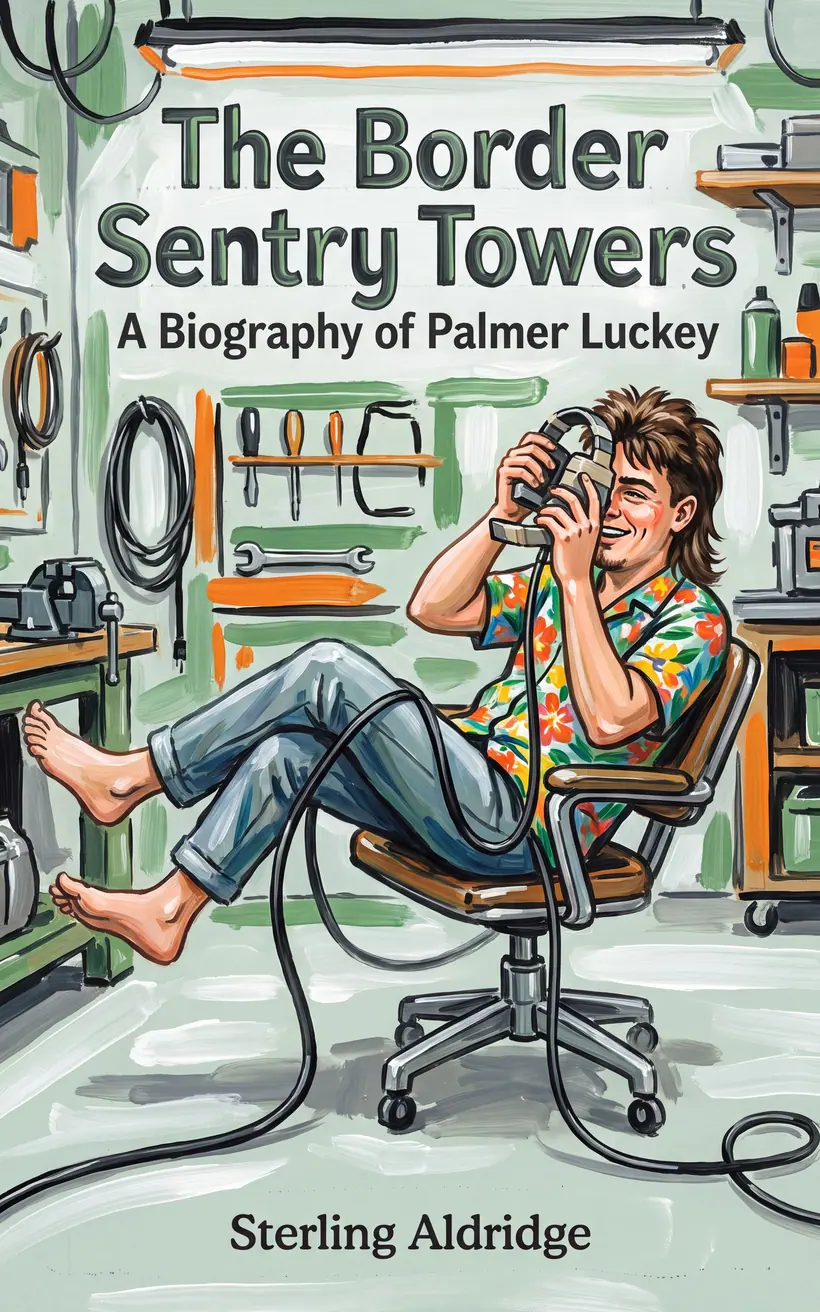
Palmer Freeman Luckey. The title never carries the subject's name: it names one concrete thing out of the life — in this case The Border Sentry Towers — and the name goes on the line underneath.
No. No subject, estate, label or foundation had approval over the text, and none paid for a word of it. The cost of that independence is that no new interviews were conducted for the book; it is built from the public record, and it says on the page where a scene is reconstructed rather than documented.
Yes — the whole opening chapter and the writer's foreword, free and in full, with no email address and no account. That is 4,589 words of the book.
About 62,000 words, 19 chapters, 204 pages in the paperback.