The Download
Paperback · Hardcover
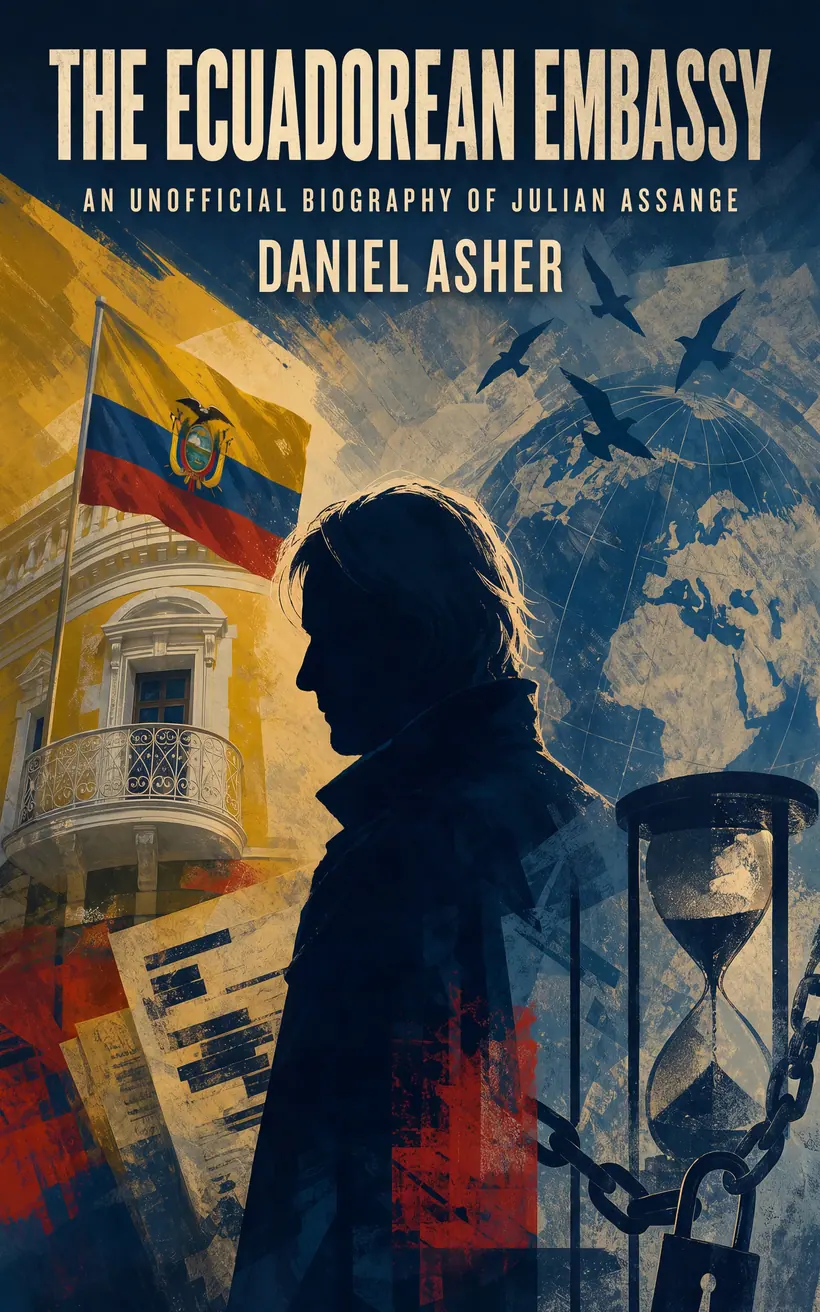
Download link emailed the moment payment clears.
4,245 words · no email, no account
No. 151 · Movements · Dissidents & Whistleblowers
a biography of Julian Paul Assange
April 11, 2019. Metropolitan Police officers enter the Ecuadorean Embassy at 3 Hans Crescent in London at the invitation of Ecuadorean president Lenín Moreno and arrest Julian Paul Assange, forty-seven, the Australian co-founder of WikiLeaks who has been living in the embassy under asylum since June 19, 2012. He is carried out of the embassy. He spends the next five years at HM Prison Belmarsh fighting extradition to the United States on eighteen federal charges, seventeen of them under the 1917 Espionage Act. On June 24, 2024, he is freed via a plea agreement in the U.S. District Court for the Northern Mariana Islands. The deal credits him for time served. He returns to Australia on June 26, 2024, fifty-two years old, after fifteen years of various forms of detention.
Daniel Asher's biography opens earlier — in Townsville, Queensland, where Assange was born in 1971 to a teen-mother drama-school owner — and follows the arc through the Magnetic Island and Lismore years and the early-1990s Underground hacking arrests, the long University of Melbourne physics-and-math studies that he did not complete, the 2006 founding of WikiLeaks in Reykjavík, the November 2010 release of the U.S. State Department cables that Chelsea Manning had leaked, the August 2010 Swedish sexual-assault allegations, the June 2012 Ecuadorean Embassy asylum, the seven-year embassy residence, the April 2019 arrest, the long Belmarsh extradition fight, and the June 2024 Saipan plea.
What emerges is a portrait of the Australian co-founder of WikiLeaks whose fifteen-year confinement the U.S. federal government secured under the Espionage Act — and whose return to Australia in June 2024 ended a case the digital-civil-liberties movement has spent fifteen years organising around.
The opening chapter is published in full — read it here.
Julian Paul Assange. The title never carries the subject's name: it names one concrete thing out of the life — in this case The Ecuadorean Embassy — and the name goes on the line underneath.
No. No subject, estate, label or foundation had approval over the text, and none paid for a word of it. The cost of that independence is that no new interviews were conducted for the book; it is built from the public record, and it says on the page where a scene is reconstructed rather than documented.
Yes — the whole opening chapter and the writer's foreword, free and in full, with no email address and no account. That is 4,245 words of the book.
About 58,500 words, 19 chapters, 192 pages in the paperback.
Paperback · Hardcover

Digital edition