The Counting Video
Digital edition
Download link emailed the moment payment clears.
3,819 words · no email, no account
No. 157 · Technology & Money · Internet Culture
a biography of Dávid Julián Dobrík
How does a channel with 14 million subscribers lose every advertiser it has in one week? In March 2021, Insider published an investigation into a sexual-assault allegation against Dom Zeglaitis, a friend of David Dobrik's, arising from a 2018 Vlog Squad event. DoorDash, Honda, EA Sports and SeatGeek were gone within days of each other. Dobrik took a three-month hiatus and, as of 2026, has not returned to the subscriber growth he left behind.
Daniel Asher's biography begins long before that week. Dávid Julián Dobrík was the eldest of four children in Košice, Slovakia; the family emigrated to the United States when he was six, and he grew up in Vernon Hills, Illinois, on a Slovak passport and a DACA visa. He posted his first Vine video at sixteen, moved to Los Angeles at nineteen, and from 2015 built the Vlog Squad group-vlog channel on YouTube. The 4:20 second vlogs became a format of record for a generation. The Tesla giveaways ran at roughly a free Model 3 a month for the channel's most loyal viewers.
Asher covers the Vine years and the Second Class compilation channel, the move to West Hollywood and the founding of the Vlog Squad, the early Twitter feuds, the relationships with Tana Mongeau and Liza Koshy, the Doff hat brand, and the Dispo photo-sharing app he co-founded with Spark Capital backing between 2019 and 2021. The money after March 2021 gets the same attention: Spark Capital and Sequoia Capital both wrote down the Dispo investment. The book closes in the quiet years of 2022 to 2026, split between Slovakia and a Wyoming property.
What emerges is a portrait of a Slovak-American creator whose vlog format and Tesla giveaways changed what online video could look like, and of the investigation that ended the era he had defined. The DACA status his YouTube career formally regularised runs under all of it.
The opening chapter is published in full — read it here.
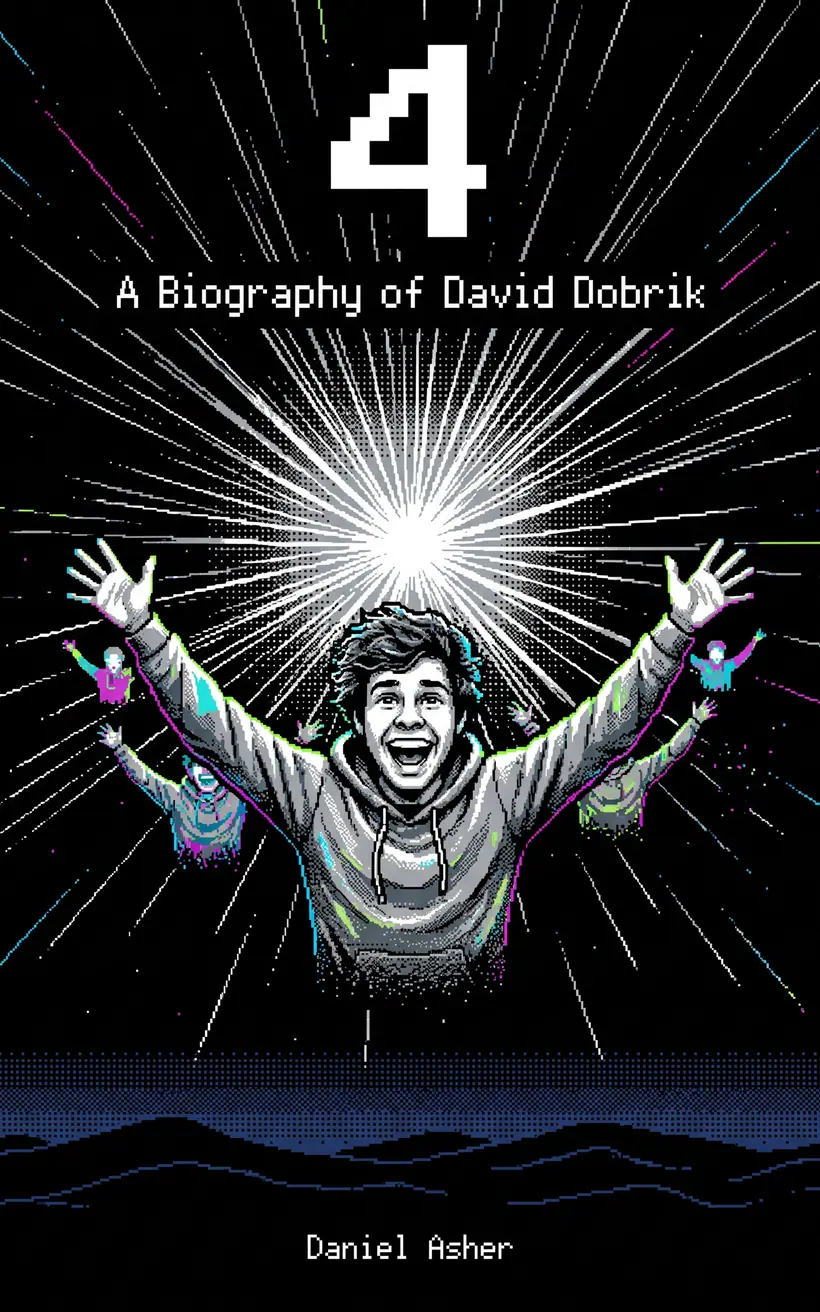
Dávid Julián Dobrík. The title never carries the subject's name: it names one concrete thing out of the life — in this case 4 — and the name goes on the line underneath.
No. No subject, estate, label or foundation had approval over the text, and none paid for a word of it. The cost of that independence is that no new interviews were conducted for the book; it is built from the public record, and it says on the page where a scene is reconstructed rather than documented.
Yes — the whole opening chapter and the writer's foreword, free and in full, with no email address and no account. That is 3,819 words of the book.
About 63,500 words, 18 chapters, 208 pages in the paperback.