The Eight-Week March
Paperback
Download link emailed the moment payment clears.
4,214 words · no email, no account
No. 243 · Movements · Civil Rights
a biography of Martin Luther King Jr.
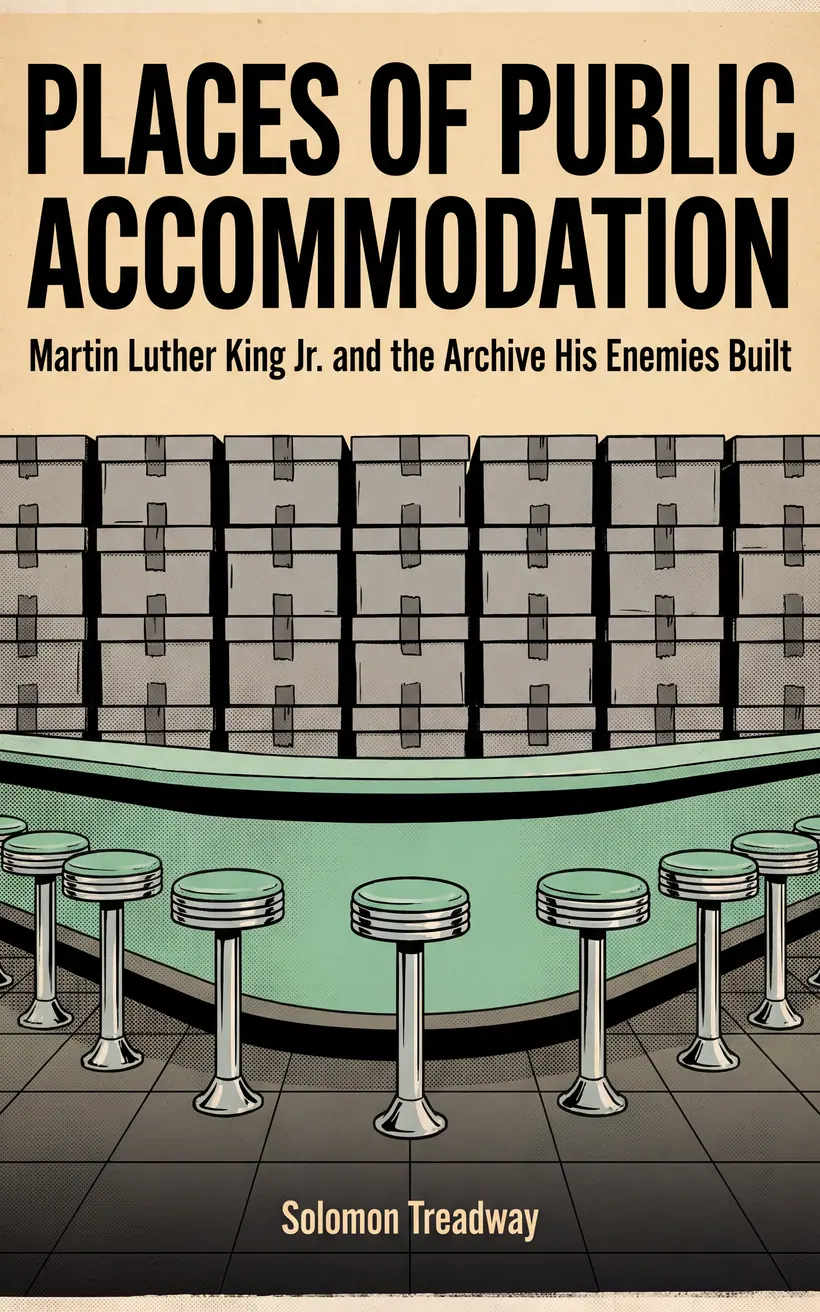
A federal court order of 31 January 1977 sent every tape, transcript and log of the FBI's surveillance of Martin Luther King Jr. to the National Archives under seal for fifty years. Judge John Lewis Smith Jr. had just dismissed two suits over the buggings, ruling that they had been too widely reported to sue over. His order describes the recordings as harvested from the places of public accommodation occupied by Martin Luther King, Jr. Those are the words of Title Two of the Civil Rights Act of 1964, the law King's movement won, the law that opened the country's hotels and lunch counters. The government used his own statute to name where it put the microphones. The seal lapses on 31 January 2027.
King took the pulpit at Dexter Avenue Baptist Church in 1954, led the Montgomery bus boycott, and was the only president the SCLC knew from its founding in 1957 until his death. He wrote the Letter from Birmingham Jail on Good Friday 1963, accepted the Nobel Peace Prize, and gave every dollar of the money away. He was shot on the second-floor gallery of the Lorraine Motel on 4 April 1968, at thirty-nine.
Twenty-one chapters argue that his power was a real and specific mechanism that can be described. That is why Albany, where Laurie Pritchett arrested people politely and gave the cameras nothing, matters here more than the March on Washington, and why Birmingham was afterwards designed around a man who would not decline to be brutal. The state's answer was not argument. It was a wiretap authorisation in October 1963, and a package containing a tape and an anonymous letter giving him thirty-four days to remove himself, which his wife opened and played alone.
The evidence is government paper: memoranda, routing slips, the sealing order, the Church Committee, and the assassination records released in July 2025. Where a claim rests on the Bureau's paraphrase of a recording no historian has heard, the book says so, and ends at the vault rather than at a verdict.
The opening chapter is published in full — read it here.
Martin Luther King Jr.. The title never carries the subject's name: it names one concrete thing out of the life — in this case Places of Public Accommodation — and the name goes on the line underneath.
No. No subject, estate, label or foundation had approval over the text, and none paid for a word of it. The cost of that independence is that no new interviews were conducted for the book; it is built from the public record, and it says on the page where a scene is reconstructed rather than documented.
Yes — the whole opening chapter and the writer's foreword, free and in full, with no email address and no account. That is 4,214 words of the book.
About 64,500 words, 21 chapters, 210 pages in the paperback.