The Buffalo Funk
Paperback
Download link emailed the moment payment clears.
4,715 words · no email, no account
No. 261 · Music · R&B & Soul
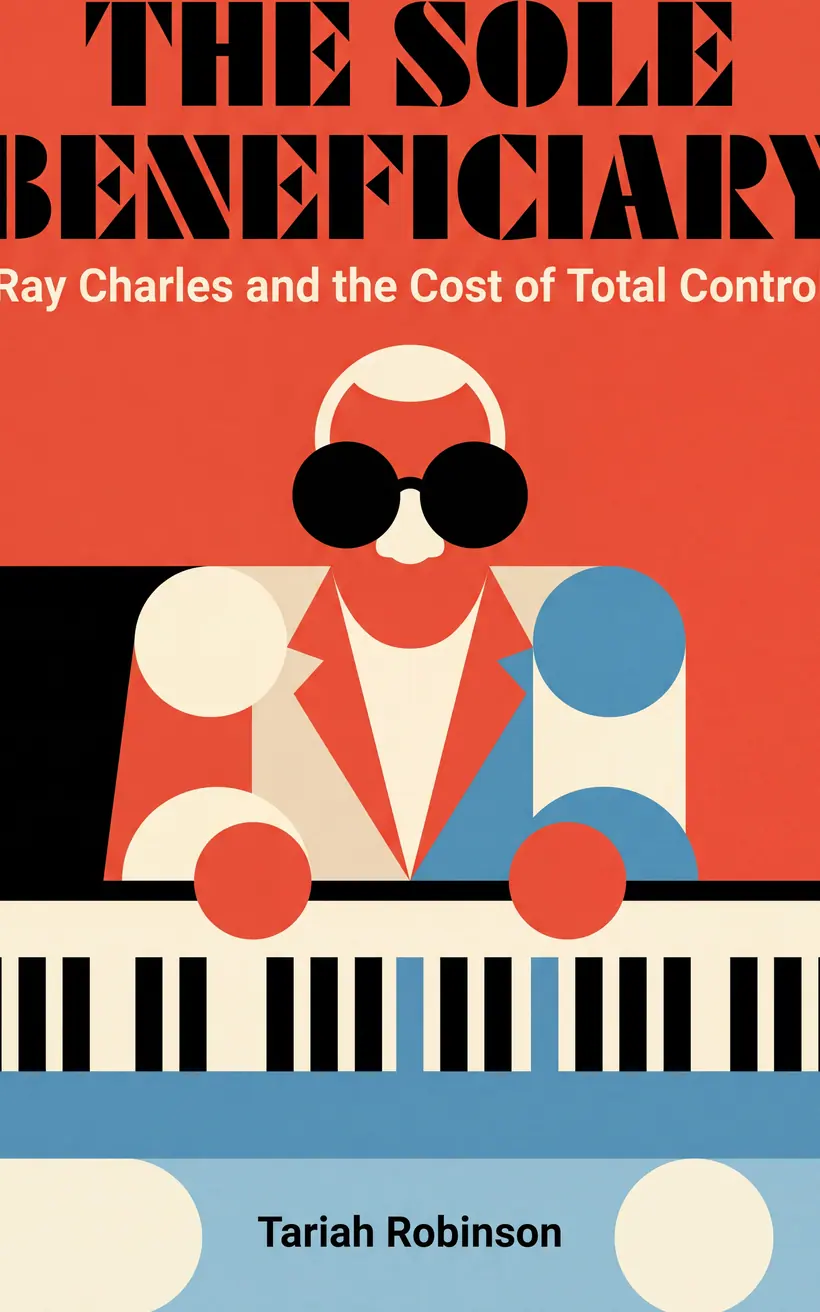
a biography of Ray Charles Robinson
Twelve children, five hundred thousand dollars each, and twelve signatures. In 2002 Ray Charles offered each of his children an irrevocable trust on one condition: a document, quoted verbatim in a published federal opinion, stating that the gift was the entire inheritance and waiving any claim against his estate. All twelve signed. In March 2010, six years after his death, seven of them filed thirty-nine termination notices covering fifty-one compositions, among them "I Got a Woman." On March 28, 2012 the Ray Charles Foundation, the sole beneficiary of his estate, sued those seven, and asked the court to declare the songs works made for hire: that in the 1950s Ray Charles was an employee of his publishers and had never owned them at all. That is an allegation in a pleading, never tried, and the book says so every time it uses it.
The argument is that the admired Ray Charles and the unlovely one are not an artist and a tyrant sharing a body but one faculty pointed at different materials. He would not be handled. The disposition is visible before the blindness is, in a boy who got onto a piano stool in Wylie Pitman's café in Greenville, Florida, because the instrument answered him and nobody else. That faculty produced arrangements for a seventeen-piece band carried entire in a memory with no score anywhere, his own label and publishing company, a building on West Washington Boulevard with the studio downstairs and the payroll counted upstairs in cash. It also produced a band run on fines, twelve children by at least nine women raised mostly in other people's houses on a monthly figure, and at the end twelve waivers. The inspirational version is refused because it is made of things that are not true: the piano came before the blindness, and the lifetime ban from Georgia never existed. Where the record stops, the book stops. His children had signed away every claim on everything he left. They held the one thing he could not sign away — the music.
The opening chapter is published in full — read it here.
Ray Charles Robinson. The title never carries the subject's name: it names one concrete thing out of the life — in this case The Sole Beneficiary — and the name goes on the line underneath.
No. No subject, estate, label or foundation had approval over the text, and none paid for a word of it. The cost of that independence is that no new interviews were conducted for the book; it is built from the public record, and it says on the page where a scene is reconstructed rather than documented.
Yes — the whole opening chapter and the writer's foreword, free and in full, with no email address and no account. That is 4,715 words of the book.
About 74,000 words, 22 chapters, 238 pages in the paperback.
Paperback
Paperback · Hardcover
Paperback · Hardcover