The Bargain
Paperback · Hardcover
Download link emailed the moment payment clears.
4,362 words · no email, no account
No. 272 · Crime · Crime
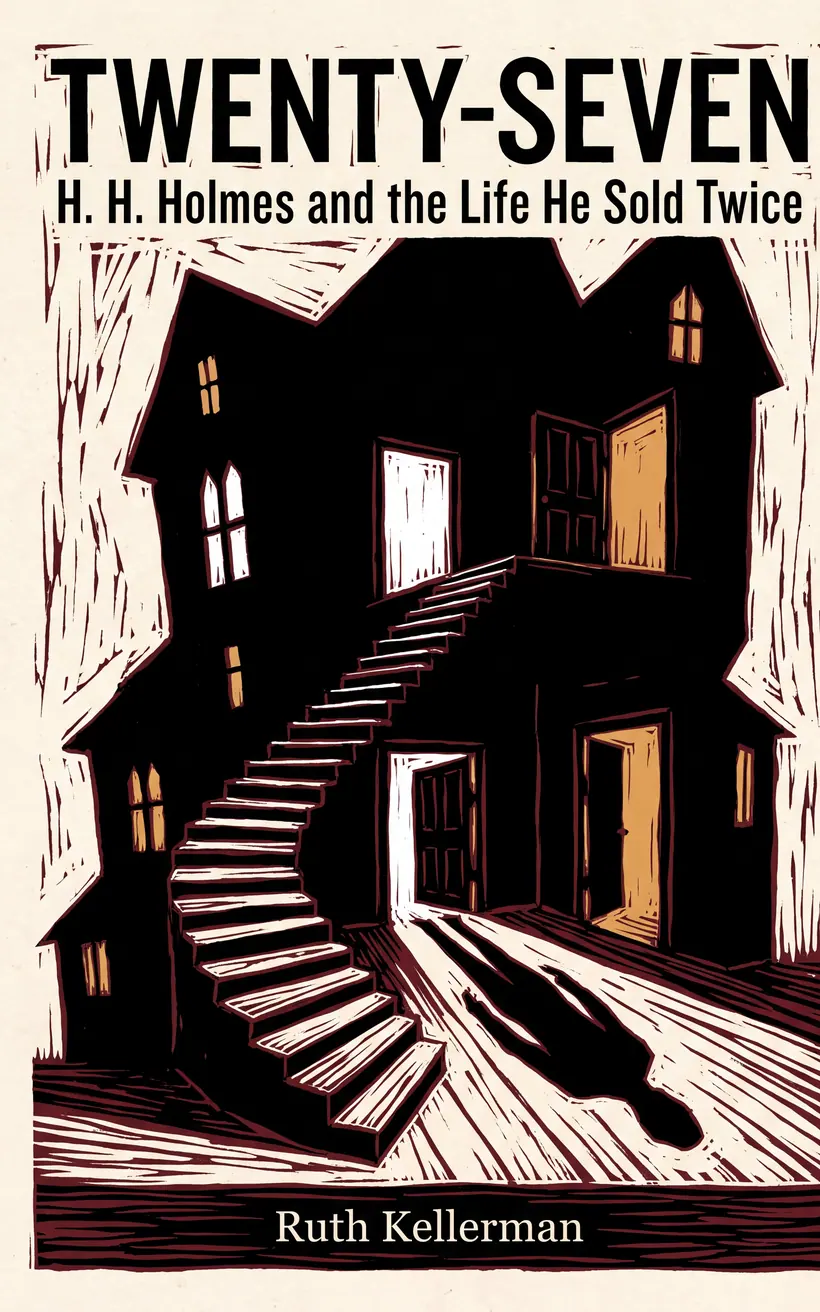
a biography of Herman Webster Mudgett, known as H. H. Holmes
The contract set a length, a deadline and a fee. A newspaper syndicate issued it. The man writing to it was under sentence of death at Moyamensing Prison, and in April 1896 he produced in longhand an account of twenty-seven murders. On the scaffold the following month he retracted almost all of it, and several of the people he had confessed to killing were later shown alive. Almost everything the public believes about H. H. Holmes descends from those pages, and has been descending for a hundred and thirty years.
Twenty-seven was never a count. It was a price, set the way he set every other figure in his life. The documents show a career fraudster in credit, property and insurance — chattel mortgages on goods already mortgaged, suppliers left unpaid, property moved between aliases, small suits from creditors who could never find the same man twice — who killed instrumentally, cheaply, and mostly to close a hole in a scheme. Twelve chapters pass before a body is proved. That is deliberate.
Four killings are proved. Benjamin Pitezel died at 1316 Callowhill Street in September 1894, chloroform in him, a pipe placed beside the body, ten thousand dollars of Fidelity Mutual behind it. Then three of his children — Alice at thirteen, Nellie at nine, Howard at seven — moved by rail through a string of cities that autumn. Detective Frank P. Geyer worked five cities boarding house by boarding house for nine weeks, his map the letters Alice had written home and handed to Holmes to post, which he pocketed and kept.
The Englewood block is read as the architecture of non-payment rather than of murder, with the counter-case in the same chapter: there was a vault, there was a basement, and a floor plan is not an alibi. The airtight vault, the body chute, the gas chamber and the crematorium date to the week they were printed in the Chicago papers, July 1895 — before the building burned, not because of it. The list of twenty-seven names is not reproduced.
The opening chapter is published in full — read it here.
Herman Webster Mudgett, known as H. H. Holmes. The title never carries the subject's name: it names one concrete thing out of the life — in this case Twenty-Seven — and the name goes on the line underneath.
No. No subject, estate, label or foundation had approval over the text, and none paid for a word of it. The cost of that independence is that no new interviews were conducted for the book; it is built from the public record, and it says on the page where a scene is reconstructed rather than documented.
Yes — the whole opening chapter and the writer's foreword, free and in full, with no email address and no account. That is 4,362 words of the book.
About 72,500 words, 22 chapters, 234 pages in the paperback.
Paperback · Hardcover
Digital edition

Paperback · Hardcover