The Bunker Hours
Paperback
Ships in 2 to 5 working days. Delivery quoted from your address at checkout.
4,440 words · no email, no account
No. 022 · Power & Politics · American Politics
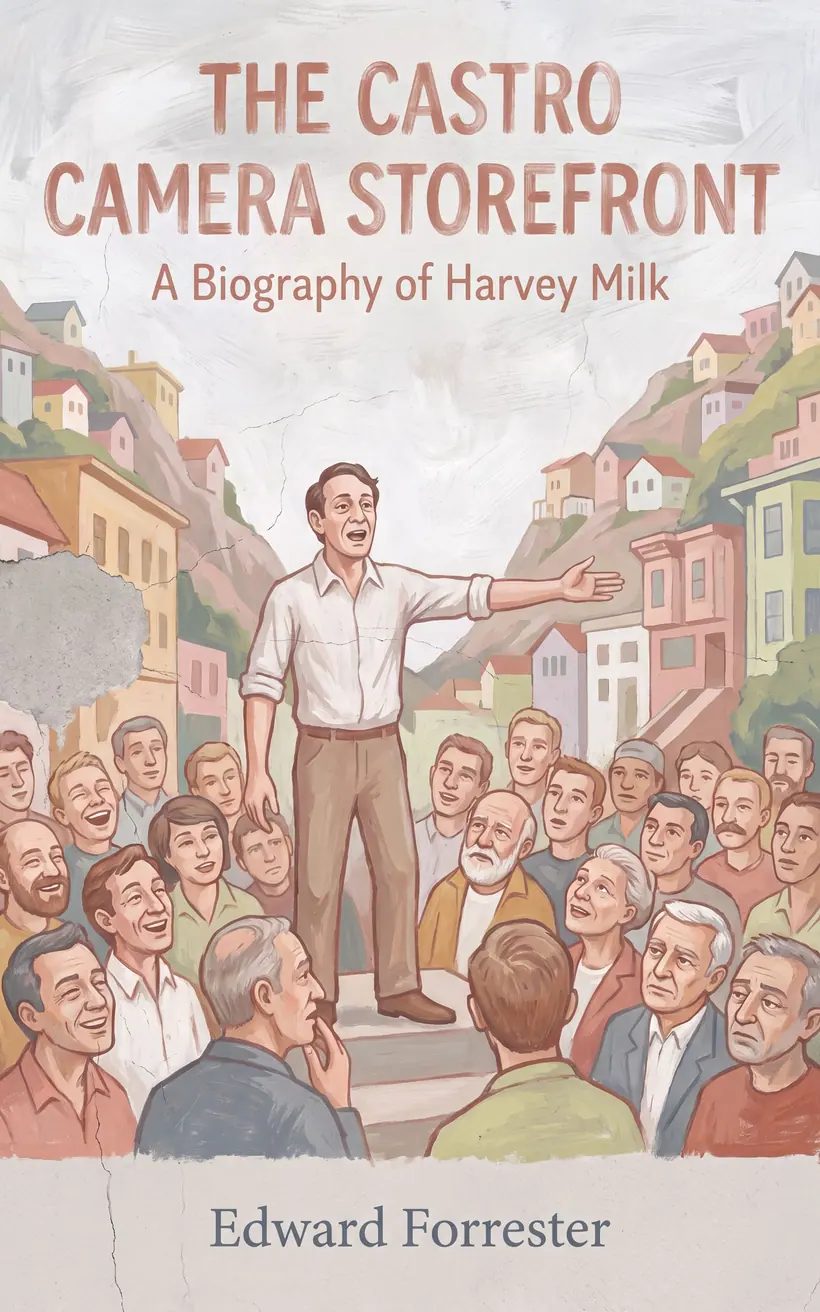
a biography of Harvey Bernard Milk
On a November morning in 1978, the doors of San Francisco City Hall opened onto a country that had not yet decided what to do with the man inside. Harvey Milk had come a long way from the camera shop on Castro Street — past three failed campaigns, past the rented suits and the bullhorns, past the friends who told him to wait his turn. He did not wait.
Edward Forrester follows Milk from a closeted boyhood on Long Island through the Navy, the financial district, and the bohemian drift west, into the neighborhood that would remake him. He traces the slow construction of a public self: the speeches rehearsed in diner booths, the coalitions built block by block, the recorded tape left in a desk drawer in case he was killed.
Drawing on oral histories, campaign ephemera, and the private letters of the men and women who loved and argued with him, Forrester reconstructs the texture of a movement still in the act of inventing itself — Anita Bryant on the radio, Proposition 6 on the ballot, a city learning a new vocabulary in public.
What emerges is a portrait of a politician who understood that hope was not a feeling but a strategy, and of the country that received his message and the one that did not.</p>
The opening chapter is published in full — read it here.
The printed edition has no ISBN registered yet. It affects library and retail listing, not your order.
Harvey Bernard Milk. The title never carries the subject's name: it names one concrete thing out of the life — in this case The Castro Camera Storefront — and the name goes on the line underneath.
No. No subject, estate, label or foundation had approval over the text, and none paid for a word of it. The cost of that independence is that no new interviews were conducted for the book; it is built from the public record, and it says on the page where a scene is reconstructed rather than documented.
Yes — the whole opening chapter and the writer's foreword, free and in full, with no email address and no account. That is 4,440 words of the book.
About 60,000 words, 18 chapters, 194 pages in the paperback.
6 × 9 in, 60# uncoated cream, black ink, perfect-bound paperback, matte laminate. Every title in the series uses the same specification, so they line up on a shelf.