Room 607
Paperback
Download link emailed the moment payment clears.
3,976 words · no email, no account
No. 041 · Screen & Stage · Performing Arts
a biography of Louis Székely (Louis C.K.)
The last chapter is an argument in print. Since the 2020 album Sincerely Louis C.K., the comedy press has been running long-form pieces about whether the comeback was earned. The comeback began at the Comedy Cellar in 2018, after a fifteen-month withdrawal. The withdrawal began on November 9, 2017, when The New York Times published a story about five women who said he had masturbated in front of them. He confirmed the accusations the next day. I Love You, Daddy was pulled from distribution. The HBO and FX deals were cancelled. The tours were cancelled.
Donovan Hadley's biography goes back for the rest. Louis Székely was born on September 12, 1967, in Washington, D.C., the son of a Mexican-Hungarian-Jewish economist and an Irish-American software programmer, and his parents divorced when he was ten. He started stand-up at seventeen. The book follows the Mexico City childhood, the Newton, Massachusetts, high-school years, the long apprenticeship at the Boston Comedy Club, the move to New York and the Late Night with Conan O'Brien writing room, The Dana Carvey Show, and the bewildering 2001 directorial debut of Pootie Tang. Then Louie, the FX series he made from 2010 to 2015 and the one Hadley calls the masterpiece, the Saturday Night Live hosting, and six Emmy Awards.
What the book is finally about is a decade of not asking. He was the most influential American comedian of his decade. The comedy press covered him, FX bankrolled him, his peers worked beside him, and for ten years none of them put the question to him. That is the story the November 2017 piece interrupted, and it is the story the comeback arguments are still circling.
The opening chapter is published in full — read it here.
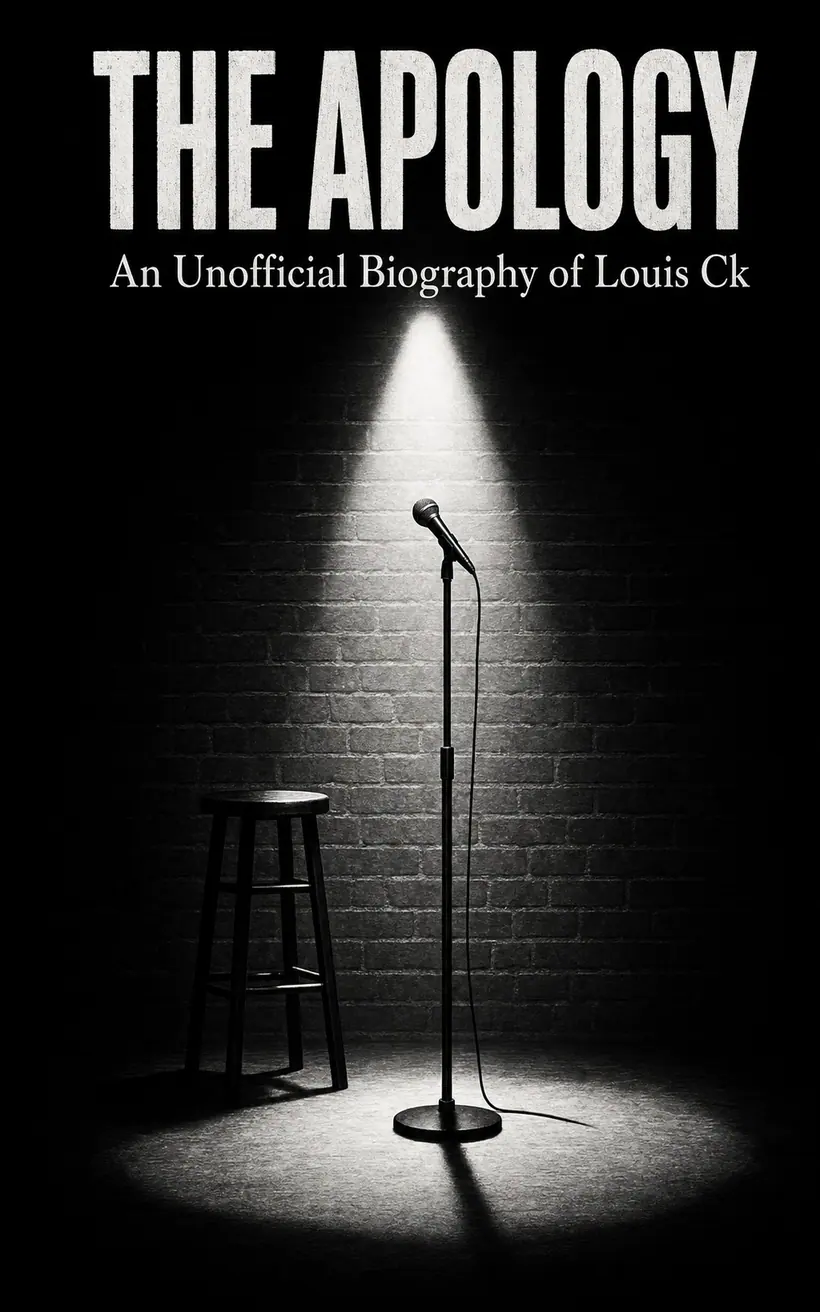
Louis Székely (Louis C.K.). The title never carries the subject's name: it names one concrete thing out of the life — in this case The Apology — and the name goes on the line underneath.
No. No subject, estate, label or foundation had approval over the text, and none paid for a word of it. The cost of that independence is that no new interviews were conducted for the book; it is built from the public record, and it says on the page where a scene is reconstructed rather than documented.
Yes — the whole opening chapter and the writer's foreword, free and in full, with no email address and no account. That is 3,976 words of the book.
About 59,500 words, 18 chapters, 196 pages in the paperback.
Yes: sexual misconduct allegations. They are listed before you buy rather than discovered afterwards. The material is handled as evidence, not as spectacle.
Listed before you buy, not after.