The Castro Camera Storefront
Paperback · Hardcover
Ships in 2 to 5 working days. Delivery quoted from your address at checkout.
4,859 words · no email, no account
No. 063 · Power & Politics · American Politics
a biography of Wilma Pearl Mankiller
December 5, 1985, Tahlequah, Oklahoma. Wilma Pearl Mankiller is sworn in as the first woman Principal Chief of the Cherokee Nation. She is forty. She inherits a nation of 100,000 enrolled members emerging from a federal-termination decade, a 1970s economic decline, and a patriarchal council that has not seriously consulted a woman before. Over the next ten years she triples enrolment, builds the Bell, Oklahoma, community water system, and negotiates the 1990 Self-Determination Compact that returned to the Cherokee Nation the authority to administer its own federal funds.
Theodore Pemberton's biography opens earlier — in the Rocky Mountain, Oklahoma, sharecropping community where Mankiller was born in 1945 to a Cherokee father and a Dutch-Irish mother — and follows the arc through the federal Bureau of Indian Affairs Relocation Program that moved the family to San Francisco in 1957, the 1969 Alcatraz occupation that the book treats as her political education, the Cherokee Nation community-development director years, the 1979 head-on car accident with her best friend Sherry Morris that nearly killed her, the 1985 ascension, the 1991 election to a full term with 82 percent of the vote, the 1995 retirement after lupus and breast cancer, the 1998 Presidential Medal of Freedom, and the death at Stilwell, Oklahoma in 2010 at sixty-four.
What emerges is a portrait of the Cherokee Nation's first woman Principal Chief and one of the most consequential American Indian self-determination organisers of the twentieth century.
The opening chapter is published in full — read it here.
The printed edition has no ISBN registered yet. It affects library and retail listing, not your order.
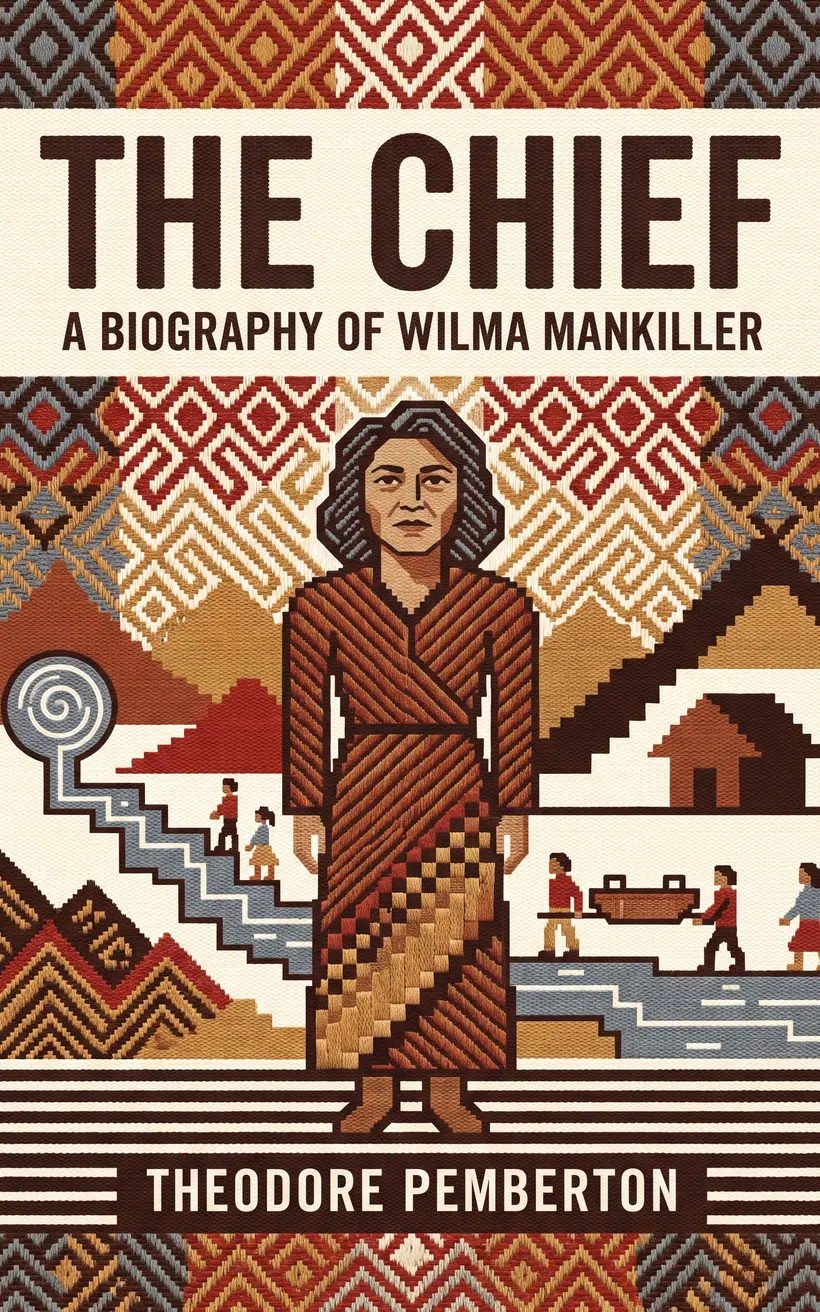
Wilma Pearl Mankiller. The title never carries the subject's name: it names one concrete thing out of the life — in this case The Chief — and the name goes on the line underneath.
No. No subject, estate, label or foundation had approval over the text, and none paid for a word of it. The cost of that independence is that no new interviews were conducted for the book; it is built from the public record, and it says on the page where a scene is reconstructed rather than documented.
Yes — the whole opening chapter and the writer's foreword, free and in full, with no email address and no account. That is 4,859 words of the book.
About 60,500 words, 18 chapters, 198 pages in the paperback.
6 × 9 in, 60# uncoated cream, black ink, perfect-bound paperback, matte laminate. Every title in the series uses the same specification, so they line up on a shelf.