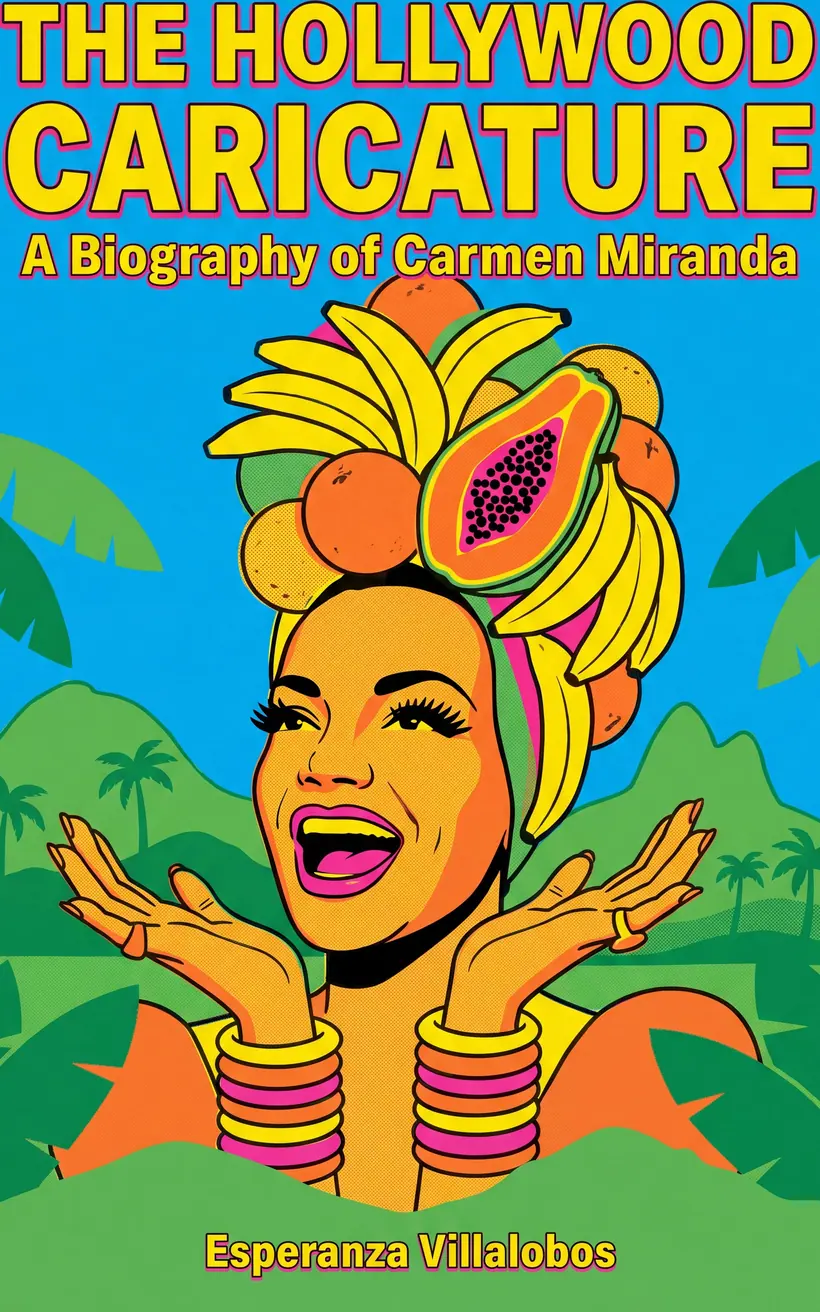
The Days Inn Room 158
Paperback · Hardcover
Ships in 2 to 5 working days. Delivery quoted from your address at checkout.
3,184 words · no email, no account
No. 091 · Music · Latin
a biography of Maria do Carmo Miranda da Cunha
The fruit hat is the whole memory. In the United States Carmen Miranda survives as a Hollywood novelty: a costume, a musical-revue number, a caricature. That version was built in a Hollywood costume department in the 1940s. It carries nothing of the years of Brazilian radio, records and casino stages that came first, or of the woman who was the highest-paid in Brazil by 1939.
Maria do Carmo Miranda da Cunha was born in Marco de Canaveses, Portugal, on February 9, 1909, the second of six children of a barber; the family emigrated to Rio de Janeiro while she was an infant. She sang on Brazilian radio from 1928 and had her first hit, Pra Você Gostar de Mim (Taí), in 1930. There was a long residency at the Cassino da Urca and a film breakthrough in Vai Começar a Batucada. Lee Shubert saw her at the Urca in February 1939 and took her to New York for The Streets of Paris. By 1944 she was the highest-paid woman in the United States.
Esperanza Villalobos works from the Lusophone archive that Miranda's American legacy has done without: the Rio childhood, the Urca years, the Fox contract under Darryl F. Zanuck, the fruit-hat costume and the That Night in Rio and Week-End in Havana revue cycle, the Brazilian critics who accused her of selling out, the 1947 marriage to David Sebastian, and the late-career Vegas residencies.
On the night of August 4, 1955 she collapsed on Jimmy Durante's NBC television show in Beverly Hills. She finished her song. She walked off stage. She died of a heart attack at her Beverly Hills home the next morning, at forty-six. What Hollywood made of her body in the 1940s was a caricature, and it is the part that survived. The catalogue she recorded in Portuguese is a different account of the same woman, and Brazilian popular music has spent the eighty years since writing it back into the record.
The opening chapter is published in full — read it here.
The printed edition has no ISBN registered yet. It affects library and retail listing, not your order.
Maria do Carmo Miranda da Cunha. The title never carries the subject's name: it names one concrete thing out of the life — in this case The Hollywood Caricature — and the name goes on the line underneath.
No. No subject, estate, label or foundation had approval over the text, and none paid for a word of it. The cost of that independence is that no new interviews were conducted for the book; it is built from the public record, and it says on the page where a scene is reconstructed rather than documented.
Yes — the whole opening chapter and the writer's foreword, free and in full, with no email address and no account. That is 3,184 words of the book.
About 60,500 words, 18 chapters, 195 pages in the paperback.
6 × 9 in, 60# uncoated cream, black ink, perfect-bound paperback, matte laminate. Every title in the series uses the same specification, so they line up on a shelf.
Paperback · Hardcover
Paperback
Digital edition