The Hare Krishna Years
Paperback
Ships in 2 to 5 working days. Delivery quoted from your address at checkout.
5,093 words · no email, no account
No. 118 · Music · Rock
a biography of John Michael Osbourne
Aston, 1968. The back-to-backs of working-class Birmingham smell of slaughterhouse runoff and rain. In a damp council house on Lodge Road, a nearsighted, dyslexic teenager called John Michael Osbourne drifts between a tool press, a holding cell, and the threadbare stages of the West Midlands club circuit. He picks up a microphone because there is nothing else to pick up. Within two years, the four-piece he fronts will invent a genre and rename the decade.
Roderick Penraith traces the long arc between the boy who was beaten by his teachers and the man the tabloids christened the Prince of Darkness — from the back-to-backs of Aston to the stages of California, from Sabbath's first riff to the mansion in Beverly Hills where he raised three children on camera and somehow lived. Penraith is unsentimental about the wreckage — the firings, the bottle, the bat, the wife who became his manager and his keeper — but she is also alert to what is rare in her subject: an unguarded sweetness, a willingness to be the joke, a voice that reached for grief when the music turned heavy.
Drawing on bandmates, roadies, neighbors, and decades of Osbourne's own contradictory testimony, Penraith assembles a portrait of an unlikely survivor — frontman, addict, husband, reality-television patriarch, occasional Latin scholar of his own myth.
What emerges is a study of working-class fame in the late twentieth century, and of the strange grace by which a man known for darkness spent fifty years, in his own crooked way, refusing to disappear.
The opening chapter is published in full — read it here.
The printed edition has no ISBN registered yet. It affects library and retail listing, not your order.
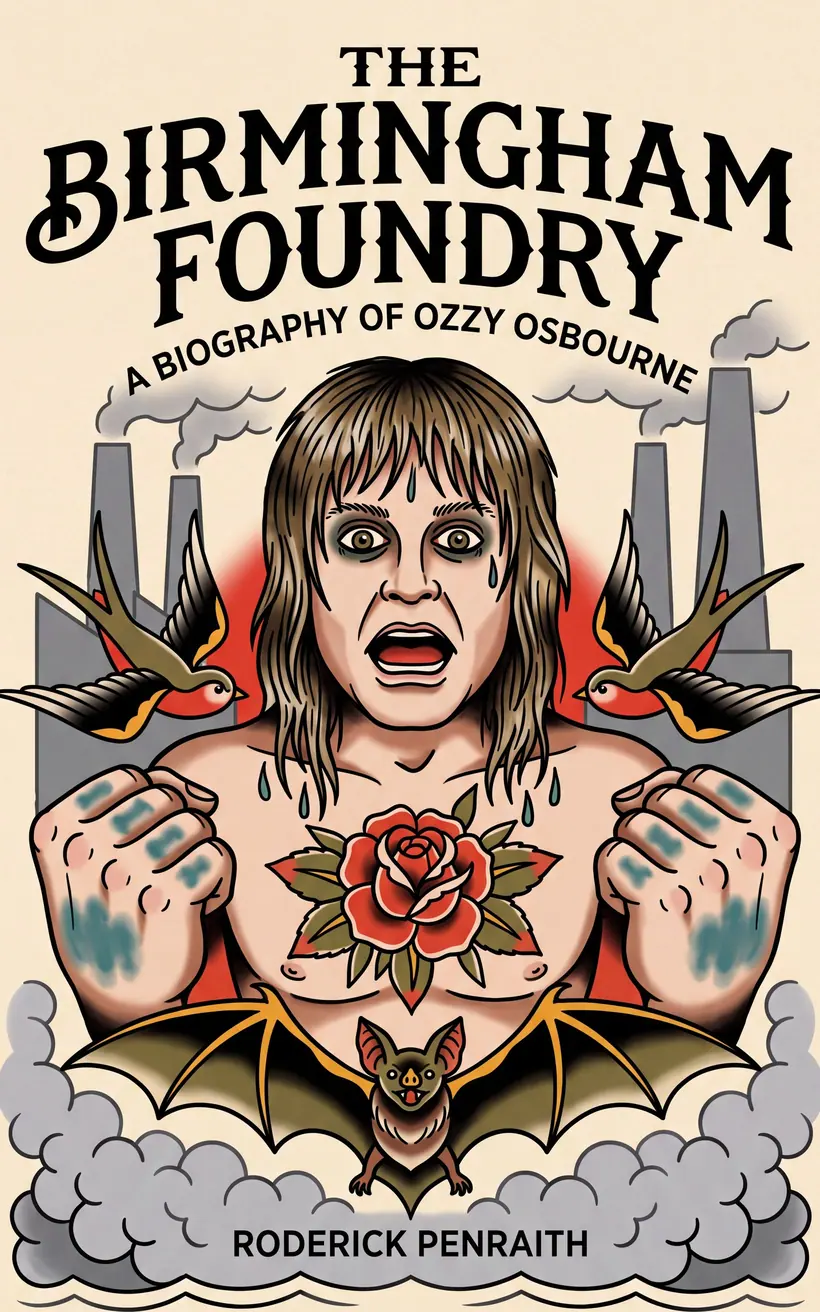
John Michael Osbourne. The title never carries the subject's name: it names one concrete thing out of the life — in this case The Birmingham Foundry — and the name goes on the line underneath.
No. No subject, estate, label or foundation had approval over the text, and none paid for a word of it. The cost of that independence is that no new interviews were conducted for the book; it is built from the public record, and it says on the page where a scene is reconstructed rather than documented.
Yes — the whole opening chapter and the writer's foreword, free and in full, with no email address and no account. That is 5,093 words of the book.
About 61,000 words, 19 chapters, 195 pages in the paperback.
6 × 9 in, 60# uncoated cream, black ink, perfect-bound paperback, matte laminate. Every title in the series uses the same specification, so they line up on a shelf.