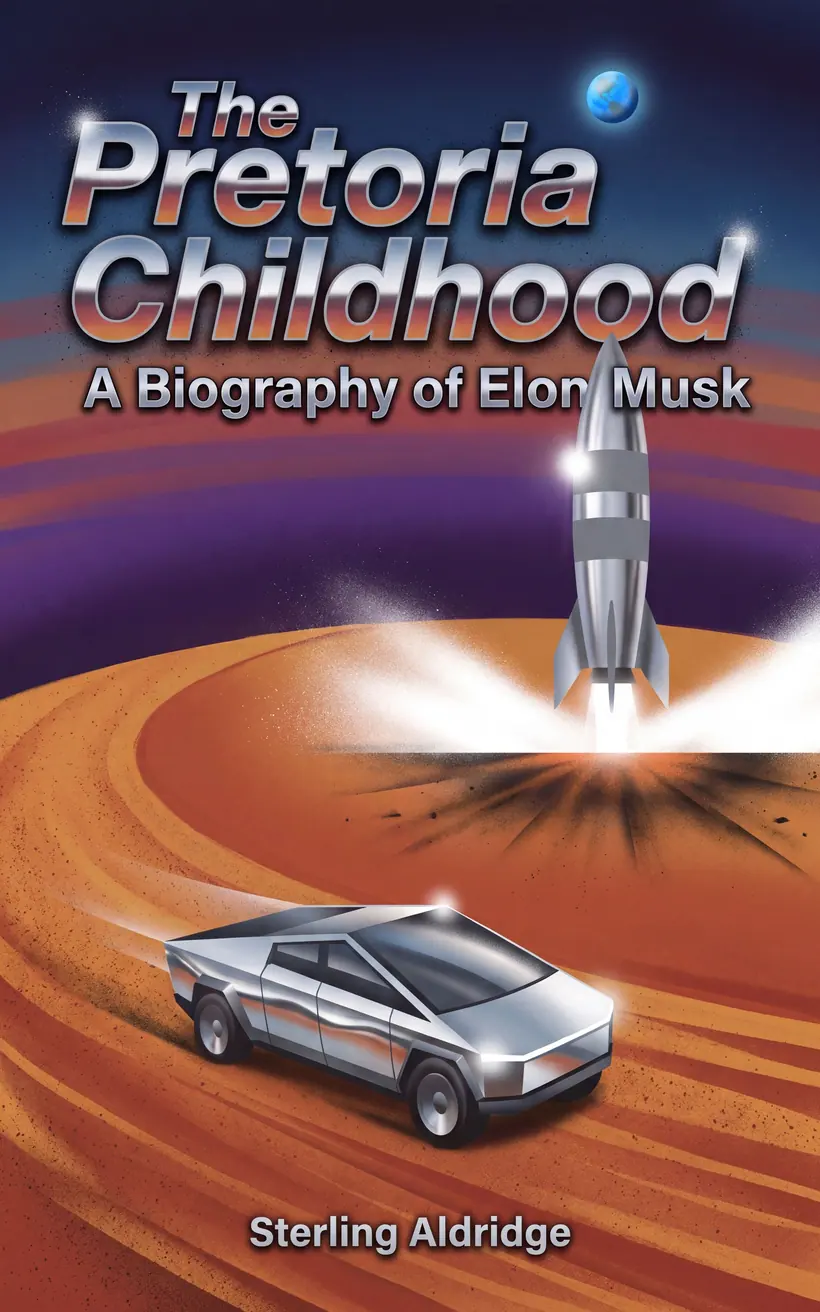
The Lanai Purchase
Paperback
Download link emailed the moment payment clears.
4,036 words · no email, no account
No. 120 · Technology & Money · Technology
a biography of Elon Reeve Musk
In January 2025 the decision was somebody else's. He was appointed to the Department of Government Efficiency, and he was out of it by May. His endorsement of Donald Trump in 2024 and his presence at Mar-a-Lago that November had led to the job; the job lasted four months.
The rest runs longer. Pretoria, South Africa, June 28, 1971, the eldest son of an English-Afrikaner electromechanical engineer and a Canadian model. Canada at seventeen. The United States at twenty-four, for a Stanford physics PhD he abandoned in two days. Then Zip2 in 1995 with his brother Kimbal, X.com in 1999, SpaceX in 2002, Tesla Motors in 2004 as a Series A investor and chairman before he took the CEO role in 2008, SolarCity in 2006 with his cousins Lyndon and Peter Rive, Neuralink and the Boring Company in 2016, the $44-billion Twitter acquisition in 2022, xAI in 2023. By 2026 he is the richest person in the world.
Sterling Aldridge's biography opens earlier and follows the arc with the procedural rigour the subject's network demands: the Pretoria childhood and the bullying at the Penseroso school, the years at Queen's University in Kingston and at the University of Pennsylvania, the two-day appearance at Stanford, the founding of Zip2 and X.com and the PayPal mafia that came out of it, the SpaceX founding and the fourth-launch success of Falcon 1 in 2008, the Tesla Model S launch of 2012 and the long autopilot era, the conversion of Twitter into a public-policy soapbox in 2020 and the purchase of it in 2022, the DOGE appointment and the May 2025 departure, and the quiet of 2026 around Starship at Boca Chica and the Optimus Gen-3 humanoid robot.
What emerges is a portrait of a Pretoria-born American industrialist whose ten companies and whose ownership of the platform he argues public policy on have made him, more than any other private person of the early twenty-first century, the gravitational center of the technology and the politics of the period.
The opening chapter is published in full — read it here.
Elon Reeve Musk. The title never carries the subject's name: it names one concrete thing out of the life — in this case The Pretoria Childhood — and the name goes on the line underneath.
No. No subject, estate, label or foundation had approval over the text, and none paid for a word of it. The cost of that independence is that no new interviews were conducted for the book; it is built from the public record, and it says on the page where a scene is reconstructed rather than documented.
Yes — the whole opening chapter and the writer's foreword, free and in full, with no email address and no account. That is 4,036 words of the book.
About 64,500 words, 19 chapters, 210 pages in the paperback.