Room 607
Paperback
Download link emailed the moment payment clears.
3,860 words · no email, no account
No. 154 · Screen & Stage · Performing Arts
a biography of Robin McLaurin Williams
August 11, 2014, his Paradise Cay, California home. Robin McLaurin Williams, sixty-three, the comedian whose ad-libbed energy had defined American comedy for forty years, hangs himself in his bedroom. His wife Susan Schneider finds him at 11:45 a.m. The post-mortem will diagnose him with diffuse Lewy body dementia — the most aggressive form of the disease — which had been misdiagnosed in his final months as Parkinson's disease.
Donovan Hadley's biography opens earlier — in Bloomfield Hills, Michigan, where Robin McLaurin Williams was born in 1951 to a Ford-Motor-Company executive — and follows the arc through the Detroit Country Day School and the Marin Country Day School years after the move to Tiburon, the Juilliard years with John Houseman and the long roommate-with-Christopher-Reeve, the Mork & Mindy breakthrough of 1978, the long stand-up career at the Holy City Zoo in San Francisco, the Good Morning, Vietnam and Dead Poets Society film years, the 1989 Hollywood Bowl benefit for John Belushi's mother, the 1997 Academy Award for Good Will Hunting, the long cocaine and alcohol history of the 1980s and the 2003-2006 relapse, the 2009 open-heart surgery, the Mrs. Doubtfire Broadway musical that opened December 5, 2021 (long after his death), the 2013 Parkinson's misdiagnosis, the Lewy body dementia, and the morning of August 11.
What emerges is a portrait of the most beloved American comedian of his generation — and of the late-life neurodegenerative disease the medical literature did not have the diagnostic vocabulary to read in his lifetime.
The opening chapter is published in full — read it here.
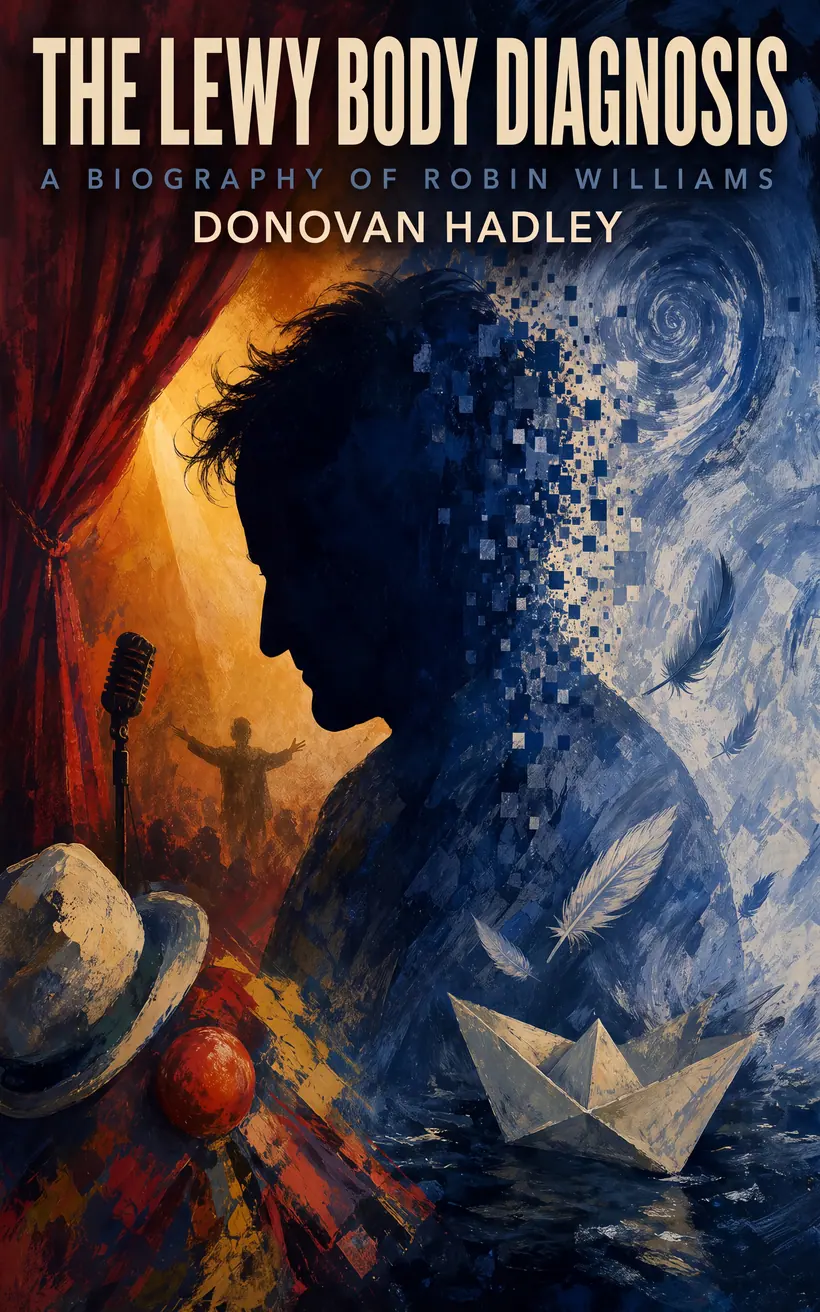
Robin McLaurin Williams. The title never carries the subject's name: it names one concrete thing out of the life — in this case The Lewy Body Diagnosis — and the name goes on the line underneath.
No. No subject, estate, label or foundation had approval over the text, and none paid for a word of it. The cost of that independence is that no new interviews were conducted for the book; it is built from the public record, and it says on the page where a scene is reconstructed rather than documented.
Yes — the whole opening chapter and the writer's foreword, free and in full, with no email address and no account. That is 3,860 words of the book.
About 63,000 words, 19 chapters, 206 pages in the paperback.