The Lake Forest Park Sidewalk
Paperback
Ships in 2 to 5 working days. Delivery quoted from your address at checkout.
4,185 words · no email, no account
No. 220 · Letters & Ideas · Literature
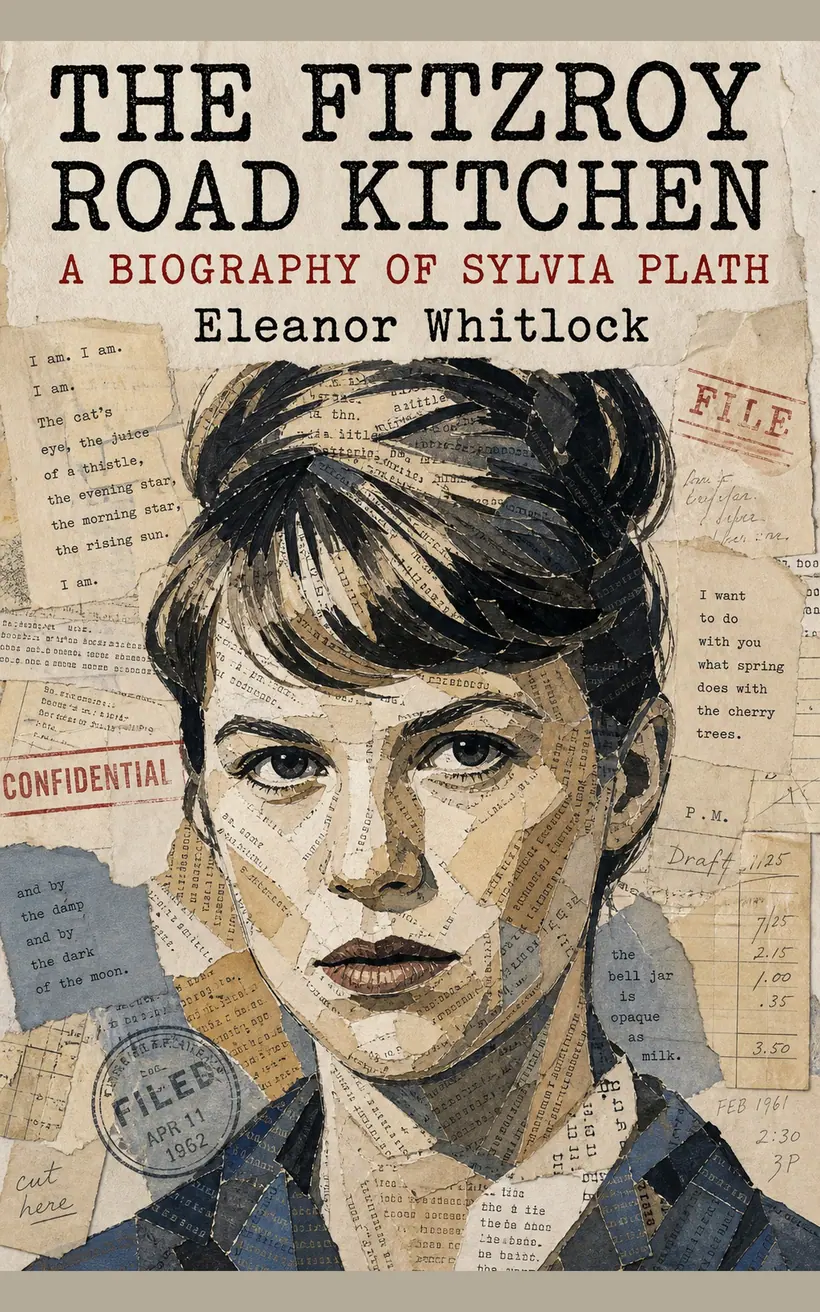
a biography of Sylvia Plath
February 11, 1963, the third-floor flat at 23 Fitzroy Road, Primrose Hill, London. Sylvia Plath, thirty, the American poet whose only novel The Bell Jar has been published under the pseudonym Victoria Lucas a month earlier and whose second collection Ariel will be published posthumously by her estranged husband Ted Hughes in 1965, places towels and wet cloths along the base of the kitchen door, leaves bread and milk in her two young children's bedroom upstairs, opens the windows of their room, and puts her head in the gas oven. Her children — Frieda, two; Nicholas, one — are unharmed. Plath has been on a high dose of an MAOI antidepressant. The British winter of 1962-63 has been the coldest on record.
Eleanor Whitlock's biography opens earlier — in Jamaica Plain, Massachusetts, where Plath was born on October 27, 1932, the elder of two children of a Boston University entomology professor named Otto Plath — and follows the arc through the long childhood the death of her father at eight shaped, the Wellesley public-school years, the Smith College scholarship years and the August 1953 nervous breakdown that produced The Bell Jar, the McLean Hospital electroconvulsive therapy, the Fulbright at Newnham College Cambridge and the 1956 meeting and June marriage of Ted Hughes, the long American teaching year of 1957-58, the Yaddo and Devon years, the births of Frieda and Nicholas, the 1962 Hughes-and-Assia Wevill affair and the September 1962 separation, the long October 1962 Ariel-poem month that produced the late masterpieces, and the morning of February 11.
What emerges is a portrait of the American poet whose thirty-year life produced the canonical late twentieth-century American poetry collection and the canonical late twentieth-century American autobiographical novel — and whose mental illness the medicine of her time was not equipped to treat.
The opening chapter is published in full — read it here.
The printed edition has no ISBN registered yet. It affects library and retail listing, not your order.
Sylvia Plath. The title never carries the subject's name: it names one concrete thing out of the life — in this case The Fitzroy Road Kitchen — and the name goes on the line underneath.
No. No subject, estate, label or foundation had approval over the text, and none paid for a word of it. The cost of that independence is that no new interviews were conducted for the book; it is built from the public record, and it says on the page where a scene is reconstructed rather than documented.
Yes — the whole opening chapter and the writer's foreword, free and in full, with no email address and no account. That is 4,185 words of the book.
About 60,000 words, 18 chapters, 180 pages in the paperback.
6 × 9 in, 60# uncoated cream, black ink, perfect-bound paperback, matte laminate. Every title in the series uses the same specification, so they line up on a shelf.
Yes: suicide; depression. They are listed before you buy rather than discovered afterwards. The material is handled as evidence, not as spectacle.
Listed before you buy, not after.
Paperback
Paperback · Hardcover
Digital edition