The Hare Krishna Years
Paperback
Download link emailed the moment payment clears.
3,968 words · no email, no account
No. 223 · Music · Rock
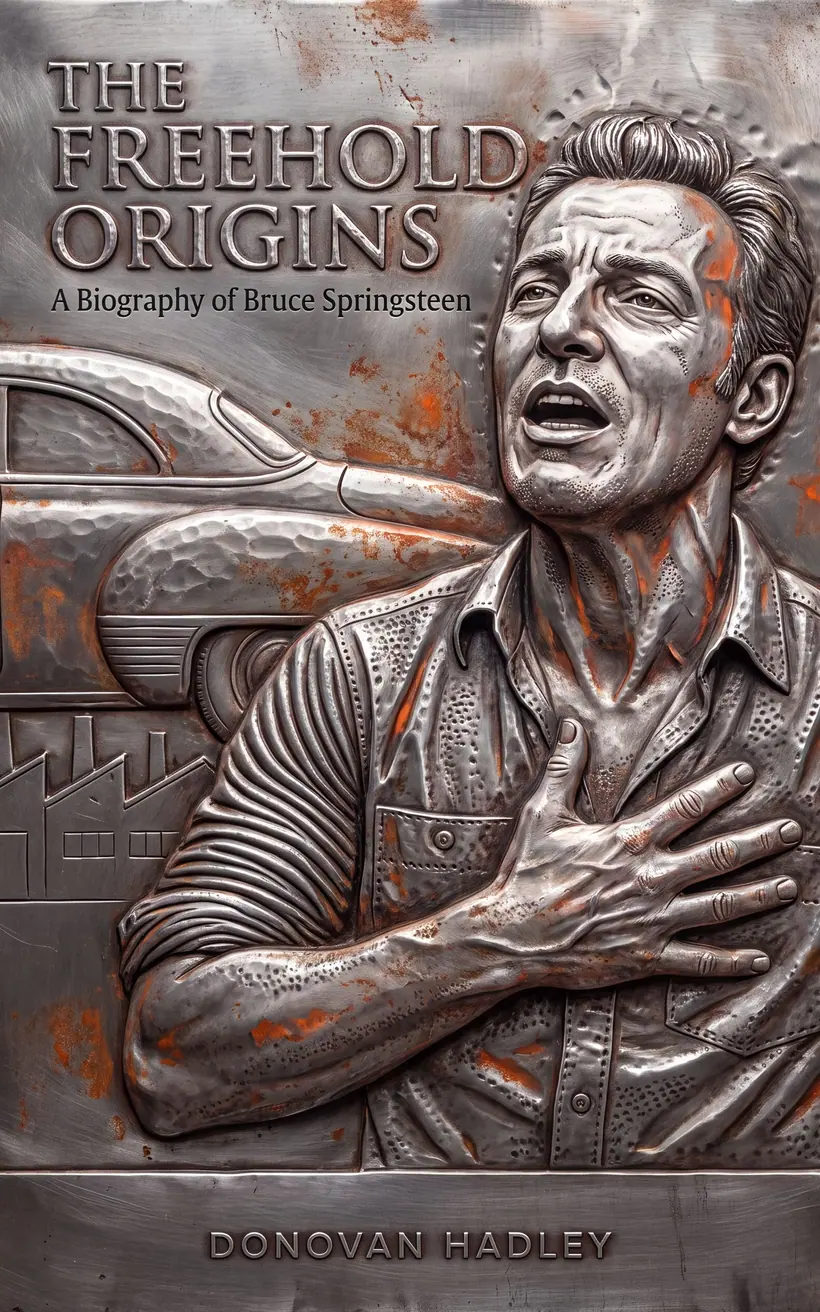
a biography of Bruce Frederick Joseph Springsteen
Born to Run was released in August 1975 and people are still playing it. Greetings from Asbury Park, N.J. had come first, in January 1973, when Bruce Springsteen was twenty-three. In the fifty-two years since, he has released twenty-one studio albums and toured them, most recently the Land of Hope and Dreams tour of 2023 to 2025, which grossed $729.7 million across 129 documented dates.
The catalogue starts in Freehold, New Jersey, on Randolph Street, next to the St. Rose of Lima Catholic church. Bruce Frederick Joseph Springsteen was born on September 23, 1949, in Long Branch, the eldest of three children of a Karagheusian-rug-mill machine operator named Douglas, called Dutch, and a legal secretary named Adele. He bought his first guitar at sixteen.
Donovan Hadley's biography works at the pace the body of work demands. It covers the Freehold Catholic-school years and the Dutch-and-Adele household, the Asbury Park apprenticeship at the Upstage Club and the Stone Pony, the John Hammond signing at Columbia, and the succession of managers from Mike Appel to Jon Landau. Then the Born to Run breakthrough, the long arena years of Darkness on the Edge of Town and The River, the 1984 commercial peak of Born in the U.S.A., the late-1980s marriage transition involving Julianne Phillips and Patti Scialfa, the acoustic Tom Joad tour of 1995, the post-9/11 The Rising in 2002, and the Springsteen on Broadway residency at the Walter Kerr Theatre across 2017 and 2018.
The last chapters are quieter. Adele Springsteen died in January 2024 at the Colts Neck farm, and the recording has continued there since. Fifty-three years of songs remade what American rock-and-roll could be, and the rug-mill worker's son ended up owning the farm.
The opening chapter is published in full — read it here.
Bruce Frederick Joseph Springsteen. The title never carries the subject's name: it names one concrete thing out of the life — in this case The Freehold Origins — and the name goes on the line underneath.
No. No subject, estate, label or foundation had approval over the text, and none paid for a word of it. The cost of that independence is that no new interviews were conducted for the book; it is built from the public record, and it says on the page where a scene is reconstructed rather than documented.
Yes — the whole opening chapter and the writer's foreword, free and in full, with no email address and no account. That is 3,968 words of the book.
About 59,000 words, 18 chapters, 194 pages in the paperback.