The Castro Camera Storefront
Paperback · Hardcover
Download link emailed the moment payment clears.
3,407 words · no email, no account
No. 229 · Power & Politics · American Politics
a biography of Frederick Augustus Washington Bailey (Frederick Douglass)
Narrative of the Life of Frederick Douglass, an American Slave was published in 1845, the first of three autobiographies its author would write. The man who wrote it had been born Frederick Augustus Washington Bailey in Talbot County, Maryland, around February 1818, the son of a Black enslaved woman named Harriet Bailey and a white father he never knew. He learned to read in Baltimore against the orders of Sophia, wife of his enslaver Hugh Auld. On September 3, 1838 he escaped north by train, through Wilmington and Philadelphia to New York, disguised as a free Black sailor, and settled in New Bedford, Massachusetts as Frederick Douglass.
Theodore Pemberton's biography opens before the book and follows the whole arc. The long childhood under enslavement at Tuckahoe and Wye House and in Baltimore. The 1838 escape and the early New Bedford years. The 1841 debut before the Nantucket Anti-Slavery Society that William Lloyd Garrison heard. The Narrative of 1845 and the British speaking tour that followed it. The founding of The North Star in 1847, and the long Rochester years after.
Then the public offices. He recruited Black soldiers for the Civil War's 54th Massachusetts Regiment, served as U.S. Marshal for the District of Columbia from 1877 to 1881 and as U.S. Minister to Haiti from 1889 to 1891, appointed by Hayes and by Harrison. Anna Murray's death and the controversial 1884 marriage to the white American suffragette Helen Pitts sit in the same stretch of the record.
He died of a heart attack on February 20, 1895, at seventy-seven, at Cedar Hill, his home in Anacostia. Seventy-seven years that began in a Maryland county under enslavement and ended decades after the Emancipation he had spent his adulthood arguing for: the most consequential abolitionist of the nineteenth century.
The opening chapter is published in full — read it here.
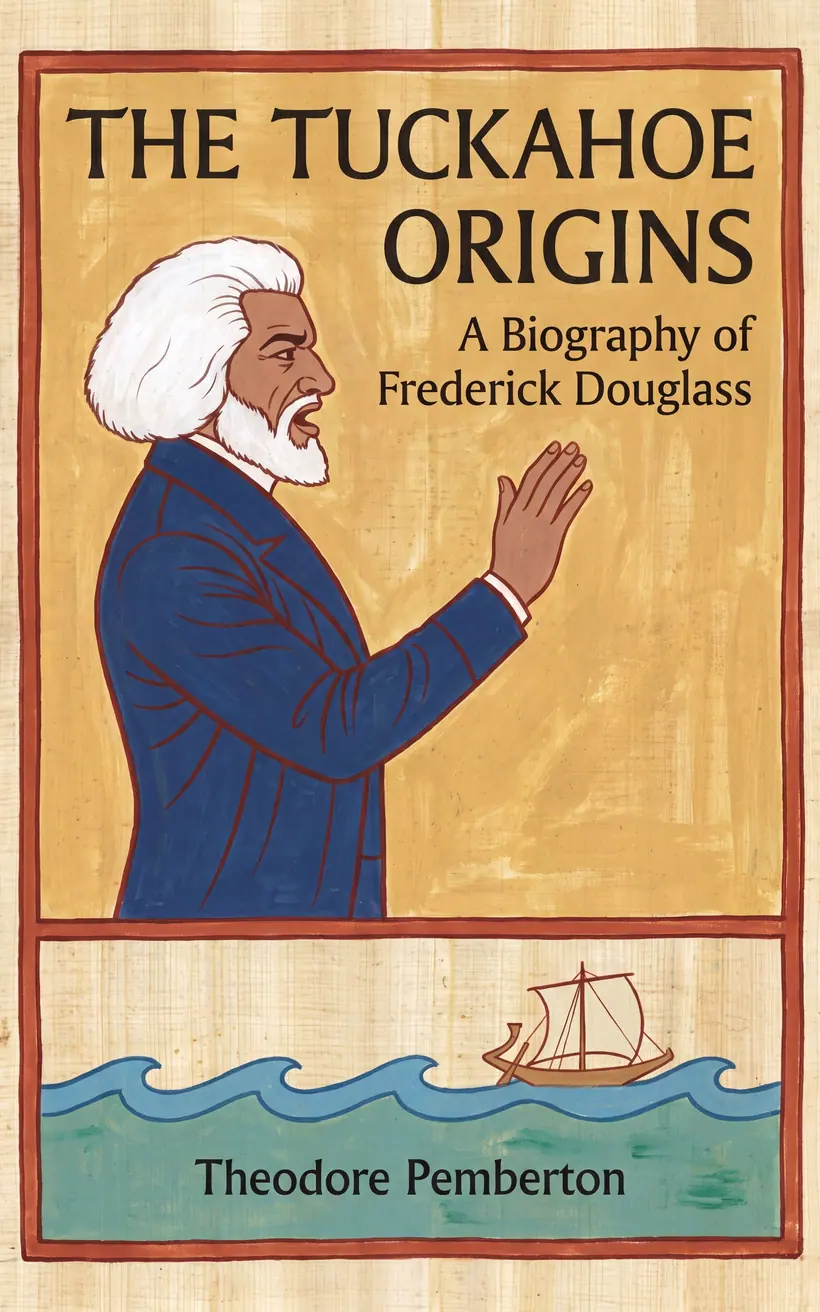
Frederick Augustus Washington Bailey (Frederick Douglass). The title never carries the subject's name: it names one concrete thing out of the life — in this case The Tuckahoe Origins — and the name goes on the line underneath.
No. No subject, estate, label or foundation had approval over the text, and none paid for a word of it. The cost of that independence is that no new interviews were conducted for the book; it is built from the public record, and it says on the page where a scene is reconstructed rather than documented.
Yes — the whole opening chapter and the writer's foreword, free and in full, with no email address and no account. That is 3,407 words of the book.
About 60,500 words, 18 chapters, 198 pages in the paperback.