The Castro Camera Storefront
Paperback · Hardcover
Download link emailed the moment payment clears.
4,498 words · no email, no account
No. 235 · Power & Politics · American Politics
a biography of John Fitzgerald Kennedy
A thousand and thirty-six days. That is the whole of the presidency of John Fitzgerald Kennedy, the thirty-fifth President of the United States, shot on Elm Street in Dallas at about half past twelve on the twenty-second of November 1963 and pronounced dead at Parkland Memorial Hospital at one o'clock, aged forty-six. Set against it: roughly 260 hours of secret White House recordings made between July 1962 and November 1963; 1,123 files released by the National Archives on one evening in March 2025, 1,062 more three and a half hours later, 140 more in January 2026; a running total near 94,600 pages. He is not the most documented American president. He is the one whose documentation is still arriving.
The book opens not in Dallas but in a room in 2002, where a historian and a physician were allowed to read a dead president's sealed medical file and were not allowed to photocopy a page of it. Its argument is that every credential Kennedy carried into the White House was true and every one of them had been enlarged — not invented, enlarged, almost always by someone acting out of devotion who had a real thing to work with. A genuine senior thesis shaped into a book by a family friend at the New York Times. A genuine night of heroism commanding PT-109 in the Solomons in August 1943, reprinted in a mass-circulation magazine and mailed into a congressional district by his father. A book of essays given the 1957 Pulitzer after the board overrode its own jury. An autoimmune disease diagnosed in London in September 1947, when a physician privately gave him a year, described publicly for sixteen years as malaria and a wartime back injury.
Two archives opened after the reputation was supposedly settled, and they point in opposite directions. The tapes, followed here in Sheldon Stern's corrected transcriptions, revise him upward. The medical file revises him downward. It lets them contradict each other instead of averaging them, and lists where the record stops.
The opening chapter is published in full — read it here.
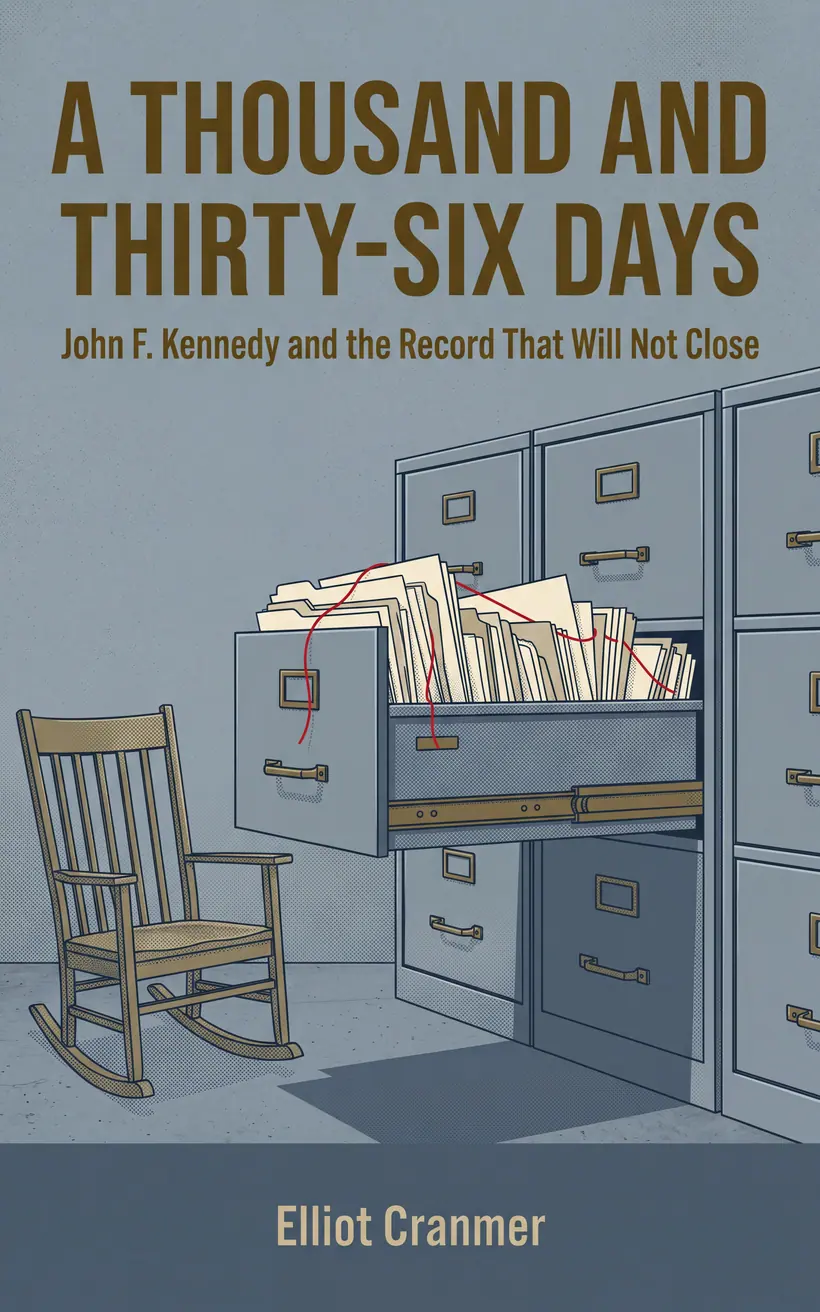
John Fitzgerald Kennedy. The title never carries the subject's name: it names one concrete thing out of the life — in this case A Thousand and Thirty-Six Days — and the name goes on the line underneath.
No. No subject, estate, label or foundation had approval over the text, and none paid for a word of it. The cost of that independence is that no new interviews were conducted for the book; it is built from the public record, and it says on the page where a scene is reconstructed rather than documented.
Yes — the whole opening chapter and the writer's foreword, free and in full, with no email address and no account. That is 4,498 words of the book.
About 65,500 words, 20 chapters, 212 pages in the paperback.