The Castro Camera Storefront
Paperback · Hardcover
Download link emailed the moment payment clears.
4,535 words · no email, no account
No. 236 · Power & Politics · American Politics
a biography of Lyndon Baines Johnson
No interviews were conducted for this book. Where a claim rests on a single witness, the text says so. What is left is documentary: roughly 9,400 recorded telephone conversations, the archives at Austin and College Park, declassified intelligence files, court records, committee transcripts. Johnson expected the tapes sealed for fifty years, so the book treats them as testimony he chose to leave rather than evidence he failed to suppress — and it reads their silences, above all the fall from more than 4,600 recordings in 1964 to about 350 in 1967.
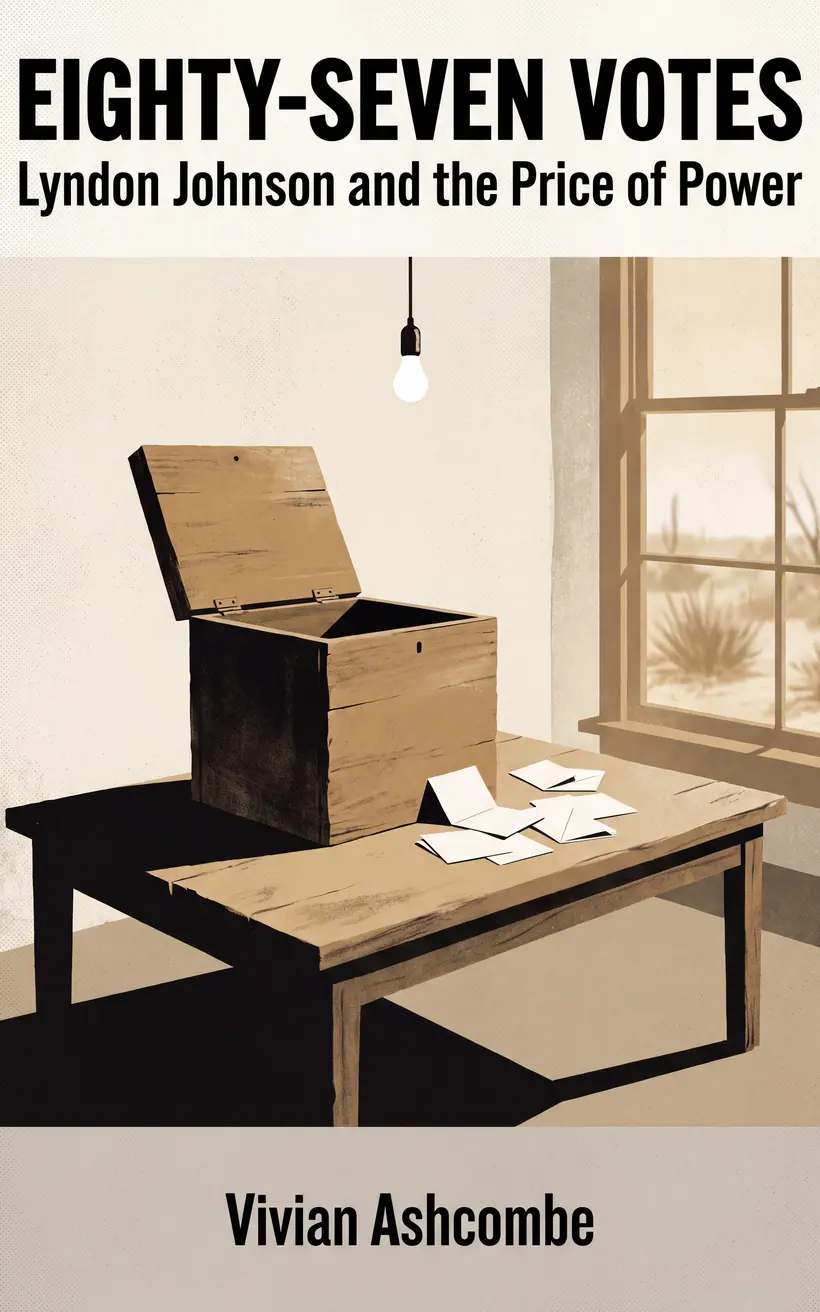
The argument begins with two numbers and says they are one. In the Democratic Senate runoff of August 1948, Lyndon Baines Johnson beat Coke Stevenson by eighty-seven votes out of 988,295 cast. Six days after the polls closed, two hundred and two names had been added to the poll list of Precinct Thirteen in Alice, Jim Wells County — in alphabetical order, in one hand, in one ink, several of them belonging to the dead. Without them there is no Senate seat, no Majority Leader, and no legislator in Washington capable of breaking the filibuster. The stolen seat and the enfranchisement are not two facts about one man but one fact stated twice: the faculties that manufactured those votes are the faculties that passed the Civil Rights Act of July 1964 and the Voting Rights Act of August 1965.
Twenty-two chapters follow the instrument back to the place that built it. The Hill Country as a ledger, not a landscape. The Cotulla year he spent forty years retelling. Herman Brown, the Marshall Ford Dam, and the federal contract as renewable campaign money. KTBC, where Lady Bird was the named owner and the actual operator. Box 13. Richard Russell, courted and then betrayed. The oath aboard Air Force One, from a judge Johnson had put on the bench. Then Tonkin, where the first attack happened and the second did not; Rolling Thunder, decided at a Tuesday lunch table; Watts, five days after the Voting Rights Act.
The opening chapter is published in full — read it here.
Lyndon Baines Johnson. The title never carries the subject's name: it names one concrete thing out of the life — in this case Eighty-Seven Votes — and the name goes on the line underneath.
No. No subject, estate, label or foundation had approval over the text, and none paid for a word of it. The cost of that independence is that no new interviews were conducted for the book; it is built from the public record, and it says on the page where a scene is reconstructed rather than documented.
Yes — the whole opening chapter and the writer's foreword, free and in full, with no email address and no account. That is 4,535 words of the book.
About 68,000 words, 22 chapters, 222 pages in the paperback.