
The Castro Camera Storefront
Paperback · Hardcover
Download link emailed the moment payment clears.
4,752 words · no email, no account
No. 244 · Power & Politics · American Politics
a biography of John Edgar Hoover
The nation's top lawman had never arrested anyone until he was forty-one. Senator McKellar put the question to him directly, and the answer was arranged two weeks later on Canal Street. By then J. Edgar Hoover had run the Bureau of Investigation for a decade, and he would run it for another thirty-eight years, through eight presidents and some eighteen attorneys general. He catalogued at the Library of Congress while reading law at night, and at twenty-four ran the Radical Division. On 10 May 1924 Attorney General Harlan Fiske Stone made him acting director of a bureau Stone had privately described as lawless. He died on 2 May 1972, the first civil servant ever to lie in state in the Capitol Rotunda.
This book argues that his power was administrative rather than political. What he had was the file: fingerprints, index cards, background checks, crime statistics, forms and routing slips. Because the instruments were the same, the reformer and the abuser cannot be separated. The proceduralism that cleaned out a bureau whose practices Stone called brutal and tyrannical in the extreme is the proceduralism that later made a blackmail package look like paperwork with a prior approval attached.
Twenty chapters follow the machine being built and then pointed somewhere new. The Palmer raids and the Buford deportations. A fingerprint collection that reached a hundred and seventy million cards, most belonging to people never arrested. The manufacture of the G-Man through press releases, a radio serial and a comic strip. The custodial detention list that Attorney General Biddle ordered abolished and Hoover renamed the Security Index without telling him. The counterintelligence programs told entirely through their approval chains, and the burglary at Media, Pennsylvania in March 1971 that put the word COINTELPRO into print.
It is also a book about a hole in an archive. Helen Gandy destroyed thirty-two drawers of it; every biographer since has worked inside that hole.
The opening chapter is published in full — read it here.
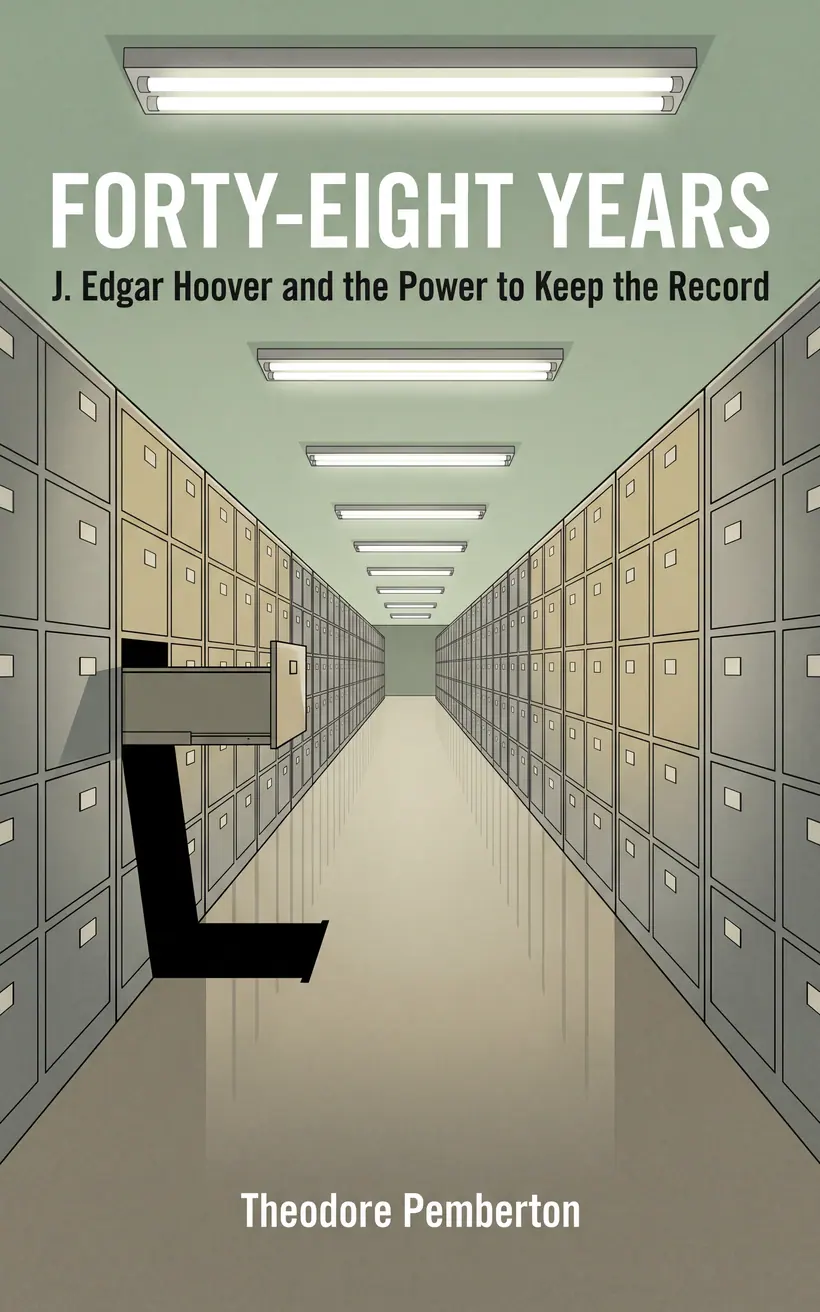
John Edgar Hoover. The title never carries the subject's name: it names one concrete thing out of the life — in this case Forty-Eight Years — and the name goes on the line underneath.
No. No subject, estate, label or foundation had approval over the text, and none paid for a word of it. The cost of that independence is that no new interviews were conducted for the book; it is built from the public record, and it says on the page where a scene is reconstructed rather than documented.
Yes — the whole opening chapter and the writer's foreword, free and in full, with no email address and no account. That is 4,752 words of the book.
About 65,000 words, 20 chapters, 212 pages in the paperback.