The Hare Krishna Years
Paperback
Download link emailed the moment payment clears.
4,947 words · no email, no account
No. 248 · Music · Rock
a biography of James Marshall Hendrix
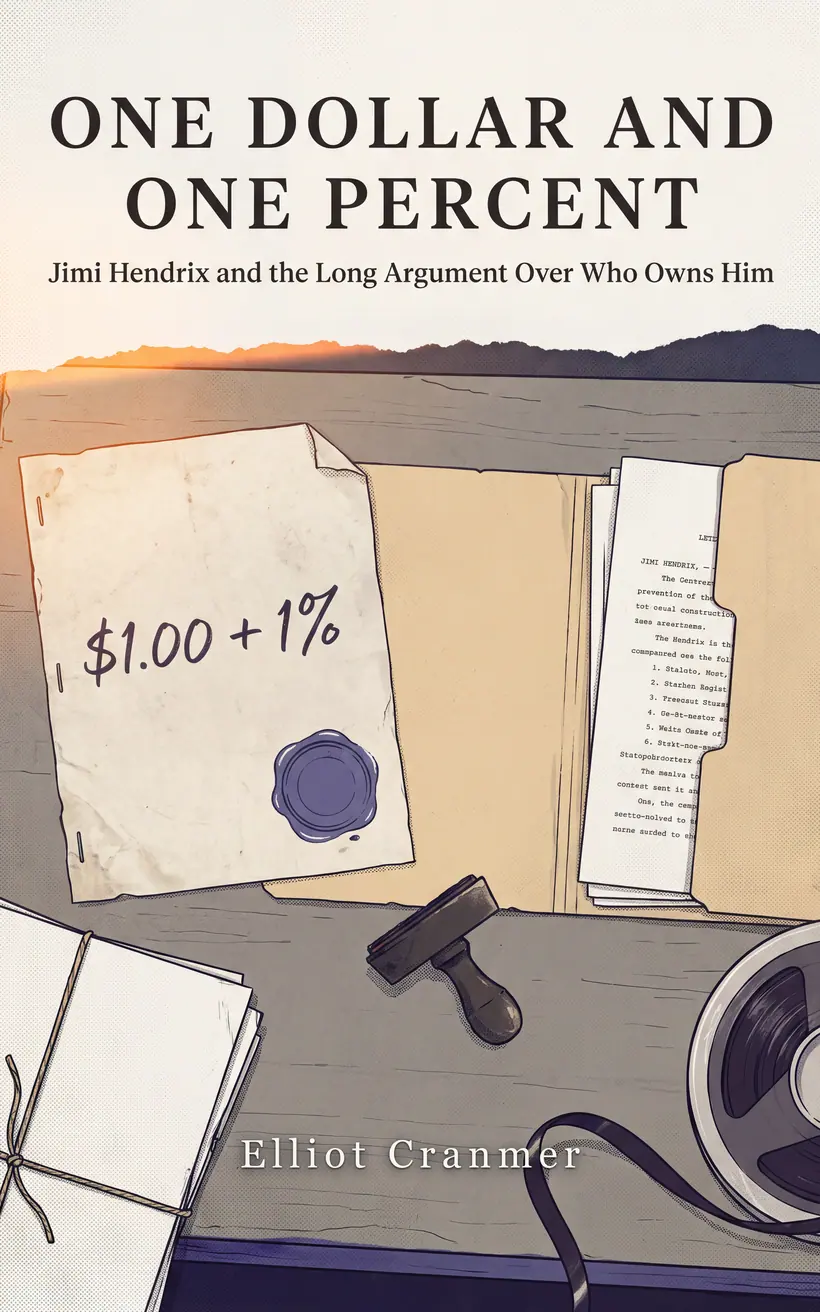
A New York office, Friday the fifteenth of October, 1965. A twenty-two-year-old sideman signs a three-year exclusive recording contract. The advance is one dollar. The royalty is one percent. Two months short of a year later, in London, he and two Englishmen he had known about a week sign a second agreement, their own managers signing as the producers.
Every argument about who owns Jimi Hendrix runs through those two documents, and neither has ever been published. In April 2026 a judge of the Chancery Division in London construed the second and dismissed the Noel Redding and Mitch Mitchell estate companies' claims against Sony Music, holding that the consent the three musicians gave in 1966 was limited neither in time nor in method. Every signature on that page belonged to a man years dead; the technology at issue was invented three decades after the last of them died.
His life and his afterlife are one continuous transaction, and the two questions — who got the money, and what happened on the last night — are the same question asked twice. Both are unanswerable for the same reason: nobody with the power to keep a record kept one anybody else could read. There is no ledger for the Bahamian company that took his royalties, no statement of his personal finances, and no reliable account of four hours in a Notting Hill flat: the one person there gave four different accounts of when she woke, and the coroner called neither the ambulance crew, the attending police, nor the doctors who worked on him.
It is not the murder book. It refuses the wild man assembled in London in 1967 by a manager, a press officer and a photographer, and the fool who signed without reading. He would spend a whole night on one overdub and not four minutes on a page, because the page was the only thing between a sideman on scale wages and a room with a tape machine in it. He released three studio albums while he was alive. The release programme has been running for fifty-six years.
The opening chapter is published in full — read it here.
James Marshall Hendrix. The title never carries the subject's name: it names one concrete thing out of the life — in this case One Dollar and One Percent — and the name goes on the line underneath.
No. No subject, estate, label or foundation had approval over the text, and none paid for a word of it. The cost of that independence is that no new interviews were conducted for the book; it is built from the public record, and it says on the page where a scene is reconstructed rather than documented.
Yes — the whole opening chapter and the writer's foreword, free and in full, with no email address and no account. That is 4,947 words of the book.
About 72,500 words, 22 chapters, 236 pages in the paperback.