The Hare Krishna Years
Paperback
Download link emailed the moment payment clears.
4,771 words · no email, no account
No. 252 · Music · Rock
a biography of Farrokh Bulsara
Somebody else decided the Kensington house should be emptied. In September 2023 Sotheby's ran six sales in London, "Freddie Mercury: A World of His Own" — 1,406 lots, all out of that one house. Every lot sold, almost 99 percent above high estimate, for £39.9 million against a pre-sale estimate of £7.6 to 11.3 million. The total is not the interesting number. The estimate is. People who price objects for a living had these in front of them. They were not wrong about the objects; they had mispriced what the objects had turned into in the three decades since he died.
There is no Freddie Mercury papers collection. No university holds one, no national library holds one; the tapes, session logs, film and contracts sit inside the band's own company, which admits no researchers. The documentary record of what happened to him after he died is stronger than the record of his childhood, his sexuality or his illness. His combs have a lot number and a price realised. His mother has a name.
The literature reads that imbalance as the residue of a man hiding. The grammar is wrong. Farrokh Bulsara took a diploma in graphic art and design from Ealing Art College in June 1969 and spent twenty-one years applying the training to a single client. He edited his accent and never unedited it. He built a wall around his house before anybody had a professional reason to stand outside it. A designer removes information from a surface so that what remains will read; concealment and design look identical from outside and are opposites in intent.
What he built held for two decades without a serious breach, then was reversed by other people within a few years of the day he could no longer defend it. The name is reportedly now an asset in a purchase agreement. The story has been filmed with the diagnosis moved two years earlier so a third act would land. A vocal take he set aside was retrieved and released. The door has been sold.
The opening chapter is published in full — read it here.
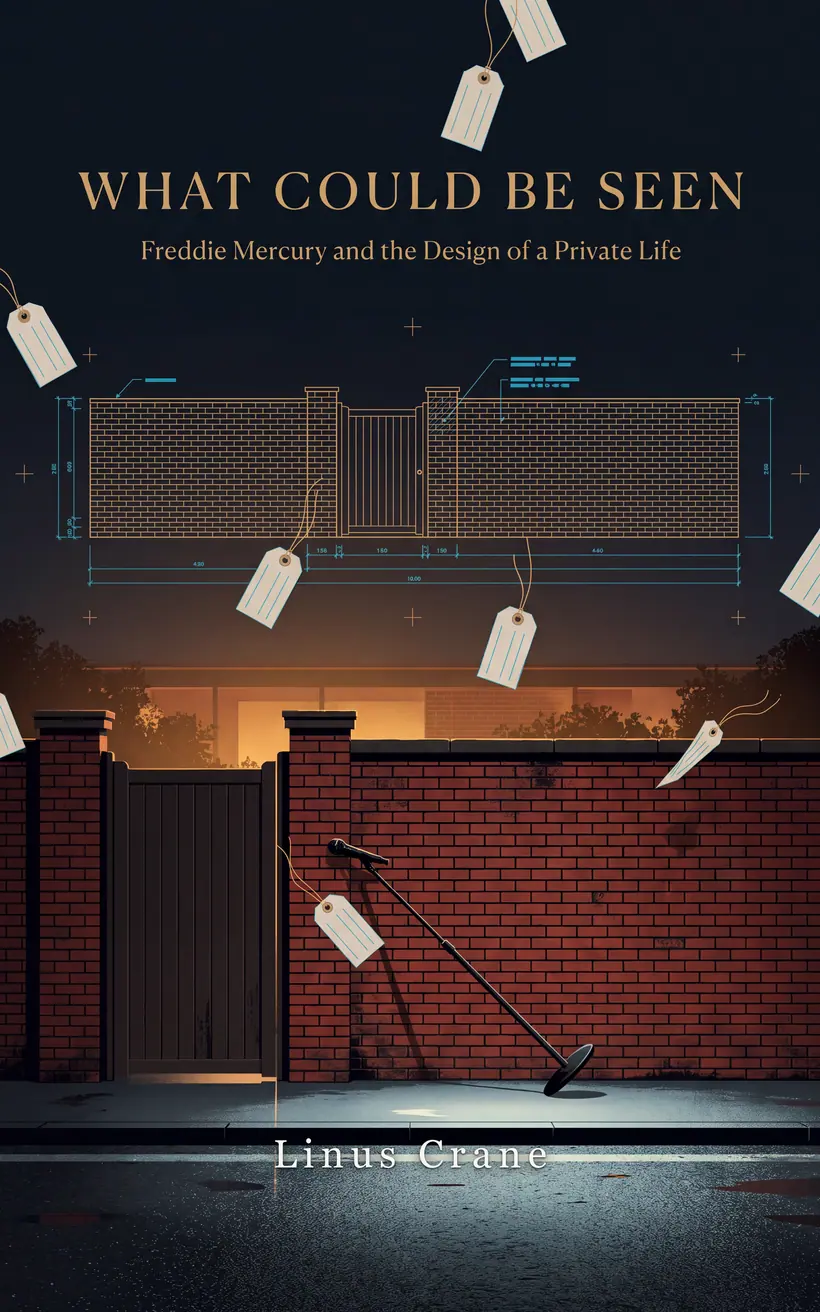
Farrokh Bulsara. The title never carries the subject's name: it names one concrete thing out of the life — in this case What Could Be Seen — and the name goes on the line underneath.
No. No subject, estate, label or foundation had approval over the text, and none paid for a word of it. The cost of that independence is that no new interviews were conducted for the book; it is built from the public record, and it says on the page where a scene is reconstructed rather than documented.
Yes — the whole opening chapter and the writer's foreword, free and in full, with no email address and no account. That is 4,771 words of the book.
About 75,000 words, 22 chapters, 242 pages in the paperback.