The Hare Krishna Years
Paperback
Download link emailed the moment payment clears.
4,707 words · no email, no account
No. 253 · Music · Rock
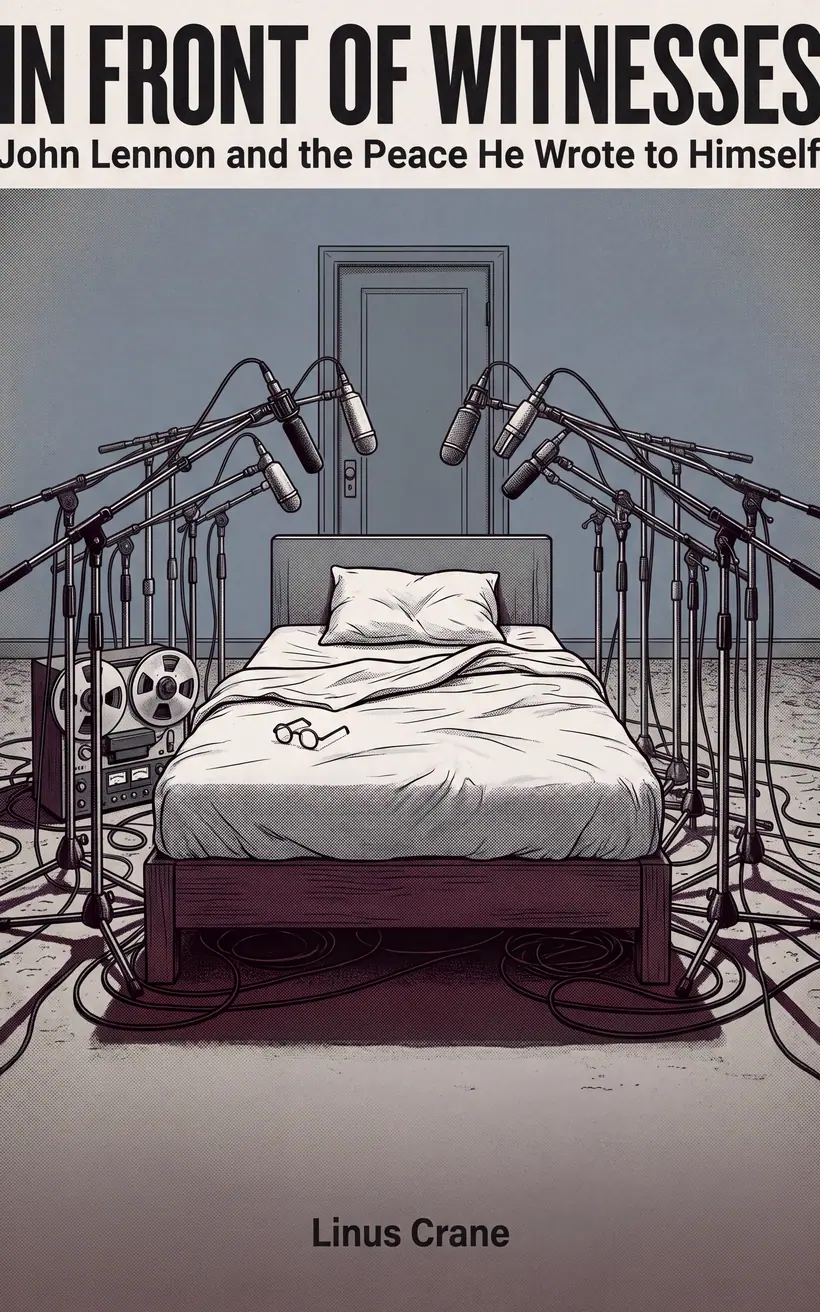
a biography of John Winston Ono Lennon
Two versions of John Lennon are on offer, and one sentence ruins both. In the unmasking, the peace campaign is a fraud and the confession of violence is the chapter that exposes it. In the tribute, the confession is a graduation certificate. Neither survives what he said next.
In September 1980, with a journalist's tape running, he was asked a craft question about a 1967 lyric. What the tape has instead is a man saying that the cruelty in the line was his own, that he had been physically violent to women, that the word for what he had been was a hitter, and that he hit because he could not express himself. Nearly every book quotes some of that. Very few quote the end of it, where he says this is why he was always on about peace. Forty-five years of writing about him has declined to print the part where he says the two were one mechanism.
This book takes him at his word and tests the word against the work. The argument is that the peace was addressed first to its author, and that the world was invited in as a witness because he could not otherwise be held to anything he said. A man sitting up in a hotel bed in Amsterdam in March 1969 is not, in the first instance, addressing a war. The violence is established early and factually: chapter six is a birthday party in Huyton on June 18, 1963, where a disc jockey made a joke, Lennon beat him badly enough to require hospital treatment, and his manager made it go away with money — all before the reader has met a single peace lyric. What survives is an injury, a payment, and a joke nobody wrote down.
It is not a prosecution: the conduct convicts him without assistance. It is not a defence. It is not narrated toward December 8, 1980; the killing occupies four sentences. His son's charge is here, in his own words, unanswered. No line of any Lennon lyric appears in the book. The songs are described.
The opening chapter is published in full — read it here.
John Winston Ono Lennon. The title never carries the subject's name: it names one concrete thing out of the life — in this case In Front of Witnesses — and the name goes on the line underneath.
No. No subject, estate, label or foundation had approval over the text, and none paid for a word of it. The cost of that independence is that no new interviews were conducted for the book; it is built from the public record, and it says on the page where a scene is reconstructed rather than documented.
Yes — the whole opening chapter and the writer's foreword, free and in full, with no email address and no account. That is 4,707 words of the book.
About 73,500 words, 22 chapters, 238 pages in the paperback.