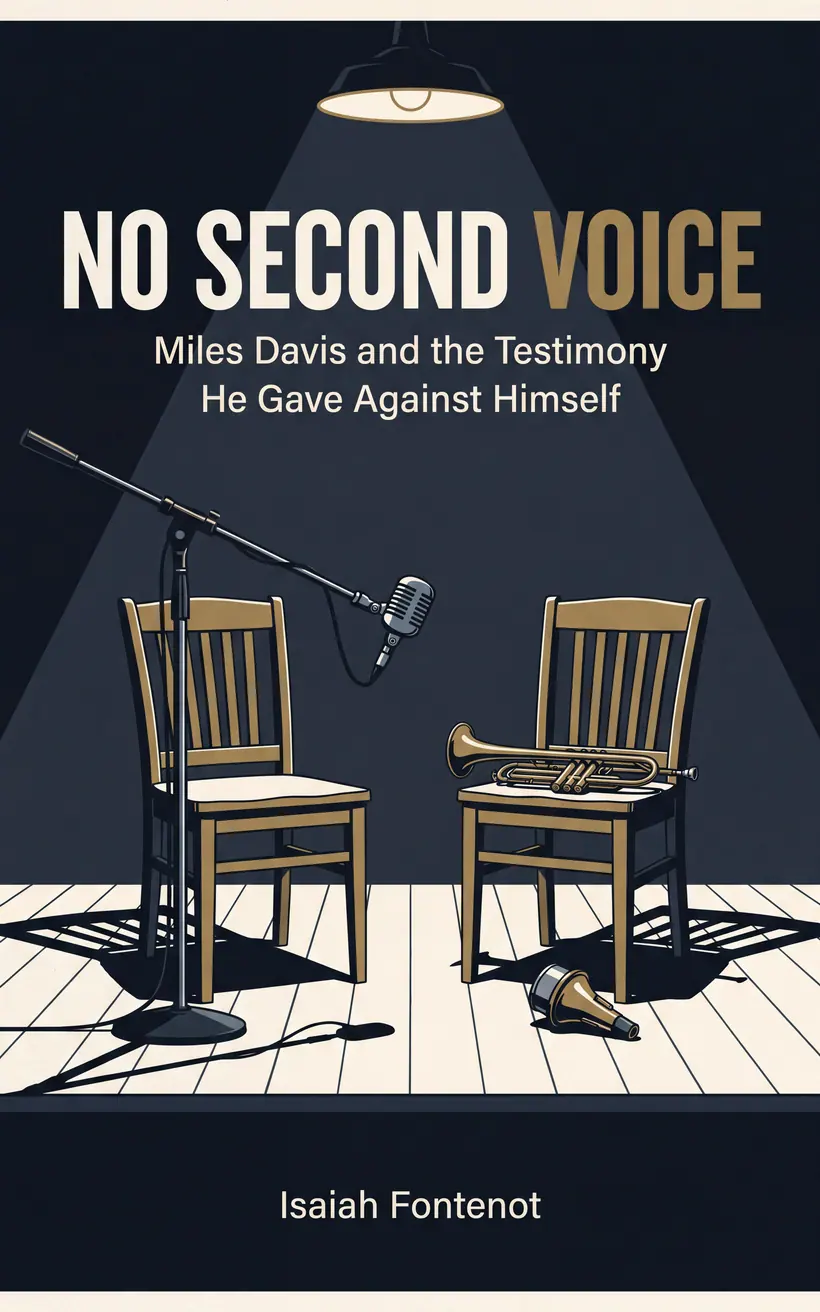
The Twelve Adopted Children
Paperback
Download link emailed the moment payment clears.
4,361 words · no email, no account
No. 254 · Music · Jazz
a biography of Miles Dewey Davis III
The autobiography Miles Davis dictated to Quincy Troupe is the only witness to almost everything contested about him. Simon & Schuster published it in 1989. It won an American Book Award, and he never took a word back. In it he describes his father striking his mother. He describes striking his own wives — at length, without remorse, in the cadence of a man narrating a personnel change. The worst conduct here is not an allegation. It is a deposition, volunteered, in a book with his name on the front.
For fifty years that deposition stood alone, because the women in those pages had not spoken. Every standard account was finished before any of them did. Then Frances Taylor Davis sat for a camera, said what had happened in her marriage, and died before the film was released. Betty Davis spoke for herself in a documentary and died five years later. Cicely Tyson published a memoir and was dead two days afterward. Their accounts can now be set beside his. Tyson's is narrower than his own. He accused himself of more than she did.
The book is a cross-examination, not a life-and-works: every chapter that reconstructs a session also reconstructs a room. The argument is that he made a music out of subtraction and a self out of the same operation: a teacher told him at thirteen to play without the shake every trumpeter used, and he never put it back. Taking things away was the technique, and it was also how he handled everything that was not music — the reason not given, the musician fired without being told why.
At the centre are the five years between 1975 and 1980, when he made no records at all: the only sustained stretch of his adult life in which nothing can be justified by the work, because there was no work. It is not a takedown, and the records are primary evidence throughout. It is not a tribute either, and it declines the sentence that the art buys the conduct a discount. Where the record stops, it says so.
The opening chapter is published in full — read it here.
Miles Dewey Davis III. The title never carries the subject's name: it names one concrete thing out of the life — in this case No Second Voice — and the name goes on the line underneath.
No. No subject, estate, label or foundation had approval over the text, and none paid for a word of it. The cost of that independence is that no new interviews were conducted for the book; it is built from the public record, and it says on the page where a scene is reconstructed rather than documented.
Yes — the whole opening chapter and the writer's foreword, free and in full, with no email address and no account. That is 4,361 words of the book.
About 71,000 words, 21 chapters, 230 pages in the paperback.
Paperback

Paperback · Hardcover
Digital edition