The Little Saint James
Paperback · Hardcover
Download link emailed the moment payment clears.
4,449 words · no email, no account
No. 267 · Crime · White-Collar Crime
a biography of Bernard Lawrence Madoff
How does a fraud that had been published in a trade magazine, filed with regulators three times, and blacklisted on the trading desks of major banks keep running until December 2008? Not by hiding. In 2006 the Securities and Exchange Commission's enforcement staff obtained Bernard Madoff's account number at the Depository Trust Company, where the ownership of American securities is recorded in fact rather than on a statement mailed to a customer. One telephone call would have established whether the positions on his customer statements existed. They did not. Nobody called.
That is the finding of the Commission's own Inspector General, in a 477-page report this book uses as its spine, not its coda. Between June 1992 and December 2008 the Commission received six substantive complaints, opened three examinations and two investigations, and closed every one. Michael Ocrant published the impossibility of the returns in MARHedge in May 2001, Erin Arvedlund in Barron's six days later. Harry Markopolos filed in 2000, in 2001, and again in November 2005 under the title "The World's Largest Hedge Fund is a Fraud." The fraud was not hidden. It was disbelieved.
Explaining why nobody looked means saying what Bernard Lawrence Madoff actually built. His firm made markets in New York Stock Exchange-listed shares away from the exchange floor. He paid retail brokers for order flow, was denounced for it, and won the argument, and it is still how commission-free retail broking is financed. He chaired the Nasdaq board and sat on SEC advisory committees. The reputation of that business stood over the other one, two floors below it, reached by a separate elevator, staffed by about twenty people producing four thousand account statements a month.
Two figures are never allowed into one sentence: some $64.8 billion of fictitious balances on the statements, and $17.5 to $20 billion of real principal that people handed over and never got back. Withdrawals exceeded the balance.
The opening chapter is published in full — read it here.
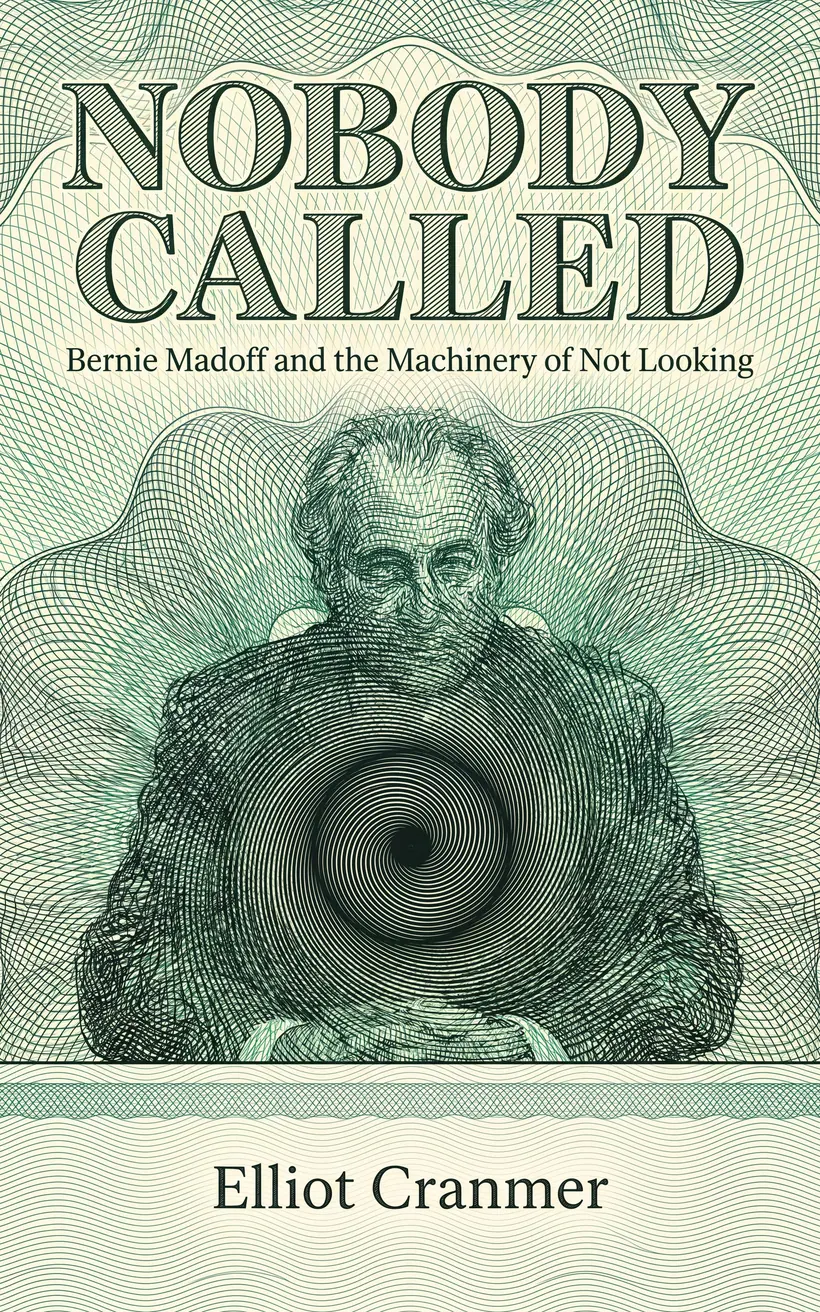
Bernard Lawrence Madoff. The title never carries the subject's name: it names one concrete thing out of the life — in this case Nobody Called — and the name goes on the line underneath.
No. No subject, estate, label or foundation had approval over the text, and none paid for a word of it. The cost of that independence is that no new interviews were conducted for the book; it is built from the public record, and it says on the page where a scene is reconstructed rather than documented.
Yes — the whole opening chapter and the writer's foreword, free and in full, with no email address and no account. That is 4,449 words of the book.
About 69,000 words, 21 chapters, 224 pages in the paperback.