The Little Saint James
Paperback · Hardcover
Download link emailed the moment payment clears.
4,312 words · no email, no account
No. 269 · Crime · White-Collar Crime
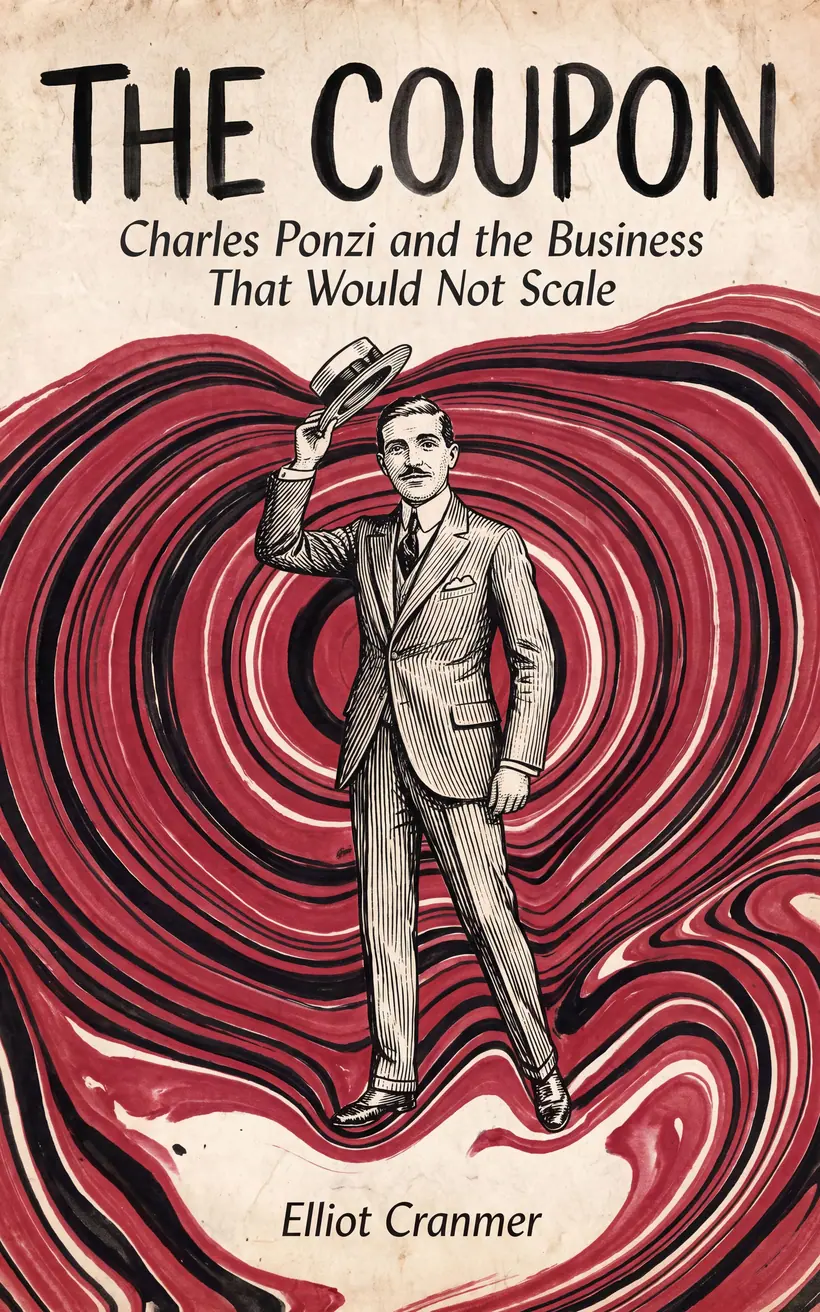
a biography of Carlo Pietro Giovanni Guglielmo Tebaldo Ponzi, known as Charles Ponzi
One hundred and fifty dollars of capital, one room at 27 School Street in Boston, one product: a printed note promising fifty percent in forty-five days, or a hundred percent in ninety. Eight months later the Securities Exchange Company had collected $9,582,000, had issued notes with a face value of $14,374,000, was taking in about a million dollars a week, and was overdrawn at the Hanover Trust Company by $331,000. Those are not a reporter's figures. They are the bankruptcy trustee's accounting, recited by Chief Justice William Howard Taft in a Supreme Court decision of 1924, a free and complete public document the popular literature has passed over for a century in favor of a round and unfootnoted twenty million.
The idea behind the company was real, and this book exists to say so. The International Reply Coupon was created by treaty in 1906: you buy a coupon in one country, enclose it in a letter, and your correspondent abroad exchanges it for the postage on a reply. After 1918 the European currencies collapsed and the treaty did not adjust, so a coupon bought in Italy for the equivalent of a penny redeemed in Boston at American face value. Anyone who did the sum in the summer of 1919 got the answer Charles Ponzi got. What killed it was unit economics. The denominations were trivial, redemption was in stamps rather than cash, the coupons had to be carried across an ocean one at a time by people who had to be paid, and every postal administration on earth had the standing to refuse volume. His crime was not inventing a business that did not exist. It was discovering that the business that did exist would not scale, and refusing to say so. The clerks, cooks and domestic workers who queued on the sidewalk got back less than thirty cents on the dollar. He died in a charity ward in Rio de Janeiro, leaving an estate of seventy-five dollars that paid for the burial.
The opening chapter is published in full — read it here.
Carlo Pietro Giovanni Guglielmo Tebaldo Ponzi, known as Charles Ponzi. The title never carries the subject's name: it names one concrete thing out of the life — in this case The Coupon — and the name goes on the line underneath.
No. No subject, estate, label or foundation had approval over the text, and none paid for a word of it. The cost of that independence is that no new interviews were conducted for the book; it is built from the public record, and it says on the page where a scene is reconstructed rather than documented.
Yes — the whole opening chapter and the writer's foreword, free and in full, with no email address and no account. That is 4,312 words of the book.
About 72,500 words, 22 chapters, 234 pages in the paperback.