The Little Saint James
Paperback · Hardcover
Download link emailed the moment payment clears.
5,429 words · no email, no account
No. 271 · Crime · White-Collar Crime
a biography of Victor Lustig
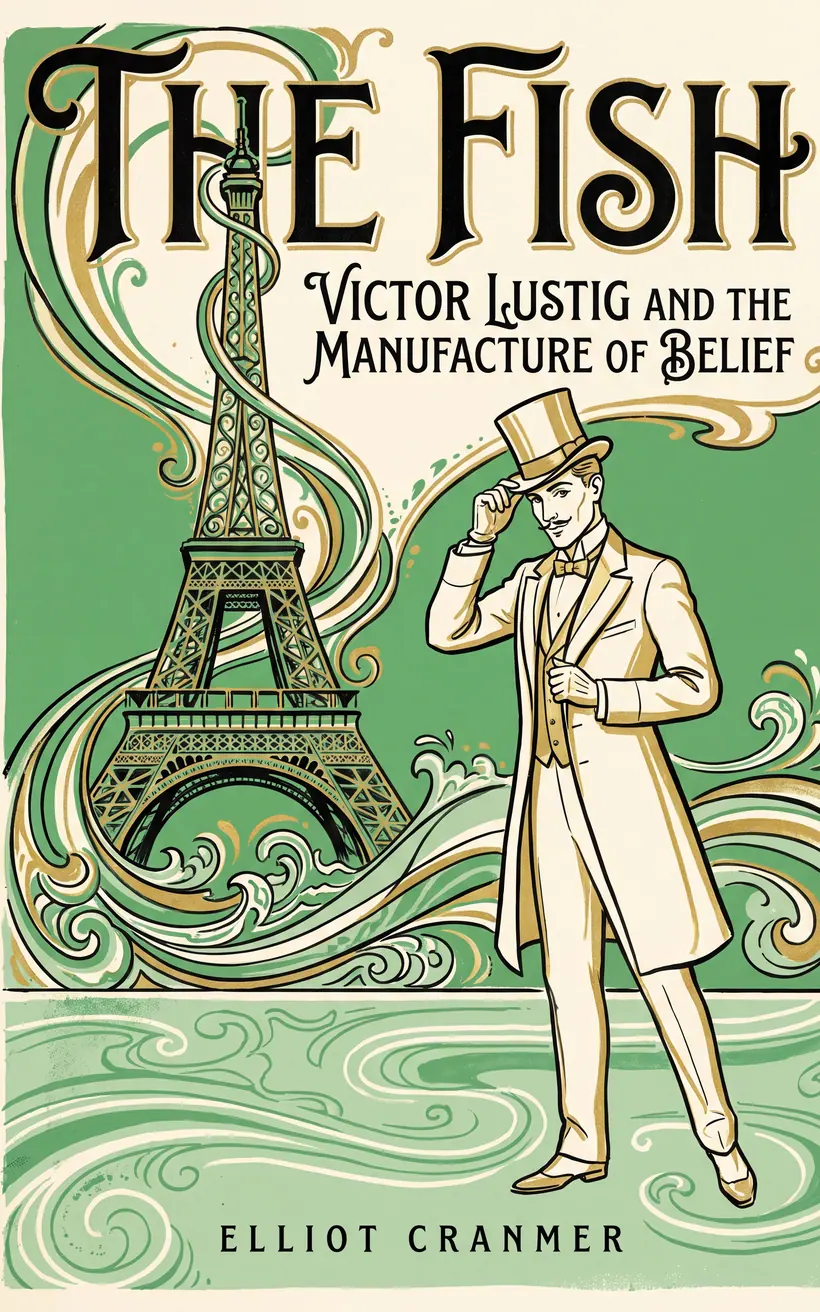
Victor Lustig is the man who sold the Eiffel Tower for scrap. Paris, May 1925: forged letterhead of the Ministère des Postes et Télégraphes, five scrap dealers at a good hotel, a Deputy Director-General with confidential news that the tower was structurally finished, roughly seventy thousand francs, a bribe on top of the price as proof the deal was real, and a train to Austria. The mark's name was André Poisson — poisson, the French for fish, the word a confidence man uses for a mark. The book went looking for what stands behind that story and publishes what it found: no French police report, no contemporary item in any Paris daily, no scrap merchant of that name in the commercial register, and no source of any kind before 1961, when an American book with reconstructed dialogue and no source notes put it into print, thirty-six years after. Every retelling since is downstream of that one. The most famous confidence trick in history may itself be a confidence trick, and the mark is the reader. Nothing here establishes that the sale did not happen, only that nothing independent supports it.
Seven chapters are the documented crime: counterfeiting from about 1930 with William Watts, a Nebraska pharmacist with an engraver's hand; thousands of dollars a month for five years, moved by couriers never told where the notes came from; the arrest, a locker key in his pocket; the window he went out of the day before trial, and Pittsburgh twenty-seven days later; a guilty plea that took one afternoon, from a man whose career rested on the principle that victims do not testify. Then Alcatraz, the one place ever built where his instrument did not work — a number instead of a name, a rule of silence, men on whom charm had no purchase. He was not a count. He was a tobacco salesman's son from Hostinné, dead of pneumonia at fifty-seven in a federal medical center. A book about how unsourced detail becomes knowledge prints its gaps beside its findings.
The opening chapter is published in full — read it here.
Victor Lustig. The title never carries the subject's name: it names one concrete thing out of the life — in this case The Fish — and the name goes on the line underneath.
No. No subject, estate, label or foundation had approval over the text, and none paid for a word of it. The cost of that independence is that no new interviews were conducted for the book; it is built from the public record, and it says on the page where a scene is reconstructed rather than documented.
Yes — the whole opening chapter and the writer's foreword, free and in full, with no email address and no account. That is 5,429 words of the book.
About 70,000 words, 21 chapters, 226 pages in the paperback.