Room 607
Paperback
Download link emailed the moment payment clears.
4,033 words · no email, no account
No. 292 · Screen & Stage · Performing Arts
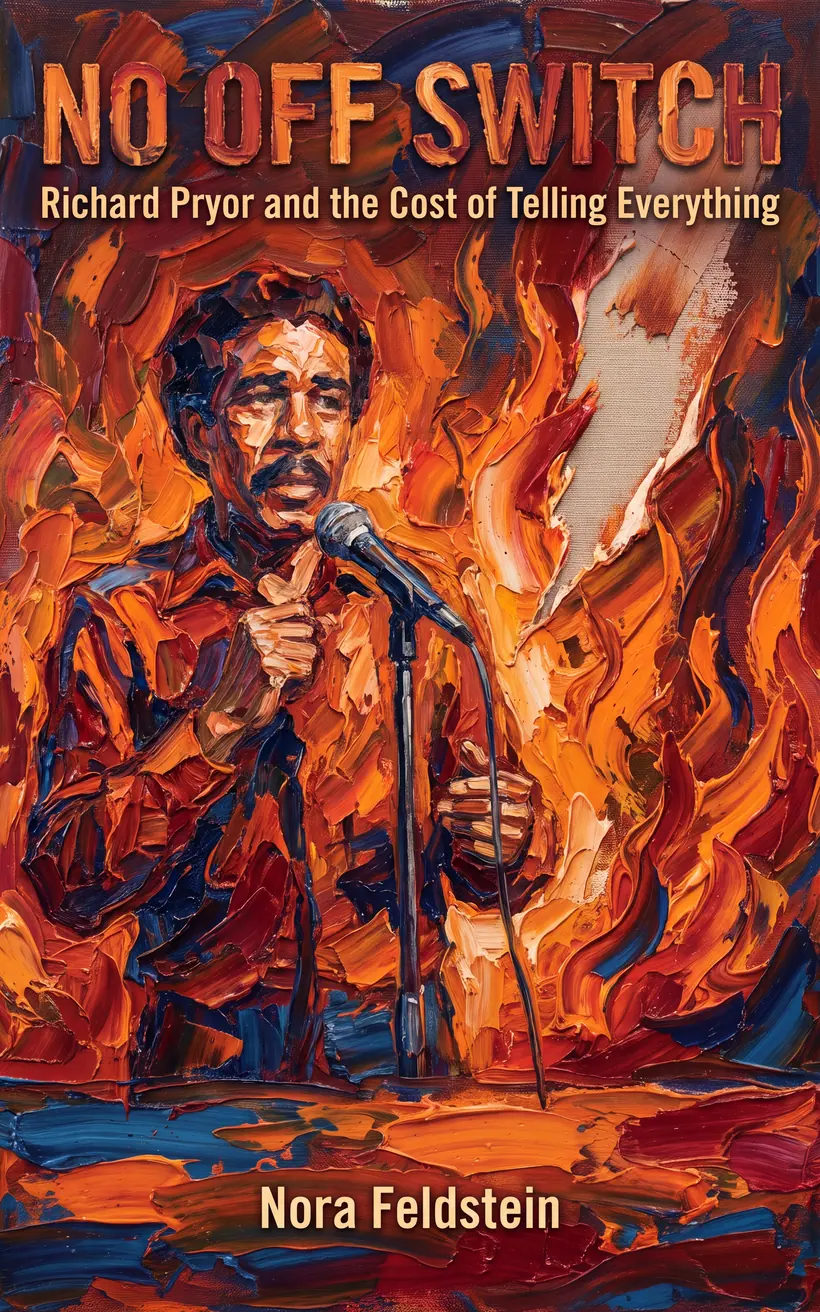
a biography of Richard Franklin Lennox Thomas Pryor
The Terrace Theater in Long Beach. Richard Pryor walked onto its stage in December 1978 and performed the night he had shot up his wife's car with a Magnum, and got the biggest laugh of the evening. The film shot there was Richard Pryor: Live in Concert, now in the National Film Registry.
Eighteen months later he ran down Parthenia Street in Northridge on fire. Eighteen months after that, at the Circle Star Theater in San Carlos, he performed the rum, the lighter and the burn ward, and the album took a Grammy. That sequence is the argument. Richard Franklin Lennox Thomas Pryor's freedom was not liberation; it was a survival technique with no off switch. A boy raised in his grandmother's brothel in Peoria learned to make a room laugh before it turned on him, and spent forty years turning that reflex into an art form, until nothing was left to protect himself with in private.
The fire is chapter 16 of 22, placed there on purpose. It was not an ending but the technique at its end point: the largest confession available to him, made with his body. Seven chapters pass before the record sounds like him. New York in 1963, where he learned Bill Cosby's act deliberately and by 1967 had everything he came for, and it was somebody else's; the Aladdin in Las Vegas, where he looked at the room, asked what he was doing there and walked off, torching four years of bookings; then Berkeley, broke and out of the business. He did not find a new voice there. He stopped suppressing the old one.
The last chapter is about tape. To escape Laff Records, Pryor licensed the label everything it had recorded of him between 1969 and 1973, and it worked that material until 1983. More than forty hours of unedited tape surfaced in 2002; a fraction came out in 2005, the year he died. The rest covers exactly the years in which the change at the center of every account of this life is supposed to have happened.
The opening chapter is published in full — read it here.
Richard Franklin Lennox Thomas Pryor. The title never carries the subject's name: it names one concrete thing out of the life — in this case No Off Switch — and the name goes on the line underneath.
No. No subject, estate, label or foundation had approval over the text, and none paid for a word of it. The cost of that independence is that no new interviews were conducted for the book; it is built from the public record, and it says on the page where a scene is reconstructed rather than documented.
Yes — the whole opening chapter and the writer's foreword, free and in full, with no email address and no account. That is 4,033 words of the book.
About 70,000 words, 22 chapters, 228 pages in the paperback.