The Annina Nosei Gallery
Paperback · Hardcover
Ships in 2 to 5 working days. Delivery quoted from your address at checkout.
5,414 words · no email, no account
No. 051 · Art & Design · Visual Art
a biography of Gordon Roger Alexander Buchanan Parks
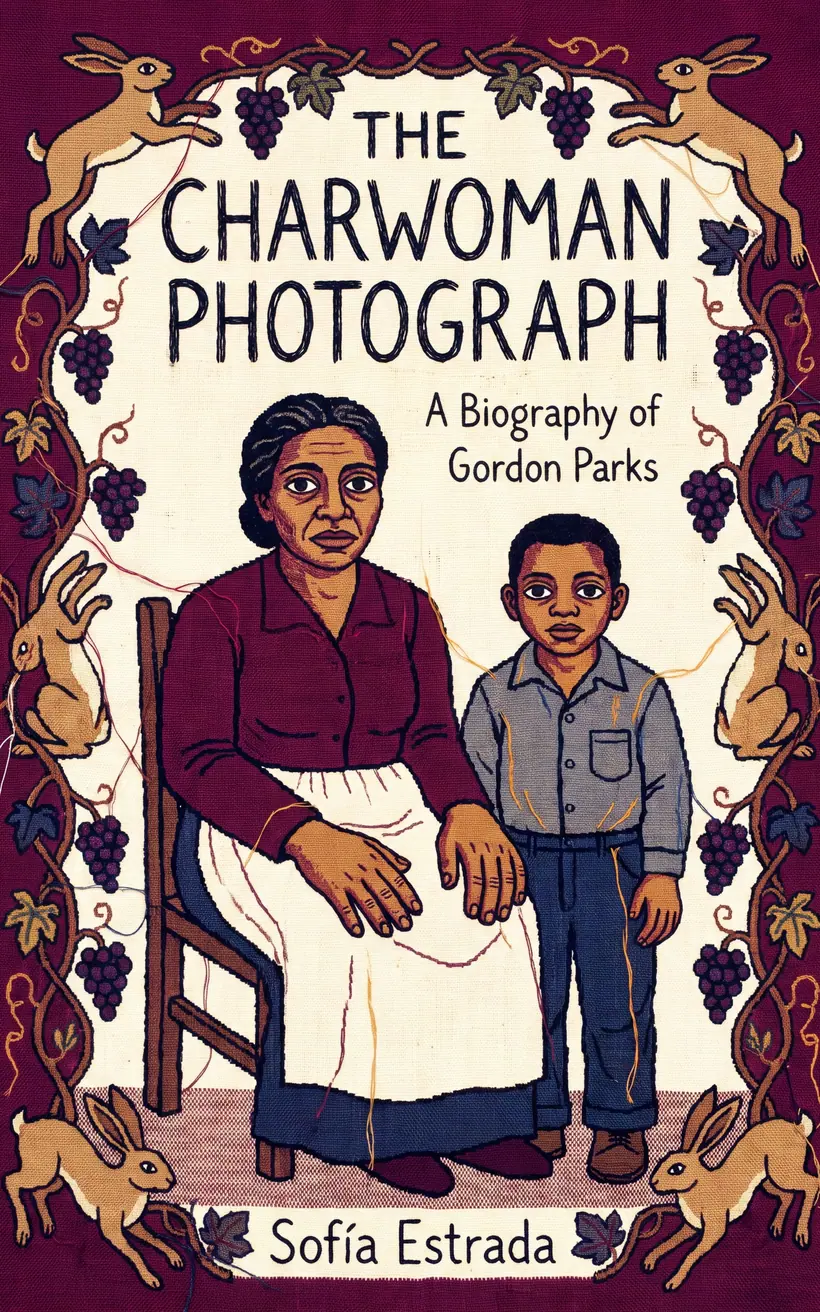
He was born on November 30, 1912, in Fort Scott, Kansas, the youngest of fifteen children to a sharecropping family. He was orphaned at fifteen, slept in trolley cars in St. Paul, Minnesota, worked as a busboy, brothel piano player, semi-professional basketball player, and railroad-dining-car waiter, and at twenty-five bought a camera at a Seattle pawnshop. By forty he was the first Black photographer on the staff of Life magazine. By fifty-eight he was the first Black director of a Hollywood studio feature — The Learning Tree, Warner Bros., 1969. The 1942 photograph he made of the Black charwoman Ella Watson standing in front of an American flag with a broom and a mop is one of the most reproduced images in the history of American photography.
Sofía Estrada's biography opens earlier and follows the arc with the documentary rigour the subject demands. The book traces the Fort Scott childhood, the Farm Security Administration assignment under Roy Stryker that produced American Gothic, the long Life magazine years, the 1971 Shaft with Isaac Hayes' theme song that won the Academy Award for Best Original Song, the 1972 Shaft's Big Score! and the long second act in fashion, classical-music composition, and three autobiographies, and the death in his Manhattan apartment in 2006 at ninety-three.
What emerges is a portrait of a multi-medium Black artist whose work in photography, film, and writing redrew the visual record of twentieth-century African-American life.
The opening chapter is published in full — read it here.
The printed edition has no ISBN registered yet. It affects library and retail listing, not your order.
Gordon Roger Alexander Buchanan Parks. The title never carries the subject's name: it names one concrete thing out of the life — in this case The Charwoman Photograph — and the name goes on the line underneath.
No. No subject, estate, label or foundation had approval over the text, and none paid for a word of it. The cost of that independence is that no new interviews were conducted for the book; it is built from the public record, and it says on the page where a scene is reconstructed rather than documented.
Yes — the whole opening chapter and the writer's foreword, free and in full, with no email address and no account. That is 5,414 words of the book.
About 60,500 words, 18 chapters, 193 pages in the paperback.
6 × 9 in, 60# uncoated cream, black ink, perfect-bound paperback, matte laminate. Every title in the series uses the same specification, so they line up on a shelf.
Paperback · Hardcover
Paperback · Hardcover
Paperback · Hardcover